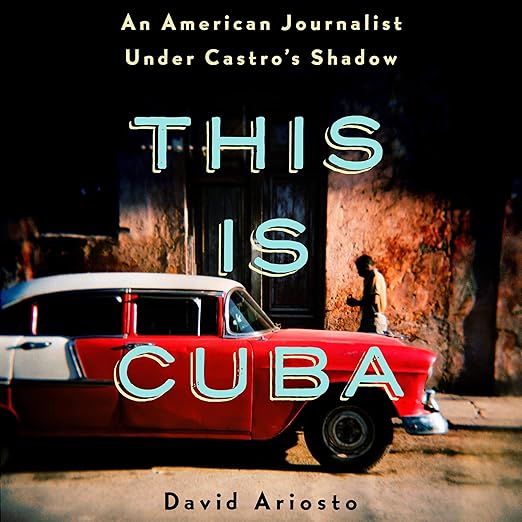
Quick Take
- Narration: David Ariosto narrates his own book with the confident, direct voice of someone who spent years reporting from inside the story. The journalistic immediacy suits the material completely.
- Themes: Cold War legacies and their living presence, the gap between Cuba’s external image and internal reality, political transition and its human cost
- Mood: Observant and atmospheric, with genuine tension in the political material and warmth in the human portraits
- Verdict: An insider account of Cuba across nine years that earns its scope through specific, well-chosen detail rather than comprehensive coverage.
I picked up This Is Cuba because I had been thinking about it since a conversation with a colleague who had visited Havana and come back with the particular confusion that Cuba tends to produce in foreign visitors: the sense that the place they experienced and the place they thought they understood from outside bear almost no resemblance to each other. David Ariosto’s book is the most thorough corrective for that confusion that I have encountered, and it has the additional advantage of being written by someone who lived inside the confusion for years rather than passing through it.
Ariosto arrived in Cuba in 2009 as a young American photojournalist offered a two-year assignment in Havana, and he stayed across nine years of transition that included the normalization of US-Cuba relations under Obama, the death of Fidel Castro, and the subsequent reversal of much of that diplomatic progress under Trump. The book covers this span with the combination of personal narrative and reported observation that tends to produce the best political journalism.
Our Take on This Is Cuba
What Ariosto does well is make the systemic visible through the specific. Black markets, restricted free speech, the Kafkaesque Soviet-style bureaucracy that slows an economy desperate to move forward, these are familiar elements of Cuba reportage, but Ariosto’s years of residency give him access to the granular detail that makes systemic descriptions feel real rather than summarized. The neighboring military coups, the suspected honey traps, the salty spooks and desperate migrants mentioned in the synopsis are not set dressing. They are the texture of what living inside the story actually felt like, and Ariosto renders that texture with the practiced hand of a working journalist.
One reviewer described the book as a travelogue rather than a detailed history, and that is an accurate characterization with both positive and negative implications. For readers who want a comprehensive political history of Cuba, this book doesn’t provide it. For readers who want to understand what Cuba looks and feels like from the inside of a nine-year residency, it is probably the best available account. Ariosto acknowledges the limitation himself in how he structures the narrative: this is a view from one position, shaped by his access and his perspective, rather than a claim to complete understanding.
Why Listen to This Is Cuba
Author narration is the right choice for this book. Ariosto’s journalistic voice has a directness and a pace that suits the material, and his delivery of the political reporting sections carries the authority of someone who was there rather than the mediated quality of a narrator working from a manuscript. The atmospheric descriptions of Havana, the classic cars, the empty shelves, the satellite dishes appearing alongside Soviet-era infrastructure, are rendered with the specific visual attentiveness of a photojournalist, which is one of the book’s consistent pleasures.
One reviewer noted that Ariosto’s style varies: sometimes almost poetic, at other times simply relating information. This unevenness is real, and it reflects the book’s hybrid nature as both memoir and reportage. But the moments of poetic precision are genuinely good, and they anchor the more documentary sections in a way that keeps the listener emotionally engaged rather than processing facts from a distance.
What to Watch For in This Is Cuba
The book’s nine-year span means it covers the Obama normalization period and its immediate aftermath in considerable detail, but the longer-term implications of subsequent political developments are not fully visible from where Ariosto was writing. The sense of a crisis brewing that the synopsis mentions reflects the book’s 2018 publication moment, and some of what has happened since then in US-Cuba relations gives the ending a slightly different valence than Ariosto intended.
Listeners who came looking specifically for accounts of everyday Cuban life, as one reviewer noted, may find the book more focused on the political and journalistic experience of being a foreign correspondent in Havana than on how Cubans themselves navigate their daily lives. Both subjects are present, but the balance tips toward the former. This is an honest limitation to flag before you invest eight and a half hours.
Who Should Listen to This Is Cuba
Listen if you want an intelligent, insider account of Cuba across a crucial decade of transition, narrated by someone who lived inside it. Listen if you are planning to visit Cuba and want context that goes beyond guidebook level. Skip if you want comprehensive Cuban history, since this is personal journalism rather than scholarship. Skip if you want primarily Cuban voices rather than an American journalist’s perspective, which is a reasonable preference the book itself doesn’t fully satisfy.
Frequently Asked Questions
Does This Is Cuba give equal weight to Cuban perspectives and the American journalist’s experience?
Not quite equally. Ariosto is honest that this is an outsider’s account from inside, and Cuban voices appear throughout but primarily in relation to Ariosto’s reporting experience. One reviewer specifically noted looking for accounts of Cubans living their daily lives and finding the book tilted more toward the foreign correspondent’s perspective. That’s an accurate characterization.
How does the book handle the political sensitivity of covering Cuba as an American journalist?
With considerable nuance. Ariosto describes the surveillance, the honey traps, the careful navigation of what can be reported and how, from direct experience rather than theory. The Cold War mechanics of operating as an American journalist in Cuba are one of the book’s most distinctive elements.
Is the book still relevant given the political changes since its 2018 publication?
The core portrait of Cuban society and the historical analysis of US-Cuba relations remains relevant and accurate. Some of the geopolitical projections about what comes next have been complicated by subsequent developments, but the fundamental tensions Ariosto describes are still active.
Does David Ariosto’s self-narration add to the book’s authority or does it have professional limitations?
It adds significantly. His journalistic voice is confident, paced, and carries the authenticity of someone who lived the material. It lacks some of the polish of a professional narrator, and his style varies between sections, but for political memoir narrated by its author, the lived authority outweighs the occasional unevenness.