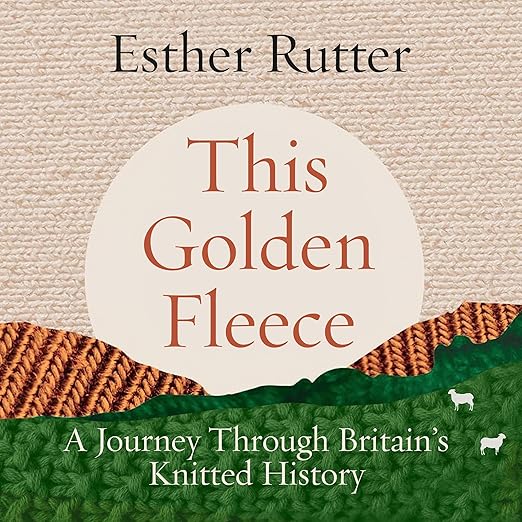
A childhood spent learning to knit, weave, and spin on a working Suffolk sheep farm is not the usual training ground for a history book, but it's exactly the background Esther Rutter brings to This Golden Fleece, an audiobook that turns wool into a thread running through centuries of British life. Rutter narrates her own debut, and that firsthand relationship with the craft, not just the history of it, shapes every chapter she reads.
Personal Discovery From Fair Isle to the Cotswolds
The book moves geographically across the British Isles, Fair Isle, Yorkshire, the Cotswolds, and beyond, using wool as the connective thread linking regional trade, industry, and identity across centuries. Reviewer Quillienne described it well: "not a systematic history, but a book of personal discovery." She added that "the history of knitting is told through the lives of people she learns about" along the way, rather than delivered as a detached academic survey.
That personal-discovery structure means Rutter's own narration carries real weight; she's not performing someone else's research but revisiting a landscape and a set of skills she grew up inside. Reviewer Corina Person Minniti admitted to hesitating before buying it, put off by one lukewarm review, and ended up glad she didn't listen to that hesitation, specifically praising how well Rutter ties her own experience into the wider historical material.
Rutter's route through the British Isles isn't random; each stop (Fair Isle's stranded knitting tradition, Yorkshire's industrial wool mills, the Cotswolds' medieval wool-trade wealth) represents a genuinely distinct chapter in how the material shaped regional economies and identities differently. That specificity keeps the book from collapsing into a single generic argument about wool's importance, giving listeners real historical texture at each stop along the way.
Rutter's Own Hands Return to the Wheel
Rutter's academic credentials extend beyond her Oxford degree into hands-on institutional roles, including work with the Wordsworth Trust and Robert Burns Birthplace Museum, giving her research into craft history a curator's eye for material culture alongside a writer's instinct for narrative pacing.
Rutter's own hands stay present throughout the narration too; she frequently describes trying a technique herself, spinning at a wheel a century old or attempting a stitch pattern she's only read about, rather than simply reporting on other people's craft from a safe research distance.
Wool Carries British Economic and Social History
What makes this more than a niche crafting book is how directly wool connects to major currents in British economic and social history: trade networks, rural industry, and the specific communities that depended on it for survival. Rutter has an academic background from Oxford and roles at institutions like the Wordsworth Trust and the Robert Burns Birthplace Museum, and that research grounding shows in how confidently she moves between memoir and documented history without either one crowding out the other.
For listeners who enjoy narrative nonfiction built around a single material or object, wool functioning here the way salt, cod, or spice have in other popular histories, this scratches a similar itch while staying rooted in one specific, well-researched landscape rather than sprawling globally. The regional specificity (real place names, real communities) is a strength rather than a limitation.
The book also sits at an interesting intersection of memoir, travel writing, and economic history, and Rutter moves between those registers more fluidly in audio than a reader might expect from the description alone. Her own narration helps smooth those transitions, since the same voice carries both the personal reminiscence about her childhood farm and the more research-driven passages about trade routes and industrial history, rather than requiring the listener to mentally shift gears between two different kinds of writing.
Rutter is careful throughout to acknowledge the industry's harder history alongside its craft romance, including the labor conditions and economic precarity that shaped wool communities across different eras. That willingness to sit with the less picturesque parts of the story, not just the cozy cottage-industry imagery wool often evokes, gives the book more substance than a purely nostalgic treatment would have offered.
Susanne C. Finds the Prose Overwritten
Not every listener bought the balance, though: one reviewer, Susanne C., pushed back hard, arguing parts of the book were overwritten and reaching for language too elevated for what's fundamentally an earthy, hands-on subject, pointing specifically at knitting and wool as basic, grounded material that doesn't always need high-flown phrasing wrapped around it. That's a fair critique of any memoir-history hybrid, and Rutter's prose does occasionally reach for more lyricism than the subject strictly requires.
As a debut book, the structure also leans more toward a personal travelogue than a tightly organized reference work, so listeners wanting a linear, comprehensive history of British wool production specifically may find the memoir digressions slow things down. Rutter went on to publish a second book, All Before Me, in 2024, suggesting this loose, discovery-driven approach is simply her established voice rather than a first-outing rough edge.
No Photos, No Strict Timeline
Listeners should also know this is very much a British-focused history, with place names, regional dialect terms, and local craft traditions that may require a bit more context for listeners unfamiliar with British geography and social history specifically. Rutter doesn't over-explain for an international audience, which keeps the book feeling authentic to its subject but does ask a little more of listeners coming from outside the UK.
Listeners hoping for a strict chronological history should also adjust expectations, since Rutter's own travel itinerary, not a strict timeline, determines chapter order, meaning the book moves between historical periods somewhat freely as her journey dictates rather than building linearly from earliest to most recent.
The print edition's photographs of specific mills, farms, and finished textile work also don't carry over to audio, a real loss for a book this visually grounded in physical craft and place. Listeners who want the fuller sensory experience of the material Rutter describes (the textures, the colors, the specific garments) may want to keep a copy of the print or ebook edition nearby as a visual reference alongside the narration.
Fiber Artists Will Value Rutter's Expertise
Readers who enjoy narrative nonfiction blending memoir with deep-dive research, fans of British social and rural history, and anyone with a personal interest in fiber crafts will find this a warm, well-researched listen narrated with genuine authority. It's also a good match for listeners who prefer a personal guide through history over a detached academic overview.
This also makes a good pairing for listeners who enjoyed other single-material histories, whether about textiles, food, or trade goods, and want to add British wool specifically to that shelf. Knitters and fiber artists looking for the historical context behind their own hobby will find Rutter's personal expertise a real asset that a purely academic historian couldn't offer in quite the same way.
Listeners wanting a tightly argued academic history rather than a personal ramble through wool country should temper their expectations going in.
The Short Version
- Performance: Esther Rutter narrates her own debut with the authority of someone who actually grew up doing the crafts she's describing.
- What it covers: British wool history, rural craft and identity, personal memoir woven into research
- Feel: Warm, discursive, and rooted in place
- Our call: A rich, personally grounded history for craft and British social history fans, though some listeners will find the prose reaches for more lyricism than the subject needs.