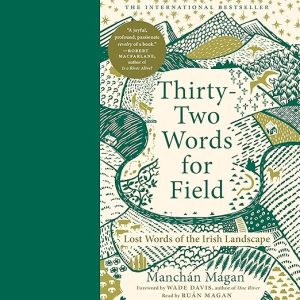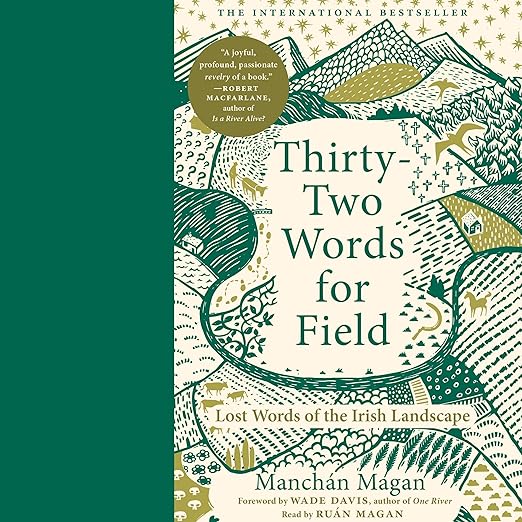
Manchán Magan's Thirty-Two Words for Field, narrated by Ruán Magan, is one of those rare audiobooks where the subject and the format align in a way that creates something the print version alone cannot fully replicate. The Irish language, at the center of this book, is above all a spoken thing - it was an oral tradition long before it was a written one, and the argument Magan makes throughout is that Irish encodes a relationship to the natural world that can only be understood by feeling the words in your mouth and hearing them in your ear. Having Ruán Magan narrate his brother's text about spoken language is not a logistical choice; it is the appropriate form for the material. This audiobook comes with a PDF companion file containing the Irish words discussed, which is worth downloading before you begin listening. Note that the companion PDF is available in your library alongside the audio once purchased.
Thirty-Two Names for a Single Field
The book's premise is established in its title: the Irish language has thirty-two separate words for what English calls a field, each specifying a different kind. Geamhar names a field of corn-grass; Tuar names a field where cattle shelter at night; Reidhlean names a field used for games or dancing; Cathairin names a field with a fairy dwelling in it. That taxonomy is not linguistic trivia - it is evidence of a culture that observed the land closely enough over three thousand years to require that level of specificity. Magan's argument throughout is that what a language loses when it narrows is not just vocabulary but perception: the people who knew what iarmhaireacht meant - the loneliness you feel when you are the only person awake at dawn - had a name for an experience that English leaves unnamed, and naming something is a form of attention. Reviewer Sheryll P. describes the book as "magical" and notes it "isn't just a list of Irish words and their meanings" but "a beautiful journey into the author's life in Ireland and all the connections of the land to the Irish language itself." That's a fair description of Magan's method: he doesn't present these words as curiosities in a catalog but as entry points into a way of seeing, illustrated through stories from his own travels and experiences in Irish-speaking communities. One reviewer notes that English itself contains traces of this Celtic substrate - bog, loch, cairn, crag are remnants of the language Magan is tracing - and finding those traces embedded in contemporary English is one of the book's quieter revelations. The range of words Magan introduces is extensive: from bróis (whiskey for a horseman at a wedding) to bladhmann (steam rising from a fermented haystack, or idle boasting), each term opens a small window into a culture that developed precise names for experiences the dominant language either never needed or chose not to keep.
Ruán Magan Pronounces What the Page Can't
The answer is phonetic, and it's important. Reviewer Neopi, who valued the book in print, identifies its single significant limitation: without phonetic guides to the Irish words, reading them on the page produces uncertainty about how they sound. In audio that problem disappears entirely. Ruán Magan pronounces the Irish vocabulary correctly and naturally - he is a native speaker performing his brother's text, which means the words exist as sounds rather than clusters of unfamiliar letters. That transformation is substantial for a book built around the argument that language is fundamentally oral. Hearing iarmhaireacht spoken is a different experience from encountering it printed on a page, and Magan's argument depends on that difference being felt. The 7-hour-49-minute runtime reflects a book that works through accumulation - each Irish word Magan introduces adds to a growing portrait of how this language sees the natural and human world, and the cumulative effect at the end of those seven-plus hours is considerable. The PDF companion of Irish words is worth keeping open during listening sessions so the visual forms of words reinforce the sounds Ruán Magan produces, creating the double encoding that Manchán Magan argues is necessary for full comprehension of what this vocabulary offers.
Advocacy, Not a Neutral Language Survey
The book is explicitly a celebration and an advocacy piece rather than a neutral linguistic survey. Magan loves the Irish language, mourns its marginal status in contemporary Ireland, and makes no effort to disguise either position. The book's emotional orientation is toward loss and the importance of what is being lost, and listeners who want a more analytical or comparative treatment of language ecology will find this too personal and too partial for their purposes. The book also doesn't engage directly with the contested politics of language revival in Ireland - the debates about how Irish is taught in schools, the tension between Gaeltacht communities and urban Irish speakers, the sociological question of whether revival is achievable. Magan's focus is on why the language matters rather than how it might be saved, which is the right scope for this particular book but may leave some readers wanting a fuller account of the current state of Irish-language communities. The final third of the book, where Magan connects the linguistic argument to a larger case for attending to what is ancient and specific about place, is the most moving section and the most deliberately persuasive. Listeners who arrive with some skepticism about the mystical framing of Gaelic vocabulary will find the personal stories in this closing section the most difficult to dismiss.
Recommended Over Print for Hearing Irish Words
Listeners interested in linguistics, language ecology, and the relationship between landscape and vocabulary will find this among the more accessible and personally compelling treatments of those subjects in audio form. People with Irish heritage who want to understand what the language actually contains - and why the argument for its preservation is not simply sentimental - will find Magan's case well-made and deeply felt. The companion PDF makes the audiobook the recommended format over print for anyone who wants to hear the Irish words spoken correctly. Listeners seeking a language-learning tool will need to look elsewhere - this is cultural and personal reflection, not instruction. But for what it is, Thirty-Two Words for Field is exact and irreplaceable in the way that only personal testimony about a living language can be.
At a Glance
- Narrator: Ruán Magan narrating his brother Manchán's book produces an intimacy that is appropriate for a text about language as lived experience rather than academic subject - the two brothers share a cultural relationship to the Irish language that comes through in the narration as something felt rather than performed.
- Subjects: Language as ecological record, the Irish landscape encoded in vocabulary, what a dying tongue takes with it
- Tone: Meditative and quietly urgent - this is a celebration that knows exactly what it might be losing
- Bottom line: Manchán Magan's sustained argument for the Irish language's irreplaceable relationship to the natural world is one of the more distinctive language books in recent years, and Ruán Magan's narration gives it exactly the right register.
A Few Questions About Thirty-Two Words for Field
Does this audiobook teach you to speak Irish, or is it more of a cultural exploration?
It is a cultural and personal exploration rather than a language-learning tool. Magan introduces and discusses dozens of Irish words and their meanings, but the book's purpose is to convey the worldview encoded in the language rather than to teach its grammar or vocabulary systematically.
Why is Ruán Magan narrating this audiobook instead of the author Manchán Magan?
Ruán Magan is Manchán's brother and a native Irish speaker, and having him narrate ensures the Irish words are pronounced correctly and naturally throughout. For a text whose central argument is that Irish is fundamentally an oral language, this casting decision is substantively appropriate rather than just a logistical convenience.
Is the PDF companion file mentioned in the listing included with the audiobook purchase?
According to the listing, the PDF is available in your library alongside the audio once you purchase. It contains the Irish words discussed in the text, which is genuinely useful to have open while listening since it gives you the visual forms of words you're hearing for the first time.
Does this audiobook require any knowledge of Irish or Gaelic to follow?
None at all. Magan explains every Irish word he introduces, and Ruán Magan's narration makes the sounds accessible regardless of the listener's background. The book is addressed to people who don't speak Irish and want to understand what the language contains - prior knowledge is not required and is not assumed.