Key Details
- Performance: Deborah Marlowe reads with steady clarity that suits Grandin's precise, observational voice without over-dramatizing the memoir's more vulnerable passages.
- What it covers: Visual thinking and cognitive difference, the intersection of animal behavior and autistic perception, navigating a neurotypical world from the outside
- Feel: Candid, intellectually energizing, quietly moving
- Our call: Temple Grandin's account of her own mind remains one of the most genuinely illuminating first-person narratives about autism ever recorded.
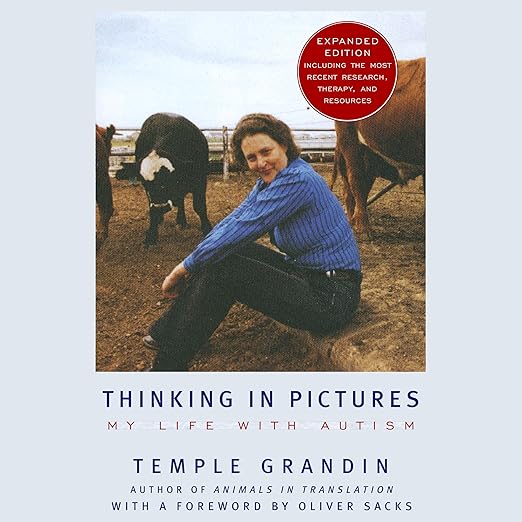
Temple Grandin's audiobook Thinking in Pictures, narrated by Deborah Marlowe, is one of those rare memoir recordings that forces you to reassess what you think you understand about human cognition. Grandin is a working scientist who designed one third of all livestock-handling facilities in the United States, and she writes from that precise, observation-trained mind. What distinguishes this from other autism memoirs is the dual perspective: she is reporting simultaneously as a scientist who studies behavior and as an autistic person who inhabits it. The result is a text that operates at two frequencies at once, and Marlowe's narration maintains that duality without flattening either register.
The Applied Perceptual Science Behind Animal Handling
Grandin's central argument is embedded in the title itself: she does not think in language the way most people do. She thinks in images, in visual sequences that run like film reels, and from that mode of perception she has built an entire career decoding animal behavior. The book moves fluidly between her childhood, her professional life, and her theoretical frameworks, never staying too long in any one place. What keeps the reader anchored is not narrative suspense but intellectual honesty. Grandin does not present her autism as something she conquered. She presents it as a different architecture of mind, one that made certain things extraordinarily difficult and others uniquely possible. That distinction carries weight across every chapter.
The chapters on animal handling are where the book's dual identity as memoir and science writing becomes most apparent. Grandin argues that animals and autistic people share a heightened sensitivity to sensory environment, and she draws those connections with the confidence of someone who has spent decades in both worlds. Her descriptions of walking through a cattle chute and reading the space the way a frightened animal would are remarkable passages. This is not sentiment about animals. It is applied perceptual science, and it distinguishes this book from almost every other autism memoir in print. The Philadelphia Inquirer's observation about Grandin's uncanny powers of observation is accurate but undersells it. What Grandin has is a capacity to describe from the inside how a mind that most people can only observe from the outside actually functions.
Marlowe Does Not Perform Grandin as Eccentric
Deborah Marlowe's narration serves the material well. She does not perform Grandin as eccentric or emotionally detached, which would have been the obvious and wrong choice. Instead, she reads with a kind of steady attentiveness that mirrors the text's own quality of careful observation. The dry precision of Grandin's scientific passages lands without feeling cold, and the more personal sections about loneliness, misunderstanding, and the long effort to build social comprehension carry genuine weight. At just over nine hours, the audiobook moves efficiently. Grandin is not a writer who repeats herself, and Marlowe honors that economy.
Readers who came to this book after someone in their family received an autism diagnosis have described it as genuinely revelatory. One reviewer in this edition writes that reading it made everything suddenly explainable. That response makes sense. Grandin is not interpreting autism through clinical language. She is reporting it from lived experience with the rigor of a scientist and the intimacy of a memoirist. The book manages to be both a scientific document and a deeply personal one, and the audiobook format, with Marlowe's committed reading, makes those two registers coexist more naturally than they might in silent reading.
The Squeeze Machine She Built for Herself
The book was first published in the mid-1990s, and some of the clinical language and diagnostic framing around autism reflects that era. Grandin herself has continued to develop and refine her thinking since then, and listeners who are current with the neurodiversity literature will occasionally notice terminology that has since evolved. This is not a flaw so much as a historical marker, but it is worth flagging for anyone who comes to this audiobook expecting current consensus on diagnosis and treatment.
The chapter structure can feel nonlinear to listeners accustomed to conventional memoir chronology. Grandin moves between autobiography, theory, and advocacy in ways that are intellectually coherent but do not follow a strict beginning-to-end life story arc. That is part of what makes the book interesting, but listeners who want a traditional narrative through-line may find themselves reorienting occasionally. The reward for staying with the structure is access to a mind that genuinely operates differently from most authors. The sections on Grandin's sensory sensitivities, her use of physical pressure as a calming mechanism, and her eventual design of the squeeze machine she built for herself are among the most intimate passages, and they arrive with enough autobiographical grounding that even the scientifically dense chapters feel personally anchored.
Neither a Cure Narrative nor a Tragedy
This audiobook is essential for anyone with a family member on the autism spectrum who wants a first-person account that is neither a cure narrative nor a tragedy narrative. It is equally strong for readers interested in animal behavior, cognitive science, or the relationship between sensory perception and professional skill. Teachers, therapists, and anyone who works with autistic individuals will find Grandin's perspective practically useful as well as personally illuminating. Listeners who prefer tightly plotted memoir with dramatic emotional arcs may find the scientific passages slow going, and those seeking contemporary diagnostic frameworks should supplement this with more recent work. But as a foundational text for understanding a particular and powerful way of being in the world, Grandin's recording holds up with real force.
Questions Listeners Ask
Is this audiobook accessible to people with no background in autism or animal science?
Yes. Grandin writes for a general audience and explains technical concepts clearly. No prior knowledge of autism research or animal behavior is needed to follow the book.
Does Temple Grandin narrate her own audiobook?
No. Deborah Marlowe narrates the audiobook version. Grandin has given many lectures and interviews available elsewhere, but this recording uses a professional narrator.