Quick Take
- Narration: Adewale Akinnuoye-Agbaje brings a quality of quiet devastation to Achebe’s prose and poetry that no outside narrator could have matched, his voice carries the weight of someone reading history that belongs to him.
- Themes: The Biafran War’s human cost, the artist’s obligation in times of political crisis, Nigerian nationalism’s promise and its betrayal
- Mood: Elegiac and morally serious, with passages of profound grief and passages of warm literary memory existing in the same breath
- Verdict: One of the most important African literary memoirs of the past century, and Akinnuoye-Agbaje’s narration makes it the rare case where the audiobook is the definitive version.
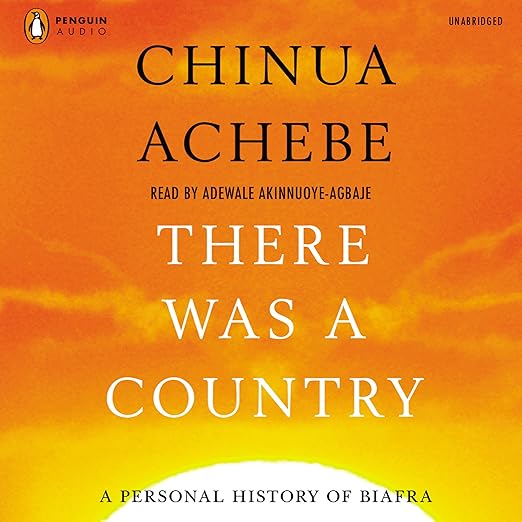
I was somewhere between Lagos and Enugu in the book’s geography, following Chinua Achebe’s account of the early days of Biafran independence, when I noticed I had been sitting at my desk for two hours without moving. There Was a Country has that quality: it draws you into its specific world so completely that the present disappears for stretches at a time. This is the memoir that Achebe spent more than forty years not writing, and you feel both the weight of that delay and the precision of what has finally been committed to record.
Adewale Akinnuoye-Agbaje narrates. The casting is inspired. An Igbo British actor best known internationally for his work in Oz and Lost, Akinnuoye-Agbaje brings something to this material that no professional audiobook narrator, however skilled, could have provided: the particular quality of someone for whom this history is not abstract. When he reads Achebe’s account of Biafran children dying of kwashiorkor as the Nigerian government maintained its blockade, the quietness in his voice is not performed restraint. It is the specific restraint of someone who recognizes what is being said and trusts the words to carry it.
The Promise of Nigeria and Why Achebe Could Not Stay Silent
The book’s first section, covering Achebe’s upbringing in a colonial Nigeria approaching independence, is the most narratively relaxed part of There Was a Country, and it is essential context for everything that follows. Achebe describes the extraordinary intellectual and cultural ferment of the late colonial period, the University of Ibadan, the founding of Nigerian literature in English, the political hopes that accompanied independence in 1960. He is writing about his own formation as a writer and as a man, and these chapters have the warmth of someone who is describing something genuinely beautiful before he describes how it was destroyed.
This structure is not accidental. Achebe has spent decades arguing, through his novels and essays, that the European colonial project’s most lasting damage was the fracturing of African cultural self-understanding. There Was a Country is the personal and historical proof of that argument: here is what Nigeria was, here is what it promised, and here is what it became. The memoir earns its grief because it earns its love first.
The Biafran War as Achebe Lived and Witnessed It
The central section of the book, covering the 1967-1970 war, is where There Was a Country fulfills the obligation that Achebe describes all committed writers as carrying: the obligation to speak for their history, their beliefs, and their people. Achebe served as a cultural ambassador for the Biafran government, traveling internationally to make the case for Biafran self-determination at a moment when much of the world was either uninterested or actively hostile. His account of those years is not a dispassionate historical record. It is a first-person witness statement that makes no pretense of neutrality.
This is where the book has generated its most significant controversy. Achebe is critical of Obafemi Awolowo’s support of the blockade, and he is explicit about his belief that the food blockade constituted a deliberate strategy of starvation. These are contested historical and political claims that have been challenged by some Nigerian historians since the book’s publication. Achebe’s account is a participant’s account, not an archivist’s, and listeners should approach it with that in mind. That is not a limitation but a specific kind of authority that carries its own requirements for the reader.
The Poetry and What It Does That the Prose Cannot
Achebe’s poetry is woven throughout the memoir, and the decision to read the poems aloud is one of the audiobook’s most significant advantages over the print version. Akinnuoye-Agbaje reads the poems with the same quiet authority he brings to the prose, and the effect is cumulative: by the time you reach A Mother in a Refugee Camp, which is among the most devastating short poems written in English in the twentieth century, the context is fully established and the poem arrives with its full weight. Reading it on the page is one experience. Hearing it spoken, after nine hours of the history that surrounds it, is another.
The book also includes Achebe’s sustained argument for the role of the committed artist in society, where his literary criticism and his personal experience come together most explicitly. He is arguing, with a lifetime’s evidence behind him, that the writer who retreats from political engagement has abandoned something essential. That argument will mean different things to different listeners depending on their own relationship to that question.
Who Should Listen, Who Should Come Prepared
There Was a Country is for anyone whose understanding of twentieth-century African history has been shaped primarily by Western accounts and who wants to hear the Biafran War as a survivor and one of the century’s great writers experienced it. It is also for readers who have encountered Achebe’s fiction and want to understand the biographical and historical context behind Things Fall Apart and Arrow of God. Those who want a balanced institutional history of the Nigerian civil war will need to supplement this memoir with other sources. For what it actually is, there is nothing else like it.
Frequently Asked Questions
Is There Was a Country primarily a memoir or a history of the Biafran War?
It is genuinely both, and the combination is part of what makes it distinctive. Achebe moves between personal memoir, political analysis, literary reflection, and poetry, and all of these modes inform each other. It is not a comprehensive institutional history of the war; it is one witness’s account told with the full depth of a major literary voice.
Does Achebe address controversial aspects of Biafran history, including the role of the food blockade?
He addresses some controversial aspects directly, including his criticism of the food blockade and his belief that it constituted a deliberate strategy of starvation. These are contested claims that some Nigerian historians have challenged since the book’s publication. Achebe’s account is written from the Biafran side and does not claim to be neutral.
Why is Adewale Akinnuoye-Agbaje particularly well-suited to narrate this book?
Akinnuoye-Agbaje is an Igbo British actor who brings to the material a quality of identification that no outside narrator could replicate. His delivery of the poetry sections has been noted by reviewers as exceptional, the restraint he brings to the most devastating passages is the restraint of someone for whom the history is not abstract.
Should listeners who have not read Things Fall Apart approach this memoir first or afterward?
The memoir is self-contained and does not require prior knowledge of Achebe’s fiction. Readers who have encountered Things Fall Apart will find richer connections in There Was a Country, since Achebe discusses his formation as a writer and the relationship between his literary work and his political context. Either order works, and reading the fiction after the memoir may actually reframe it productively.