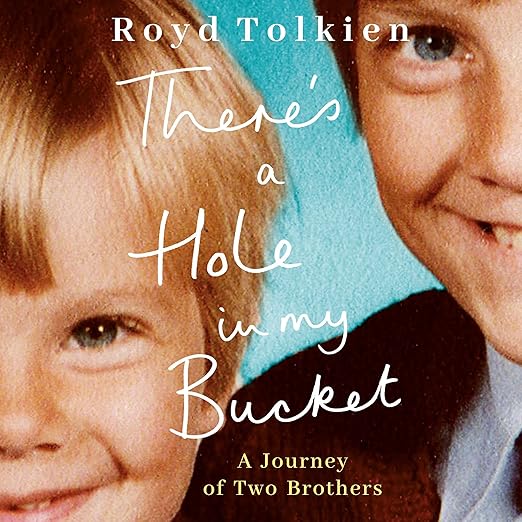
A reader in Australia signs off with five words that stop you: thank you Royd, and Drew. Royd Tolkien wrote the memoir. Drew Cullingham reads the audiobook. No other Drew appears anywhere in this record, in the description, in the family, or in the list of people the book is about. It may be a thank-you to the narrator, which would make it the rarest thing on any listing of this kind, or it may be somebody in the story whose name never reached the page. The record will not settle it. What the record does show is a reader moved enough to thank two people by name, and only one of them wrote the book.
Fifty Tasks, Beginning with a Dare at the Eulogy
Royd Tolkien and his brother Mike grew up on their great-grandfather's stories and turned into the kind of siblings who go looking for adventures. When Mike was diagnosed with motor neuron disease, the condition the description calls MND and a reader calls ALS, the two of them started working through Mike's bucket list: remote camping in Norway, a long stretch of Royd's beloved New Zealand. That part of the book is the part most memoirs would end on. Here it is the setup.
Mike left a second list, and the discovery of it is the actual premise. Fifty things Mike wanted Royd to do after his death, beginning with an instruction to trip on the way to the lectern while delivering the eulogy. Ten hours of a bereaved brother being dared, from beyond the grave, by the person he is grieving. The tasks are described as challenging, humorous and often heartbreaking, and the structure they impose is what separates this from the standard shape of a loss memoir, where the loss arrives at the end and the reflection follows.
Cullingham Reads It, Not the Bereaved Brother
Ten hours and thirty-three minutes for Brilliance Audio, read by Drew Cullingham rather than by the author. That is a defensible choice for material this raw, and it is a real one: a memoir written in the first person about a brother's death, performed by somebody who did not lose the brother. The steadiness that buys is worth something over ten hours. So is what it costs, and no part of this page lets you hear which side of that trade the recording lands on. No sample and no second credit appear anywhere on the listing.
A Book Finding Readers in Its Exact Circumstance
Sibling grief is the subject, and it is a strangely underserved one. Books about losing a parent or a child fill shelves; books about losing the person who shared your childhood on equal terms are rarer, and the responses here are written by people who came looking for exactly that. One arrived a week after a mother's death and having lost a younger brother the same year. Another read it because a brother-in-law had the same disease. This is a book finding readers in the exact circumstance it describes, or being found by them, which amounts to the same recommendation.
Humor is the genuine surprise, and the fifty tasks are the mechanism. A dying man whose first posthumous instruction to his brother is a pratfall at the funeral has set the tone deliberately, and the description keeps the promise in view: challenging, humorous, heartbreaking, in that order. One response calls it touching and entertaining in the same breath, another very sad and sweet. A book that can hold both without apologizing for either is doing something difficult well.
Richard P. wrote the fullest response on the page, and it is worth reading before you buy, though it is dated three weeks before the release this listing carries, which places it with another edition. It opens by listing the reasons the book landed: a mother dead a week earlier, a younger brother lost that same year, a prolonged illness the writer describes as a journey nobody would recommend and nobody would trade away. That response is not a review so much as a report from inside the readership, and it is the most persuasive thing on the page.
The Tolkien Name Is Doing Marketing Work
The Tolkien name is doing marketing work, and one reader admits as much. Having picked it up partly out of fondness for J.R.R. Tolkien and curiosity about a younger generation of the family, this reader went in with some trepidation about the subject and came out pleasantly surprised. The description leads with the great-grandson framing for obvious reasons. Anybody arriving for Middle-earth should understand that the connection is genealogical: what you get is motor neuron disease, Norway, New Zealand and a funeral.
Bwalk's entry is a curiosity in its own right, since the title is longer than the body. The heading runs to a full summary of the book, life, love, the loss of a sibling and the start of a journey through grief, while the response underneath manages two sentences. It is a neat demonstration of how little this column actually has to tell you. Two of the five entries are one-liners, one of them four words long. For a ten-hour memoir, that is a thin evidence base.
Seven ratings sit behind the 4.3 figure, and every one of the five grades on display comes in above it. Whatever the other votes look like, they are pulling the average down and leaving no explanation behind, which is the least useful configuration a rating can have. The subtitle is missing too. A reader supplies it in passing, A Journey of Two Brothers, and that phrase would have told a browsing shopper more about the book than the nursery-rhyme title ever will.
Tolkien Completists Will Find No Inheritance Here
Bereaved siblings are the readership this will reach hardest, and the column proves it. Beyond them, it suits listeners who like memoirs with a structure to march through, readers drawn to accounts of terminal illness written by the survivor rather than the patient, and anyone who wants their grief writing to contain jokes. The listing files it under people with disabilities, which fits the diagnosis at the center while underselling how much of the book belongs to the brother left behind.
Tolkien completists hoping for literary inheritance will not find any, and listeners currently raw from a recent loss should know the illness is described closely rather than glossed. Anybody hoping to hear the eulogy scene in the voice that lived it should adjust expectations now. Grief memoirs live on specifics rather than sentiment, and fifty tasks written by a dying brother are about as specific as the form gets.
The Short Version
- Performance: Drew Cullingham reads a first-person memoir about a brother's death, and the only response to mention a Drew signs off thanking Royd and Drew together, which may or may not be aimed at the reader.
- What it covers: motor neuron disease, a bucket list inherited from the dead, the sibling bond, grief with jokes in it
- Feel: Warm, funny and abruptly sad
- Our call: A bereavement memoir that keeps its sense of humor, given a shape by fifty tasks that most books in the form never manage.