Quick Take
- Narration: Dion Graham is exceptional, his voice carries the moral weight of these five families’ stories without ever editorializing.
- Themes: The working homeless crisis, housing as a human right, the gap between American myth and economic reality
- Mood: Urgent and heartbreaking, the kind of book that changes how you look at a city skyline
- Verdict: Goldstone’s immersive journalism belongs alongside Evicted and Random Family as essential reading on American poverty, and Graham makes it impossible to look away.
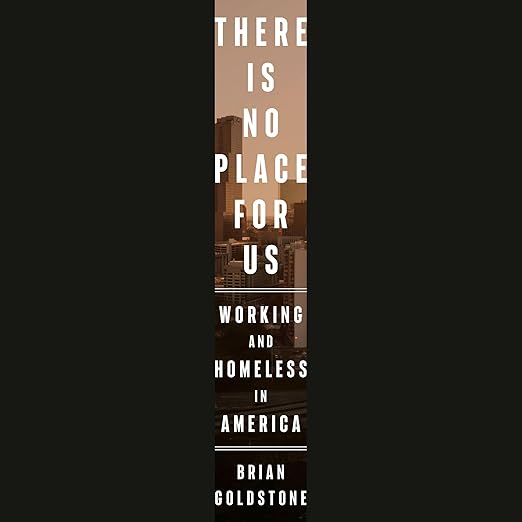
I started listening to There Is No Place for Us on a Sunday afternoon, and by evening I had cancelled the dinner plans I’d been half-thinking about and was still listening, sitting at the kitchen table in the dark. That doesn’t happen often. It happened here because Brian Goldstone’s reporting is genuinely extraordinary, and because Dion Graham reads it in a way that makes you feel the moral weight of every sentence.
The premise sounds almost too simple: five Atlanta families, all employed, all working, all losing their housing. But Goldstone’s genius is in the specificity. Maurice and Natalia leave Washington, D.C., priced out, and come to Atlanta, the so-called Black Mecca, looking for a fresh start. Kara dreams of her own cleaning business while mopping hospital floors. Britt secures a coveted housing voucher. Michelle is in school to become a social worker. Celeste works warehouse shifts while undergoing treatment for ovarian cancer. Each of them, one by one, falls into homelessness. Not because they stopped working. Because the math stopped working for them.
The Human Cost of a Thriving Economy
What makes this book more than competent social journalism is Goldstone’s ability to hold structural analysis and intimate portraiture at the same time. He understands, and makes you understand, that the working homeless crisis isn’t a byproduct of a failing economy but a thriving one. In cities like Atlanta, rapid growth and gentrification produce displacement not despite prosperity but because of it. The economics are clearly laid out, and they’re infuriating in the best way: the kind of infuriating that produces action rather than despair.
The book has been compared to Adrian Nicole LeBlanc’s Random Family and Matthew Desmond’s Evicted, and those comparisons are apt. Like LeBlanc and Desmond, Goldstone earned his access through years of presence, sitting with these families in extended-stay hotel rooms, following them to work, watching them make impossible calculations. The result is a text that feels novelistic without losing journalistic rigor.
What Dion Graham Does With This Material
Dion Graham is one of the finest audiobook narrators working today, and his performance here is among his best. He reads Goldstone’s prose with a controlled moral seriousness that serves the material without sentimentalizing it. When he voices the families’ words, Celeste managing her warehouse shift around chemotherapy appointments, Britt’s quiet shock at losing her voucher, there’s a restraint that makes the scenes more devastating than any heightened performance would. You feel the weight of these lives precisely because Graham doesn’t perform the weight; he simply carries it.
The 13-hour runtime is substantial but never padded. Goldstone writes at the length the story requires, and Graham sustains attention throughout. I found myself wishing certain sections were longer, particularly the passages about the extended-stay hotel economy, which are among the most illuminating pieces of reporting in the book.
What the Synopsis Leaves Out
The book is a finalist for the Andrew Carnegie Medal and the Los Angeles Times Book Prize, and was on Barack Obama’s favorite books list for the year. These badges signal the seriousness with which the book has been received. But they don’t capture what’s most important about it: the way Goldstone refuses to let these families function as types. Maurice is specific. Celeste is specific. Their dignity is rendered with such precision that when the housing systems fail them, the failure feels like a personal injustice rather than a statistical outcome.
One reviewer noted some factual issues with a passage about homeownership and rent control. It’s worth flagging: like any reported work, the book isn’t without its debatable claims. But the core argument, that working people are being displaced by the same growth that’s supposed to signal prosperity, is powerfully supported by the evidence Goldstone assembles.
One aspect of Goldstone’s approach that deserves particular attention is his handling of the extended-stay motel economy, the network of budget lodging facilities that have become de facto long-term housing for displaced families who don’t qualify for shelter beds and can’t afford a lease deposit. Goldstone is one of the first journalists to document this system in novelistic depth, and the passages describing what it’s actually like to raise children in a single motel room, the logistics, the indignities, the costs that compound and spiral, are among the most illuminating pieces of domestic reporting I’ve encountered in recent years. These sections make visible something that official homelessness statistics actively obscure, because families in extended-stay motels are technically housed and therefore invisible in the data. Goldstone’s argument, that the true scale of the housing crisis is far larger than the shelter population suggests, is powerfully supported by these portraits. Dion Graham reads these sections with particular care, allowing the texture of daily life in these settings to accumulate rather than rushing through them toward dramatic incident.
Who This Audiobook Is For
This audiobook is for anyone who wants to understand what homelessness in America actually looks like in the current economy, and for anyone whose mental image of homeless people doesn’t include people with full-time jobs. It’s essential listening for policy-adjacent readers, urban planners, social workers, and anyone living in a rapidly gentrifying city who wants to understand what’s happening on the margins of that growth.
Listeners who want their nonfiction to offer tidy solutions will be frustrated. Goldstone diagnoses, illuminates, and argues, but this is not a policy playbook. The discomfort is intentional, and it’s the book’s greatest strength.
Frequently Asked Questions
How does this compare to Matthew Desmond’s Evicted as an audiobook experience?
Both follow low-income families through housing crises with immersive, novelistic reporting. Goldstone focuses on the working homeless specifically, people with jobs who still can’t stay housed, and his Atlanta focus gives the book a sharp geographic and political specificity that complements Desmond’s Milwaukee study.
Is Dion Graham’s narration as strong as his work on other major nonfiction titles?
Yes, and arguably among his best. He brings controlled moral authority to Goldstone’s prose without editorializing, which is exactly what this material requires.
The book covers five families, does the narrative ever become hard to track on audio?
Goldstone structures the chapters clearly, and Graham’s distinct handling of each family’s story makes them easy to differentiate. The audio edition is actually well-suited to the multi-portrait format.
Does the book offer solutions, or is it purely diagnostic journalism?
Primarily diagnostic. Goldstone argues that housing must be treated as a fundamental human right, but the focus is on illuminating the crisis rather than prescribing policy. Readers looking for a reform roadmap will need to supplement elsewhere.