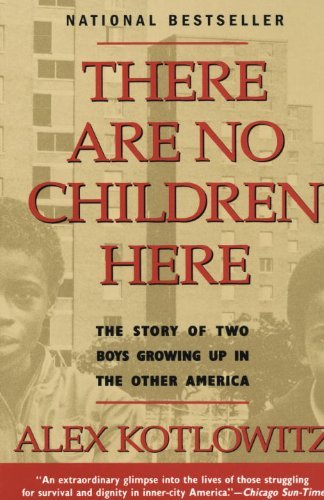
I first encountered Alex Kotlowitz's name in a graduate seminar on literary journalism, sandwiched between James Baldwin and Truman Capote on a syllabus that treated nonfiction as something capable of breaking hearts. I did not read the book then. Life moved on. It was not until a late Sunday afternoon in November, with the light going grey outside my window and a cup of tea gone cold on the desk, that I finally listened to the full audiobook of There Are No Children Here. I finished it past midnight, sitting still in a way that good books sometimes force on you.
Published originally in 1991 and drawn from two years Kotlowitz spent with the Rivers family, this is the story of Pharoah and Lafayette, two brothers growing up in the Henry Horner Homes on the west side of Chicago. The title comes from their mother, LaJoe, who said those words to the author early in his time with the family: there are no children here. The boys grow up too fast, absorbing the violence and economics of a world that has been designed, through decades of policy and neglect, to forget them.
A Closer Look at There Are No Children Here
There is a mode of poverty journalism that keeps its subjects at arm's length, turning individual lives into data points or sociological abstractions. Kotlowitz refuses that posture completely. He spent years with this family. He knew these boys. That closeness shows on every page, and Dion Graham's narration carries that intimacy into audio with remarkable control. Graham does not perform grief. He does not modulate his voice for dramatic effect at moments of violence or loss. He simply reads with sober care that respects the material, and that restraint makes everything hit harder.
Lafayette is the older brother, watchful and burdened with a sense of responsibility for Pharoah that would be heavy for an adult. Pharoah is younger, tender, fascinated by words and spelling bees, clinging to scraps of ordinary childhood in a place where ordinary is a foreign concept. Kotlowitz does something rare here: he stays close enough to these two boys that the reader understands their interior lives, their specific fears, their private jokes, their grief. The result is a book that refuses to reduce two real human beings to symbols of a social problem.
What Makes There Are No Children Here Worth Hearing
Henry Horner Homes is not simply a backdrop in this book. Kotlowitz makes it function almost as an antagonist, a physical space shaped by failed urban planning, municipal disinvestment, and the kind of bureaucratic indifference that grinds people down across generations. The gangs that operate within its buildings are not romanticized or explained away. They are part of an ecosystem that the boys must navigate daily, and that navigation is exhausting in ways that most listeners will never personally understand.
What strikes me, more than thirty years after the book's original publication, is how little has structurally changed. Kotlowitz's reporting is specific to one building complex at one historical moment, but the forces he documents, the withdrawal of public resources, the criminalization of poverty, the psychological toll of living surrounded by violence, have not disappeared from American life. The book functions as both a specific document and a durable critique. It does not moralize. It witnesses. That distinction matters enormously.
Where Alex Kotlowitz Loses Some Ground
Dion Graham is one of the more reliable narrators working in audiobook production, and his work here earns the material. He voices the Rivers family members with individual distinction without ever slipping into caricature. LaJoe, the mother, comes through as exhausted but not broken, a woman of real complexity whose love for her children is not in question even when her capacity to protect them is. Graham understands that this is a book built on the dignity of its subjects, and he never lets his performance undercut that.
At 10 hours and 41 minutes, the audiobook sustains focus across a narrative that is episodic by design. Kotlowitz structures the book around seasons, following the family through stretches of time rather than imposing a conventional plot arc. That structure suits the reality it documents. There are no tidy resolutions here. There are only days followed by more days, small victories shadowed by constant precarity. Graham's pacing accommodates that rhythm, never rushing toward conclusions the book itself refuses to manufacture.
Who Should Pick Up There Are No Children Here
There Are No Children Here is essential reading for anyone working in education, social policy, urban planning, or journalism, and for any reader who wants to understand what American poverty has looked and felt like from the inside. It is also, genuinely, one of the finest works of American literary nonfiction produced in the last fifty years, and it belongs in that conversation without qualification.
That said, this is a book saturated with violence, loss, and the particular anguish of watching children fail to get what they need. Listeners who are sensitive to accounts of gun violence, child endangerment, or the grinding realities of poverty should come prepared. The book earns its difficulty. It is not gratuitous. But it does not shield you from anything either. With a 4.5 rating across more than 1,700 listeners, the audiobook has found the audience it deserves. It is the kind of book that stays in your body long after you have finished it, the way difficult truths sometimes do.
The book also rewards rereading, or re-listening, because the knowledge of what is coming changes how you hear the early chapters.
How does Dion Graham handle the emotional weight of narrating this book?
Graham takes a restrained, dignified approach that suits the material perfectly. Rather than performing emotion, he reads with steady gravity, allowing Kotlowitz's prose and the reality of the story to create the emotional impact without theatrical amplification.
How long is the audiobook and is the pacing manageable for a single long listening session?
The audiobook runs 10 hours and 41 minutes. Kotlowitz's chapter structure, organized loosely around seasons, makes it easy to listen in segments, though the cumulative impact builds considerably as the book progresses.