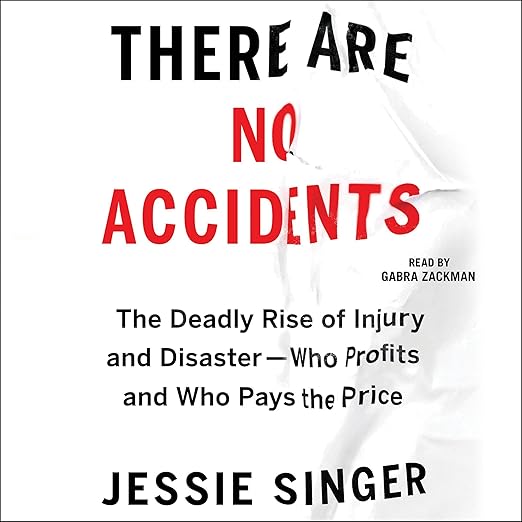
Quick Take
- Narration: Gabra Zackman delivers Singer’s propulsive, poetic prose with the kind of urgency the subject demands without ever tipping into advocacy performance.
- Themes: Systemic inequality and preventable death, the politics of blame, corporate accountability versus individual responsibility
- Mood: Intellectually urgent and quietly furious, built from grief and transformed into argument
- Verdict: One of the most consequential pieces of investigative social journalism you will listen to this year, grounded in Singer’s personal loss and expanding into a structural critique that changes how you see ordinary life.
I was halfway through my morning walk when Gabra Zackman delivered the line that stopped me: Jessie Singer arguing that the 173,000 accidental deaths that occur in the United States every year are, in the aggregate, not accidents at all. They are the predictable consequence of decisions made by people and institutions with the power to prevent them, who chose not to. I had to stand still for a moment and let that land before I could keep moving.
There Are No Accidents began as a personal investigation. Singer’s best friend was killed by a driver who insisted it was an accident. That insistence, the way the word accident functions as a full stop in conversations about responsibility, is where Singer starts, and from there the book widens into one of the more rigorous and disturbing arguments about American power I have encountered in longform nonfiction.
Our Take on There Are No Accidents
Singer’s central claim is precise: the word accident protects those who make dangerous environments while punishing those who must live in them. She follows this claim through factories at the turn of the century, coal mines, urban highways, rural hospitals, and Superfund sites, tracing how consistently it is the poor and people of color who bear the physical cost of conditions that wealthy institutions created and continue to maintain. This is not correlation she is describing. She documents the mechanism: how accident language prevents investigation, diffuses anger, generates empathy for perpetrators, and transfers blame to victims.
Reviewer V. Bush, who has a career in air traffic control and aviation and came to the book with professional expertise in accident prevention, described it as breathtaking brilliance. That is a reader who could have found it naive and instead found it clarifying. The transportation planner reviewer Alexander Kalamaros said the implications were staggering even for someone already working in the field. These are not casual endorsements from readers who needed convincing. They are from practitioners who recognized what Singer was naming.
Why Listen to There Are No Accidents
Gabra Zackman is an excellent narrator for this kind of book. Singer’s prose is described by one reviewer as propulsive, witty, poetic, profound, comprehensive, and concise, which is a formidable list of demands for a narrator to honor. Zackman meets them. At eight hours and fifty minutes, the book never drags, and the reason is a combination of Singer’s sentence-level craft and Zackman’s ability to maintain the book’s emotional undercurrent without making it feel like a performance of outrage. The grief at the root of this investigation is present throughout, and Zackman keeps it audible without exploiting it.
The personal origin story, Singer’s friendship and the death that motivated this research, does not disappear as the book widens into structural critique. It returns at intervals as an anchor, reminding you that the systems being analyzed produce real losses for real people. That integration of the personal and the analytical is one of Singer’s most effective structural choices.
What to Watch For in There Are No Accidents
One critical review raised a legitimate methodological objection. Singer’s argument that ALL accidents can be prevented by fixing environments rather than individuals does, the reviewer argued, occasionally overstate the case. Blaming the built environment for every fatal mistake can slide from structural critique into a position that removes individual moral agency entirely, which creates its own problems for accountability. That tension in the argument is real, and Singer does not always resolve it cleanly.
This is a book that makes you see ordinary infrastructure differently. The reviewer who called himself a certified transportation planner said reading it led him to think about responsibility and ethics in all aspects of life beyond his professional domain. That kind of conceptual transfer is exactly what the best investigative nonfiction achieves, and it also means this is not easy listening in the sense of leaving you unchanged.
Who Should Listen to There Are No Accidents
This is for readers who want investigative journalism that operates at the level of structural analysis rather than individual scandal. If you find yourself frustrated by the phrase it was just an accident in news coverage and want language and evidence to articulate why, Singer provides both. Policy readers, urban planners, public health professionals, and anyone who has experienced a preventable loss will find this essential. Those who prefer their nonfiction to end with uplift rather than a sobered sense of how much systematic inertia stands between current practice and a genuinely safer society should know that Singer is honest about the difficulty of what she is proposing.
Frequently Asked Questions
Does Jessie Singer’s personal connection to the subject, her best friend’s death, undermine the book’s analytical objectivity?
Singer is transparent about the origin of the investigation, and the book’s strength is that the personal loss drives rigor rather than replacing it. She documents the structural argument with evidence across multiple domains, and reviewers with professional expertise in accident prevention found the analysis credible.
How does the book handle the opioid crisis specifically, since it is mentioned in the synopsis?
Singer draws connections between different categories of so-called accidental death, including opioid overdoses, traffic fatalities, and industrial accidents, to demonstrate that the pattern of who bears the cost and who escapes accountability is consistent across these seemingly unrelated domains.
Is Gabra Zackman’s narration emotionally measured, or does she editorialize toward the book’s political positions?
Reviewers and the general reception of this audiobook suggest Zackman matches Singer’s own tone, which is urgent but controlled. The outrage in the book is built from evidence rather than performed, and Zackman honors that distinction.
Does the book offer solutions, or is it primarily a critique?
Singer explicitly includes a section on actions individuals and society can take to prevent accidental deaths. The book is primarily diagnostic, but it does not end without a directional argument about what accountability and environmental design reform could accomplish.