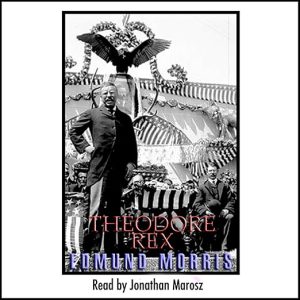
William McKinley's assassination hands Theodore Roosevelt the presidency in 1901 at just forty-two, the youngest man ever to hold the office, and this audiobook picks up almost exactly where that abrupt, violent handoff leaves off. Edmund Morris's Theodore Rex is the second volume of his Roosevelt trilogy, following the Pulitzer Prize winning The Rise of Theodore Roosevelt, and reviewer Mike Powers frames the shift precisely: this book continues where the first 'leaves off' and follows TR through his full seven years in the White House as the twenty-sixth president.
At 25 hours and 47 minutes, Jonathan Marosz has an enormous amount of dense archival material to carry, the Panama Canal negotiations, the Nobel Peace Prize, labor and trust disputes, and the creation of a national conservation policy that would eventually protect millions of acres, and the register he brings, measured and unhurried rather than performed for drama, is the right instinct for a book built on primary-source density rather than narrative invention.
Reviewer Bill Slocum raises a genuinely interesting craft question in his four-star review: can historians write actual literature, works of art that inform readers about a historic figure while remaining artistically expressive, not just accurate? His answer is yes, and Morris's prose, dense but propulsive enough to have won a Los Angeles Times Book Prize for Biography, is offered as the evidence.
Edmund Morris's own career adds useful context for judging this book's reliability. The Rise of Theodore Roosevelt won both the 1980 Pulitzer Prize for Biography and the 1980 National Book Award, and Morris's reputation from that first volume was strong enough that Ronald Reagan's own staff later recruited him to serve as Reagan's official biographer, a project that eventually produced the far more controversial Dutch, which mixed fictional narrative devices into nonfiction. Theodore Rex, by contrast, sticks to the same rigorously sourced, narrative-driven method that won the first volume its prizes.
What Edmund Morris Gets Right
This is widely regarded as one of the strongest single-term presidential biographies in the genre, and the San Francisco Chronicle's own assessment, quoted directly in the synopsis, calls it a portrait of 'a presciently modern political genius.' That is not hollow jacket copy; Mike Powers' five-star review independently backs it up, calling Morris 'the greatest herder of emperors since Napoleon' for his handling of Roosevelt's global diplomacy.
The subject matter itself carries real relevance beyond pure history. A president who inherited power after an act of terrorism, then spent his term wrestling with corporate trust power, labor unrest, and the beginnings of a genuine environmental policy, gives this book a throughline that lands differently for a modern listener than a purely ceremonial presidential biography would.
The synopsis specifically credits Roosevelt with combating 'the problems of race and labor relations and trust control,' and the race-relations piece in particular tends to get less attention than the Panama Canal or conservation achievements in popular memory of his presidency; a biography willing to give it real page time rather than treating it as a footnote is doing something more honest than a simpler, more celebratory account would.
The Nobel Peace Prize the synopsis credits him with is worth putting in real context: Roosevelt won it in 1906 for personally mediating the Treaty of Portsmouth, which ended the Russo-Japanese War, making him the first American ever to win a Nobel Prize of any kind. That is a genuinely significant diplomatic achievement to have folded into a single presidential term already carrying the Panama Canal, a labor crisis, and a new conservation policy.
Where Edmund Morris Loses Some Ground
This is the second book in a trilogy, not a standalone entry, and while Powers' review confirms it works as a continuation rather than requiring the first volume cover to cover, listeners who want TR's full origin story, the Rough Riders, the New York governorship, the vice presidency, will be missing that context starting here. Morris built each volume around Roosevelt's presidency-era material specifically, so the gap is intentional rather than a flaw in this particular audiobook.
At nearly 26 hours, this is a genuine commitment, longer than most single-president biographies and structured around dense archival research rather than a brisk narrative pace. Tanya Arlington's brief five-star review, calling it simply 'excellent reading,' and Powers' more detailed praise both suggest the density rewards patience rather than testing it, but listeners should go in expecting a serious, unhurried history rather than a fast survey.
The book ends with Roosevelt leaving office at just fifty, his reputation already secure, rather than following him through his post-presidency safari, Bull Moose run, or Amazon expedition. Morris covers those later chapters in a separate, third volume, so listeners hoping for the full arc of Roosevelt's later life should know this one stops at the handoff to Taft.
The Times Literary Supplement, quoted in the same synopsis, goes further, placing this 'alongside Henry Adams's volumes on Jefferson and Madison' as one of the great histories of the American presidency, a serious, specific comparison rather than generic praise, and one worth knowing about for listeners trying to gauge where this sits in the wider canon of presidential biography before committing to the runtime.
The San Francisco Chronicle's phrase 'a gilded age of wealth, optimism, excess and American global ascension' is worth sitting with for a moment, since it frames Roosevelt's presidency as the hinge point between two very different Americas: the raw industrial fortune-building of the late 1800s on one side, and the beginnings of a modern regulatory and conservationist state on the other, with TR himself standing directly in the middle of that transition rather than safely on either side of it.
A biography this dense with names, dates, and interlocking political maneuvers is easier to flip back through in print than to relocate a specific passage inside a 26-hour audio file; listeners who expect to use this as ongoing reference material for a class or research project, rather than one continuous listen, may want a print or ebook edition within reach alongside the audiobook for that specific purpose.
Who Should Pick Up Theodore Rex
Serious history listeners who want a single presidential term treated with the depth most biographies reserve for an entire life, and anyone specifically drawn to the Progressive Era's collision of corporate power, labor, and early conservation policy, will find this among the genre's strongest entries available.
Listeners newer to Roosevelt, or hoping for a faster-paced single-volume overview of his whole life, should look for a shorter biography instead; this is dense, source-driven, and unapologetically long, built for readers already committed to the subject rather than as anyone's introduction to TR.
The sheer length also suits long-form listening formats specifically, a multi-week commute, a cross-country drive, or a dedicated history binge, in a way a shorter single-sitting biography simply is not; listeners planning their next long audiobook around a real commitment should weigh that practical fit alongside the subject matter itself.
Frequently Asked Questions
Do I need to listen to the first book in Edmund Morris's trilogy before this audiobook?
It helps but is not strictly required. Theodore Rex covers Roosevelt's presidency specifically, and reviewer Mike Powers confirms it continues directly from The Rise of Theodore Roosevelt, though the presidency-era story here is largely self-contained.
How long is this audiobook and does the pacing hold up over that length?
It runs 25 hours and 47 minutes. Reviewer feedback describes the density as a strength rather than a slog, but listeners should expect a serious, source-heavy pace rather than a brisk narrative.
Does this audiobook cover Theodore Roosevelt's whole life?
No, it covers only his two presidential terms, from taking office after McKinley's assassination to leaving the White House at fifty. His earlier life and later post-presidency years are covered in the trilogy's other volumes.
Is this audiobook mainly political history, or does it cover Roosevelt's personal life too?
It is primarily political and policy history, the Panama Canal, labor disputes, trust control, conservation policy, though Morris's narrative style keeps Roosevelt's personality and relationships present throughout rather than treating the presidency as pure administrative record.