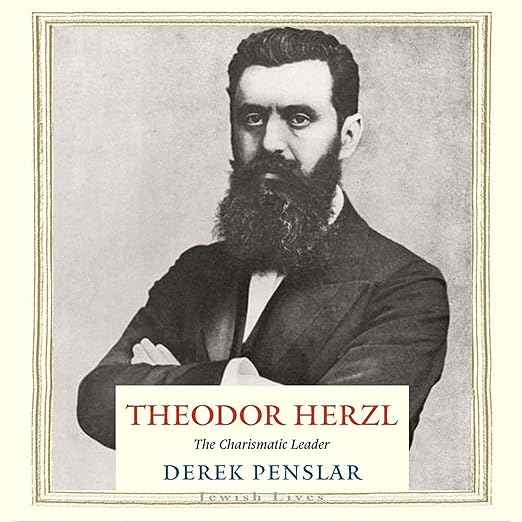
Yale University Press published the book and University Press Audiobooks made the recording, and this listing says so outright, which is rarer on an audiobook page than it ought to be. Behind those two lines sits Derek Penslar's account of Theodor Herzl, 1860 to 1904, a life the copy calls as puzzling as it was brief, compressed into eight hours and twenty minutes. It is a short biography of a man remembered mostly as a symbol, and its argument runs toward the person underneath the symbol.
A Screen for Others' Deepest Needs
Three questions carry the whole book, and the description puts all three up front. How did a cosmopolitan, assimilated European Jew end up leading the Zionist movement? How could one person be an artist and a statesman, a rationalist and an aesthete, a stern moralist carrying deep and at times dark passions? And why did scores of thousands of Jews, many from traditional and observant backgrounds, accept him as their leader? Penslar's answer to the first is the one that reframes everything after it: the road to Zionism had as much to do with personal crises as with antisemitism.
D. Bryner's March 2020 five-star arrived already impressed by the historian's credentials and came away calling the research impeccable and the analysis dispassionate, thorough and well written. Dispassionate is the operative word on a subject where almost nothing published is. Penslar is not building a case for or against anybody. The book reconstructs how a European man of letters in private difficulty converted himself into an organizer with, in the copy's phrase, indefatigable energy and electrifying charisma, and the conversion is treated as a historical problem rather than a miracle.
Herzl became a screen onto which Jews of his era could project their deepest needs and longings. That sentence in the description does more work than the rest of the copy combined, because it relocates the charisma from the man to his audience. Charisma stops being a personal quality and becomes a transaction, which is a far more interesting thing to spend eight hours on and the reason the subtitle earns its keep.
Lerman Must Signal Whose Writing This Is
Reading the primary source first is, in effect, what one listener recommends. A July 2020 five-star describes arriving at this biography having already worked through Herzl's own tract on the Jewish state, wanting to understand what forms a person, nature and nurture and experience together. That is a good sequence to steal. The tract is short, the biography assumes you have some sense of what the movement wanted, and hearing the argument after hearing the man's own pitch makes Penslar's psychological reading land much harder.
Peter Lerman carries the recording alone, and the specific difficulty here is quotation. The copy says Penslar draws on a vast body of Herzl's personal, literary and political writings, which means the text is dense with the subject's own words: diaries, letters, plays, polemics. Print separates those from the historian's voice with indentation and smaller type. A reading has nothing but the voice, and a listener needs to know at every moment whether they are hearing Herzl or hearing an assessment of Herzl. Sample a passage well into the book rather than the opening, where quotation is usually thinnest.
Eight hours and twenty minutes is a deliberate scale. Long enough to work through the writings properly, short enough to finish across a few sittings, and matched to a subject whose public career was compressed into a small number of years. Nothing here sprawls. Compare it with the multi-volume political biographies this figure usually attracts and the restraint starts to look like the point rather than a limitation.
A Courier Review Holds the Lowest Grade
Every written response on this page was filed in 2020, five years before the recording was published in November 2025. Three of the four discuss Penslar's text: the quality of the research, the clarity of the prose, the evenhandedness of the analysis. The fourth, filed in the United Kingdom, runs to four words reporting that an order arrived on time and was fine as expected, which is a comment on a courier. So the 4.5 badge across 55 ratings is a verdict on the Yale book, and the lowest grade in the visible column happens to sit on the only entry that says nothing about the book at all.
Jewish Lives appears in the series field with no number beside it, and nothing on the record links, lists or dates another volume. Anyone wanting to know what else the series covers, or where this installment sits inside it, has to go hunting. Set that beside the empty ISBN and page-count fields and the structured data on this page is thin, although the publisher split written into the description makes up for a good deal of it.
Neither Saint nor Villain, Deliberately
Widest of the four responses is a May 2020 five-star, which credits Penslar's wit and colorful language for carrying the research and argues the book works as more than a biography, helping a reader think about charismatic leadership in general. That is a fair description of who else should be here. Students of how movements acquire figureheads, of how personal instability converts into public authority, and of the gap between a leader and the thing followers need a leader to be, will all find a well-documented case study.
Advocacy is the thing this book declines to supply, in either direction, and that will frustrate listeners who arrive wanting it on a subject that rarely gets discussed calmly. Penslar's Herzl is neither saint nor villain: an artist and a statesman at once, a rationalist and an aesthete, a moralist with dark passions, who found a cause that fit his temperament and threw everything he had at it. Take it as biography rather than as argument, and start with the tract if you want the full effect.
Key Details
- Read by: Peter Lerman holds the sole credit on a University Press Audiobooks production of a Yale University Press title, a split the description states outright.
- At its heart: Charisma as something followers supply, assimilation and its crises, the making of a movement, biography against myth.
- Vibe: Cool, documented and unhurried, closer to a lecture than to a eulogy.
- Short version: A dispassionate short life of a man usually discussed as a symbol, and the better for refusing to argue.
Questions Listeners Ask
Which publisher produced the Theodor Herzl audiobook?
University Press Audiobooks, and the description states it plainly alongside the note that Yale University Press published the printed book. That split explains the production: a university press licensing its list to an audio specialist rather than recording in house. Peter Lerman holds the sole reading credit across eight hours and twenty minutes.
Do I need background in the subject before starting this one?
No prior reading is required, though the copy assumes you already know why Herzl matters. The book opens on questions rather than context: how an assimilated European Jew came to lead the movement, and why so many Jews from observant backgrounds accepted him. Penslar answers by reconstructing the private crises alongside the politics.
Is the audiobook a full-length biography or a short introduction?
Eight hours and twenty minutes puts it between the two. Long enough to work through Herzl's personal, literary and political writings in detail, short enough to finish across a few sittings. It covers a life the description itself calls brief, running from 1860 to 1904, so the compression matches the subject rather than fighting it.