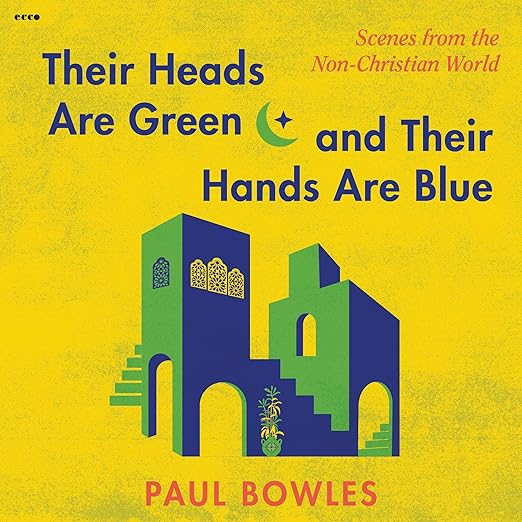
Quick Take
- Narration: Raphael Corkhill delivers Bowles’s dense, evocative prose with measured authority, a voice that never romanticizes but always compels.
- Themes: Cultural collision, Western gaze, the allure of the inaccessible
- Mood: Contemplative and disquieting, like a long layover in an unfamiliar city
- Verdict: Essential listening for serious travel literature fans, though readers expecting narrative warmth will find Bowles resolutely aloof.
I came to Paul Bowles late. I had read The Sheltering Sky years ago and found it brilliant and cold in equal measure, the kind of novel that stays lodged in you like a splinter. So when I picked up the audiobook of Their Heads Are Green and Their Hands Are Blue on a slow Tuesday evening, nursing a cup of tea with nowhere urgent to be, I was not expecting warmth. What I found instead was something rarer: a writer at his most personally revealing, even as he maintains the posture of the dispassionate observer.
Published in 1963 and drawn from Bowles’s long decades of living in Tangier and traveling through North Africa, Sri Lanka, and beyond, this collection of travel essays represents the nonfiction counterpart to his fiction. The title itself is lifted from Edward Lear’s poem “The Jumblies”, a detail one reviewer noted, pointing to Bowles’s kinship with Lear as a well-traveled eccentric who processed experience through an oddly skewed lens. On audio, read by Raphael Corkhill over just under seven and a half hours, the essays land with the quiet precision of someone who has said the same difficult thing many times and has stopped expecting agreement.
Our Take on Their Heads Are Green and Their Hands Are Blue
What separates Bowles from most Western travel writers of his era is that he refuses to make the cultures he visits comfortable for his readers. He does not flatten them into postcards. One reviewer put it well when he noted that Bowles captures “the abnormal psychology of the planet itself” rather than of individuals, and that phrasing rings true in nearly every essay. When Bowles writes about the music of Morocco or the rhythms of daily life in Sri Lanka, he is not translating; he is recording, often with the detached fascination of a field anthropologist who has gone native without quite going native.
There is a tension in these pages that the audio format actually heightens. Corkhill’s voice is formal but not stiff, he treats the prose with the same respect one would give a legal document, which, given Bowles’s precision, feels appropriate. The essays on North Africa in particular carry a charged quality: you sense that Bowles is aware of his position as a privileged outsider, even if he rarely explicitly names it. One reviewer writing decades after first reading the book called it “dated in some ways” but praised its eloquence and noted that it can be read as either a narrative of cultural collision or as the journal of a man collecting music for kicks in dangerous territories. Both readings hold water simultaneously, and that ambiguity is part of what makes the book worth your time in 2025.
Why Listen to Their Heads Are Green and Their Hands Are Blue
The audiobook format suits Bowles surprisingly well. His prose has a cadence that rewards being heard rather than skimmed, the long subordinate clauses, the sudden dry asides, the way description hardens into observation. Corkhill finds the grain of each sentence without embellishing, and at seven hours and twenty-two minutes, the collection never overstays its welcome. Each essay functions as a self-contained piece, which means you can listen in segments without losing the thread.
Beyond the narration, there is the historical weight of the material. Bowles was writing about places that were still far outside the Western imagination in the early 1960s, places that, as the synopsis notes, were “as yet unencumbered by the trappings, luxuries, and corruptions of modern civilization.” That framing is itself worth interrogating now, but the essays’ value is not diminished by our awareness of it. If anything, the essays become more interesting when you hold them against what the postcolonial world has since revealed. The impact of colonialism, as one reviewer observed, still echoes in these places, and Bowles’s portraits are unwitting documents of a world mid-transformation.
What to Watch For in Their Heads Are Green and Their Hands Are Blue
The book is, as multiple reviewers warn, genuinely dated. Some of Bowles’s assumptions about the cultures he visits carry the unmistakable mark of a mid-century Western intellectual, curious, sympathetic up to a point, but never quite aware of the frame he himself occupies. Readers expecting self-critique or postcolonial reflexivity will not find it here. What they will find is prose of exceptional quality: specific, controlled, and occasionally darkly funny. Bowles finds humor in the friction between his expectations and reality in a way that keeps the essays from tipping into condescension, but it is a narrow line, and not every reader will feel he walks it successfully.
There is also a certain deliberate emotional distance that may frustrate listeners who prefer travel writing with a warmer, more confessional register. Bowles is not Cheryl Strayed or even Pico Iyer, he does not invite you into his interior life so much as position you beside him at a slight remove. Whether that counts as a flaw or a feature will depend entirely on what you want from travel literature.
Who Should Listen to Their Heads Are Green and Their Hands Are Blue
This audiobook is best suited to listeners who already have some appetite for literary nonfiction and who can engage critically with an older text without expecting it to conform to contemporary sensibilities. If you loved The Sheltering Sky, this is essential context for understanding Bowles’s relationship to the world his fiction inhabits. Fans of Bruce Chatwin’s In Patagonia or Ryszard Kapuscinski’s African dispatches will recognize the mode and find much to appreciate. For casual listeners looking for cheerful adventure travel, this is the wrong shelf. But for those drawn to the literary edge of the genre, where travel becomes a meditation on difference, proximity, and what it means to watch, Bowles remains one of its most rewarding, if unforgiving, guides.
Frequently Asked Questions
Is this the same Paul Bowles who wrote The Sheltering Sky?
Yes. Paul Bowles spent most of his adult life in Tangier, Morocco, and his travel essays in this collection draw directly from the same regions and cultural encounters that informed his fiction. The two works illuminate each other considerably.
How does Raphael Corkhill’s narration handle Bowles’s long, dense sentences?
Corkhill reads with steady authority and does not rush the prose. His formal, measured delivery suits Bowles’s deliberate style, though listeners who prefer more expressive narration may find it a touch austere.
Is the content outdated, given that these essays were written in the early 1960s?
Some assumptions reflect their era, and several reviewers note the dated quality of Bowles’s perspective. The essays remain valuable as historical documents and as exceptional prose, but readers should approach them with awareness of the postcolonial context Bowles himself did not fully inhabit.
Does the audiobook work well listened to in individual segments rather than straight through?
Yes. The essay format makes it well-suited to episodic listening. Each piece stands on its own, so you can listen to one or two at a time without losing narrative coherence.