Quick Take
- Narration: Tom Parks reads with pastoral warmth that suits the devotional quality of Kendall’s prose, without tipping into performance.
- Themes: Faith under social pressure, divine approval versus human approval, ordinary people as vehicles for transformation
- Mood: Reflective and devotionally rich, accessible to readers well outside Evangelical Christianity
- Verdict: Kendall’s genuine insight into familiar Bible stories makes this worth the time even for readers who think they already know these characters.
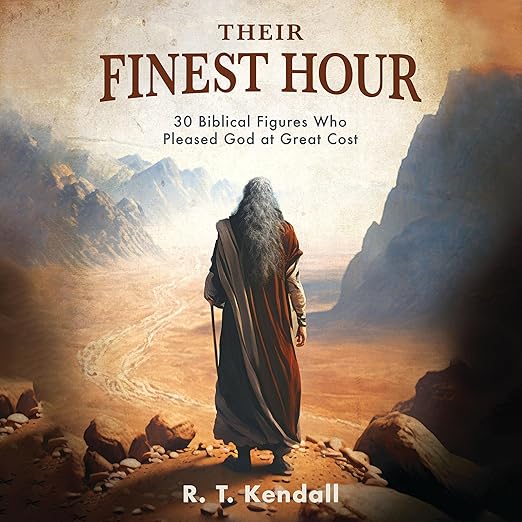
I tend to approach devotional audiobooks the way I approach familiar paintings in a museum I have visited a dozen times, expecting to see what I have already seen. Their Finest Hour surprised me in the way the best of those museum visits do: by pointing at something I had walked past before without registering. I listened through two consecutive evenings, which is not how I usually pace this kind of reading.
R.T. Kendall has spent decades as a pastor and author, and Their Finest Hour collects thirty profiles of biblical figures whose defining moments of faith came precisely when it cost them something socially or personally. The framing device, the approval addiction, Kendall’s term for the human tendency to seek others’ praise over divine direction, gives the collection a coherent thread that prevents it from feeling like thirty disconnected vignettes. These stories are meant to be read against the pressure to conform, and Kendall keeps that pressure visible throughout.
Our Take on Their Finest Hour
The selection of figures is carefully curated. Kendall includes expected entries, Rahab, who chose a future with God’s people over her prior life; Habakkuk, whose willingness to wait became its own form of faith, alongside figures who receive less attention in devotional literature. Leah, described as experiencing delayed significance, is one of the stronger portraits: Kendall finds genuine theological weight in a story that is usually treated as a domestic subplot, and the reading invites reassessment of what significance looks like from outside a narrative’s center.
A reader who has taught the Bible for over fifty years described encountering truths she had been missing for decades, not because the material was obscure, but because Kendall’s angle of approach illuminated something familiar in a new direction. That is the real achievement here: the book does not depend on novelty of subject but on quality of attention. The writing is simple and direct, which is accurate, but Kendall’s simplicity is not thinness, it is the clarity of someone who has thought very carefully about how to say a difficult thing plainly.
Why Listen to Their Finest Hour
Tom Parks carries the right register for this material. He reads with pastoral warmth without performing it, the voice of someone sharing something he considers important, not auditioning for an inspirational recording. At seven hours, the book is comfortable listening across a week of daily sessions. Each chapter functions as a discrete unit, which makes it genuinely useful for small groups and Bible study contexts as several reviewers noted, but the collection also reads with cumulative force across the full arc.
Kendall writes, as one reviewer put it, like your brother as well as your pastor, with honesty and care for Scripture rather than institutional protectiveness. That tone is rare in this genre and makes even the chapters on familiar figures feel like genuine engagement rather than recitation.
What to Watch For in Their Finest Hour
The book assumes a Christian orientation in its readers. Non-Christian listeners may find the framework engaging as cultural analysis of biblical narrative, but the book does not pitch itself to secular curiosity, it is devotional literature in the proper sense, addressed to people who want to deepen their relationship with God rather than study the Bible at critical distance. The thirty-chapter structure means some profiles are necessarily compressed; figures who might warrant extended treatment get a chapter rather than an essay. Readers wanting deeper biographical or historical excavation of specific characters will need to supplement elsewhere.
Who Should Listen to Their Finest Hour
Christians looking to reencounter familiar biblical figures from a different angle, small group leaders wanting a chapter-a-week discussion resource, and any reader interested in how faith functions under social pressure as a recurring biblical theme. Skip it if you are looking for critical-historical analysis of the Old and New Testament figures, this is theological reflection, not scholarship in the academic sense.
Frequently Asked Questions
Is Their Finest Hour structured to be read front to back or dipped into chapter by chapter?
Both work. Each of the thirty chapters is a standalone profile, making it ideal for small group or devotional use. Read sequentially, the cumulative argument about divine versus human approval builds with genuine force.
Does the book require deep prior knowledge of the Bible to follow?
No. Kendall provides enough context for each figure that listeners without detailed biblical knowledge can follow the portraits. Familiarity enriches the experience but is not a prerequisite.
How does Kendall handle figures like Rahab and Leah who are often marginalized in devotional literature?
With sustained attention and genuine theological insight. Leah’s story in particular receives a reframing around delayed significance that goes beyond the typical treatment of her as a background figure in Jacob’s narrative.
Is this book denominationally specific or broadly Christian in its perspective?
Kendall’s background is Evangelical, but the book’s concerns, faith under social pressure, the temptation toward approval addiction, ordinary people achieving significance in God’s eyes, are broadly Christian rather than denominationally narrow.