Quick Take
- Narration: Dion Graham is an AudioFile Golden Voice with over 300 audiobooks to his name, and his work here is among the finest history narration of recent years – AudioFile specifically praised his resonant voice, enunciation, and expressiveness, and the 2026 Audie Awards finalist status confirms the reception.
- Themes: the legal architecture of slavery, the abolitionist movement’s origins in a specific atrocity, the relationship between law and moral transformation
- Mood: Grave and purposeful, with moments of genuine narrative tension
- Verdict: Essential history, brilliantly narrated – Kara’s account of the Zorg incident and its consequences for the British and American abolitionist movements deserves the widest possible audience.
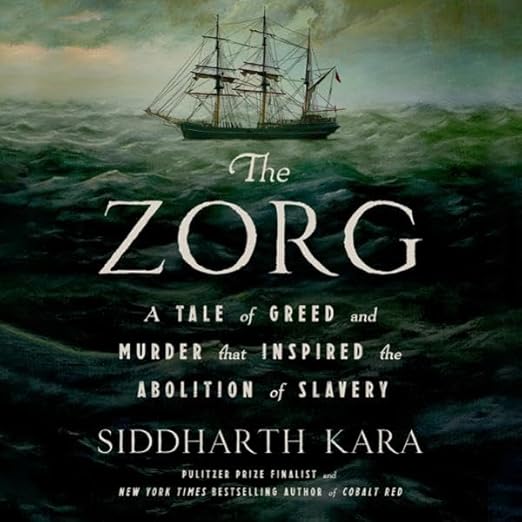
I was somewhere in the middle of a Thursday evening when I started The Zorg and did not stop until it was finished. That does not happen often with nonfiction. Seven hours and forty-three minutes is a long evening session, but Siddharth Kara writes with the momentum of a legal thriller and the moral seriousness of someone who has spent his career documenting what happens when profit and human life are brought into legal relation. By the time I reached the final chapters – the court case, the mysterious abolitionist, the consequences that radiated outward across two continents – I had completely forgotten that I had other things I was supposed to be doing.
The Zorg is the story of a Dutch slave ship that set sail in late 1780, was captured by a British privateer, and then made a series of navigational errors that brought it dangerously low on water in the mid-Atlantic. The solution proposed by the new British captain – throw the enslaved people overboard, beginning with women and children, to save water and preserve the most valuable human cargo – was executed on multiple occasions. What followed was one of the most consequential legal cases in the history of the abolitionist movement: because the enslaved people had been thrown overboard rather than dying of natural causes, they were technically cargo destroyed for insurance purposes, and the case wound up in England’s highest commercial court.
Law as the Lens on an Atrocity
Kara’s central insight – the one that makes this book so analytically valuable – is that the legal proceedings exposed, with unusual clarity, the full moral horror of the system that produced them. The court was asked to rule on whether throwing enslaved people overboard constituted a recoverable insurance loss. The question reduced human beings to a line item in a claims settlement, and it did so in full public view at a moment when the nascent anti-slavery movement in Britain needed exactly this kind of visible atrocity to build popular pressure for abolition. Kara traces the thread between the courtroom and the eventual Slave Trade Act of 1807 with the care of someone who has done original archival work rather than synthesizing existing accounts.
The primary source research is one of the book’s genuine contributions. One reviewer notes Kara’s painstaking investigation of the ship’s records, the insurance documents, the court proceedings, and the mystery surrounding the identity of the abolitionist who first revealed what had happened. That last element – the anonymous witness or insider who brought the case to public attention – runs through the book as a genuine historical puzzle that Kara pursues with enough rigor to produce conclusions rather than mere speculation.
The Middle Passage in Numbers and in Names
One reviewer opens their note with the statistics: between 1517 and 1867, approximately 12.5 million Africans were forced onto the Middle Passage, of whom roughly 10.7 million survived the voyage. Those numbers are the backdrop against which the Zorg must be understood – not as an exceptional atrocity but as a particularly legible one, documented in court records and newspapers in ways that most of the violence of the slave trade was not. Kara does not let the reader treat the Zorg as uniquely monstrous while excusing the broader system that produced it. The incident was the moment when the system was briefly forced to account for itself, and that accountability – however partial and legally framed – was what made it politically consequential.
Kara’s previous book, Cobalt Red, documented contemporary child labor in the Democratic Republic of Congo’s cobalt mining industry with a similar methodology: primary source research, survivor testimony, and structural analysis of how global economic systems enable the exploitation of the most vulnerable. The Zorg applies those same habits to a historical case, and the result has the same quality that distinguished Cobalt Red: moral seriousness combined with genuine investigative precision, not advocacy that substitutes passion for evidence.
Dion Graham and the Three Registers This Book Requires
The AudioFile review cited in the book’s promotional copy praises Graham’s resonant voice as nearly perfect – and this is not marketing language doing the work that narration should be doing. Graham’s performance is exceptional in a specific way: he manages the shift between the book’s three registers – legal analysis, historical narrative, and survivor or witness testimony – without losing coherence. The legal sections require precision and authority; the narrative sections require forward momentum and tonal control; the human testimony sections require restraint and gravity without theatricality. Graham delivers all three.
The 2026 Audie Awards finalist status for both Best Nonfiction Narrator and Best History/Biography is the market confirmation of what the AudioFile review describes. These nominations are evidence of sustained excellence across the full production, not just notable moments. For listeners who care about the quality of the audio experience alongside the quality of the historical account, this is as good as the genre gets.
The Abolitionist Consequence
The book’s final sections trace how the Zorg case energized both the British abolitionist movement – already organized around figures like Granville Sharp and Thomas Clarkson – and the nascent American movement that would eventually produce figures like Frederick Douglass and William Lloyd Garrison. This connection between a specific act of atrocity, a legal proceeding, and a political movement of global consequence is the historical argument Kara is making, and it is a compelling one. The Slave Trade Act of 1807, the American abolitionist literature of the 1830s, the eventual Emancipation Proclamation – all of these can be traced, in part, to what a British court did with a Dutch slave ship in a case about insurance liability.
Who Should Listen, Who Should Skip
Listen if: you want to understand the legal and political origins of the British abolitionist movement; you’re drawn to history that connects a specific documented incident to large-scale social change; or you’ve read Cobalt Red and want to follow Kara’s earlier research project.
Skip if: graphic accounts of violence against enslaved people will be unmanageable for you – Kara does not soften what happened on the Zorg. The violence is part of the historical record and the book does not look away from it.
Frequently Asked Questions
Is this the same ship and incident as the Zong massacre that appears in other histories of the abolitionist movement?
Yes. ‘Zorg’ is the Dutch spelling of the ship’s name; some earlier English-language accounts use ‘Zong.’ Kara’s research draws on primary Dutch and British sources, and his identification of the ship is the result of original archival investigation. Listeners familiar with accounts of the Zong massacre will find Kara’s version both more detailed and more precise.
Does the book cover the American abolitionist movement as well as the British, or is it primarily focused on England?
The primary legal drama unfolds in England, but Kara explicitly traces the American consequences – how the case energized the American abolitionist movement and contributed to the political conditions that eventually produced emancipation. Britain is the primary focus, America the secondary one.
Dion Graham has won multiple Audie Awards and is an AudioFile Golden Voice – does the narration live up to that reputation here?
Yes, emphatically. AudioFile specifically praised this performance, and the 2026 Audie Awards finalist nominations for both narrator and book category are the formal recognition of what the listening experience confirms. This is one of the best-narrated nonfiction history titles in recent memory.
Kara’s Cobalt Red was about contemporary forced labor – how does this book compare in terms of approach and tone?
The methodology is similar: primary source research, witness testimony, and structural analysis of how economic systems enable human exploitation. The Zorg applies these tools to a historical case, which gives Kara somewhat more distance than Cobalt Red’s contemporary reporting provided. Both books share the same commitment to precision over advocacy, and both reach similarly disturbing conclusions about what happens when human beings are legally constituted as property.