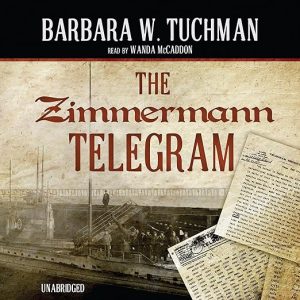
I finished The Zimmermann Telegram on a Tuesday commute when I was in one of those moods where podcasts felt thin and I wanted something with actual density to it. Barbara Tuchman has a way of making you feel like you are being brought into a confidence, like she is sharing not just the facts but the texture of events, the way things actually felt to the people who were living them. Seven hours and twelve minutes with her voice filtered through Wanda McCaddon's narration is a genuinely good way to spend a stretch of time when the world feels like it is mostly noise.
The premise is compact and remarkable: in January 1917, British Naval Intelligence intercepted a secret telegram from German Foreign Secretary Arthur Zimmermann to the German ambassador in Mexico, proposing a military alliance in which Mexico would attack the United States in exchange for help reclaiming Texas, New Mexico, and Arizona. What the British did with that information, and how they eventually handed it to Washington without revealing how they obtained it, is a story of extraordinary calculation and careful misdirection. Tuchman was writing this in 1958, decades before many of the relevant intelligence files were fully accessible, and yet the book holds up because her analytical instincts are so strong.
Where This One Lands
One reviewer described the book as telling history as if it were a detective story, and that framing is accurate. Tuchman structures the narrative around questions of evidence and motive rather than simple chronology. She wants you to understand not just what happened but why it was plausible that it happened, why Germany would make such a gamble, why Wilson would resist entering the war for as long as he did, and why the telegram's revelation landed with such force when it finally became public.
The book examines German miscalculation and British calculation in parallel, and the interplay between those two processes is where the real drama lives. There is also a thread of dry humor running through Tuchman's prose that McCaddon handles well. Her portraits of her main actors, including Zimmermann himself, Wilson, and the British intelligence officers who managed the delicate task of using the intercepted cable, are drawn with economy and occasional sharpness. She is not interested in hagiography or vilification. She is interested in behavior, in the ways that personality intersects with circumstance to produce historical outcomes.
Why Listen to The Zimmermann Telegram
Listeners expecting the kind of sprawling multi-theater history that Tuchman delivered in The Guns of August should calibrate expectations. The Zimmermann Telegram is a focused study, and its brevity is one of its primary virtues. One reviewer specifically praised how the shortness keeps the narrative moving and the plot interesting. That is right. Tuchman does not pad the material. She identifies the key decisions and the key actors and follows those threads to their conclusion without detour.
The book covers the telegram's conception in Berlin, its transmission through a route that would later embarrass Germany, its interception and decryption by Room 40 at the British Admiralty, and then the intricate diplomatic choreography by which the British handed it to the Americans without revealing the depth of their intelligence capabilities. For listeners who already know the broad outlines of WWI history, this provides a valuable close-up on one specific mechanism of American entry. For listeners who are less familiar with the period, it functions as an excellent introduction to the dynamics of early twentieth century great power politics.
What Gives Us Pause
Wanda McCaddon is a reliable narrator for serious nonfiction, and she is a good match for Tuchman. She does not try to dramatize the material beyond what the prose invites. She reads with intelligence and appropriate pace, and she handles the occasionally complex German names and diplomatic terminology without stumbling. This is the kind of narration that serves the book rather than competing with it, which is exactly what Tuchman's dense, carefully constructed sentences require. The combination of strong source material and an unobtrusive narrator who trusts the writing is one of the better models for how history audiobooks should work.
A word on value: at seven hours and available as a free audiobook through Audible membership, The Zimmermann Telegram offers a high return on time invested. History writing of this quality and precision is genuinely hard to find, and Tuchman remains one of the best reasons to spend serious time with nonfiction audio. This is a good place to start or to return to.
Who Should Listen to The Zimmermann Telegram
The seven-hour runtime makes this an ideal choice for listeners who want historical substance without a major time commitment. It fits in a long weekend of commuting or a single day of focused listening. Available as a free audiobook through Audible membership, the barrier to trying it is low. Recommended for listeners interested in WWI history, intelligence and espionage, or diplomatic history. Also good for anyone who enjoyed The Guns of August and wants something shorter and more concentrated. Skip it if you need narrative drama over analytical depth, or if you are looking for a comprehensive overview of the entire war period.
How does this compare to The Guns of August for Tuchman newcomers?
The Guns of August is larger in scope and often considered her masterwork. The Zimmermann Telegram is shorter and more tightly focused, which makes it arguably more accessible as a first encounter with Tuchman's method.
Is Wanda McCaddon's narration a good fit for the analytical style of the material?
Yes. McCaddon reads with appropriate authority and pacing for serious nonfiction. She does not overdramatize Tuchman's prose, which lets the analytical quality of the writing come through clearly throughout.
Does the book address how the British avoided revealing their decryption capabilities when sharing the telegram?
Yes, that is one of the book's most interesting threads. Tuchman walks through the careful misdirection the British employed to protect Room 40's capabilities while still ensuring the telegram reached Washington in convincing form.