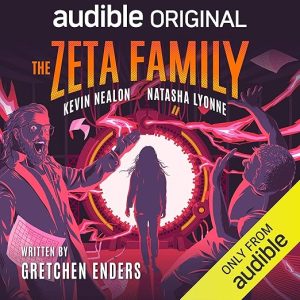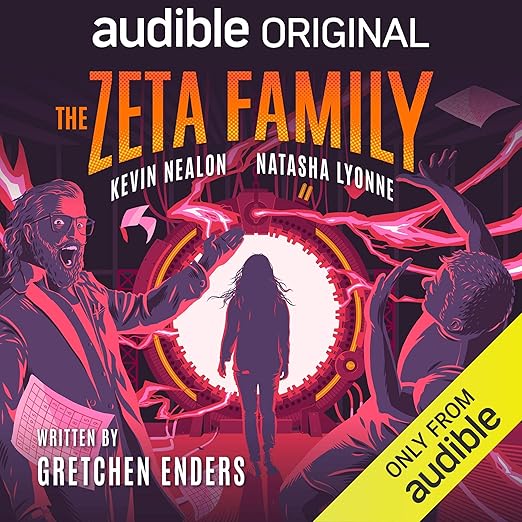
The Zeta Family came to me through a recommendation that went something like this: imagine if Hunter S. Thompson wrote a cult comedy and then handed it to Natasha Lyonne and Kevin Nealon to perform as an audio drama with full sound design. That description turns out to be only slightly larger than the actual product, which says something about how far the production reaches. I put it on one evening expecting thirty minutes of novelty and finished the full three hours and seventeen minutes without getting up from my chair.
Gretchen Enders wrote and created this, and the structural intelligence behind it is more sophisticated than the comic premise might suggest. Katie, the aspiring reporter who infiltrates the Zeta Family compound in rural upstate New York, is our entry point into a world that is genuinely difficult to categorize. Is Zeta Doug, described in the synopsis as a cross between Hunter S. Thompson and George R.R. Martin with a little too much sci-fi in his head and acid in his bloodstream, a genuine spiritual visionary, an elaborate con artist, a man who has convinced himself of something that was never true, or something more complicated than any of these? The production holds that question open with admirable discipline, refusing to resolve it into easy satire or easy sympathy.
A Closer Look at The Zeta Family
The choice to make the entry character a journalist is doing specific work here. Katie's professional objectivity is the first thing the Zeta Family begins to dissolve; her journalistic distance from the material she is documenting is precisely what Zeta Doug's compound is designed to undermine. That tension, between the observer who needs to maintain separation and the community that identifies separation as the pathology it is trying to cure, is the engine that drives the three-hour runtime more effectively than any conventional plot mechanism could.
Natasha Lyonne voices the narrator with the specific quality that her career has built: a kind of intelligent fatalism that allows you to trust her even when she is clearly in over her head. She is funny without playing the material for laughs, which is exactly the right calibration for an audio drama that wants you to find the cult simultaneously absurd and genuinely threatening. Her narration suggests a person who knows how this ends and is describing it from a distance while still being unable to fully detach from what happened there. That ambivalence is one of the production's most successful effects.
What Makes The Zeta Family Worth Hearing
The hardest performance in any cult drama is the cult leader, because the character has to be convincing enough that the audience understands why people follow him while also being visible enough as a performance that we maintain ironic distance. Nealon plays Zeta Doug with a loose, improvisational quality that suggests a man who has stopped distinguishing between his authentic self and his constructed one, which is possibly the truest thing you can say about that psychological type. He is genuinely funny and genuinely unsettling in the same moment, a combination that serves the material exactly right.
The production values are exceptional for audio drama. The Kelly and Kelly production team has created a sound environment for the compound that makes the physical space feel real, with layered ambient sound, musical scoring that shifts between the ironic and the genuinely eerie, and a recording quality that rewards headphone listening in a way that many audiobooks do not. This was designed to be heard in a specific way, and hearing it that way pays off substantially. The gap between listening through speakers and listening through headphones is more pronounced here than for almost any other full-cast audio drama.
Things to Know Before Starting The Zeta Family
The Zeta Family runs three hours and seventeen minutes, notably brief even for the format. That brevity is not a weakness; it is a formal decision. Audio drama at full production quality cannot sustain indefinitely the level of immersive investment it requires from the listener; the medium has a different economy of attention than prose fiction. Three hours is enough to build the world, complicate the central question about Zeta Doug's nature, and arrive somewhere that feels genuinely complete without ever resolving into the kind of tidy moral that would deflate the experience.
The explicit content warning in the synopsis is worth noting for listeners who factor such things into their choices. The compound setting generates situations and language that the warning anticipates, and the comedy is often dark in the specific sense that it finds things funny that are also troubling. That combination is not to every listener's taste, but for those who find it their register, The Zeta Family delivers it with genuine craft that never lets the darkness become merely grim.
Who Gretchen Enders Is Writing For
Listeners drawn to audio drama as a format, particularly productions that use sound design and multi-cast performance to create immersive fictional worlds, will find this among the best examples available. Fans of Natasha Lyonne's other work who follow her into audio will not be disappointed; she is in full command of a role that suits her specific comedic intelligence. Anyone interested in cult dynamics through a satirical rather than documentary lens will find the production thoughtful and funny in roughly equal measure.
Listeners who prefer conventional audiobook narration, or who find the explicit content warning a deterrent, should know that upfront. The three-hour commitment is genuinely accessible, but the format is audio drama rather than audiobook, which requires a different kind of attention and a willingness to receive it as an immersive experience rather than a story being read to you. Approached as the former, it is one of the more distinctive productions available in its category.
- Narrator: Kevin Nealon, Natasha Lyonne, and Amy Goodmurphy deliver a full audio drama performance with genuine comic chemistry, functioning as ensemble cast rather than conventional narrators.
- Subjects: Cult dynamics and the seduction of belonging, the journalist and the story that consumes her, the thin line between genuine weirdness and manufactured mystique
- Tone: Darkly funny and immersive, with a production quality that rewards headphones
- Bottom line: A genuinely inventive audio drama that uses the format's specific capabilities to do something print fiction cannot, with a cast that commits fully to a premise that could easily have been ruined by winking at the audience.
Frequently Asked Questions
Is The Zeta Family an audiobook or an audio drama, and does that distinction matter for how you listen?
It is an audio drama with full cast, musical scoring, and immersive sound design rather than a conventional single-narrator audiobook. The distinction matters significantly: this was designed for headphone listening in a way that a narrated audiobook is not, and the production values reward that kind of attention. Think of it as a radio play rather than a read novel.
Do you need to know Natasha Lyonne's work to appreciate her narration here?
No prior familiarity is required. Lyonne voices the narrator with an intelligent, ironic fatalism that works entirely within the context of this production. That said, listeners familiar with her comic sensibility from film and television will find it fully present here and applied with particular precision to material that suits it.
Is Zeta Doug presented as a fraud, a genuine believer, or something more ambiguous?
The production deliberately holds that question open, which is one of its structural strengths. Nealon plays him with a loose authenticity that suggests the line between performance and belief has long since dissolved for the character. The production refuses the easy satirical answer, making the cult dynamics more genuinely unsettling than a straightforward parody would achieve.
What does the explicit content warning in the synopsis refer to?
The warning reflects language and situations arising from the compound setting and the dark comedy register of the production. The humor is often found in circumstances that are simultaneously troubling, and some of the dialogue reflects the environment Enders has built. Listeners who regularly engage with dark comedy will likely find it within their range; those sensitive to explicit content in comedy contexts should factor it in.