The First Company-Commander Account of the Falklands
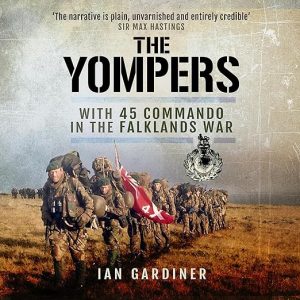
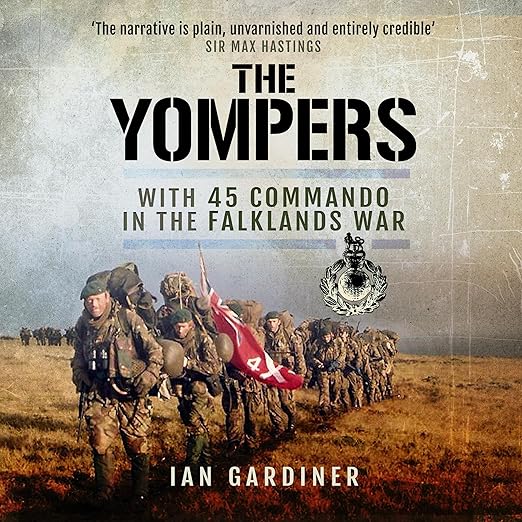
Ian Gardiner carried a radio and a rifle across East Falkland in the appalling midwinter weather of 1982, and this audiobook is his own account of that eight-thousand-mile deployment, narrated in his own voice across eleven hours and twenty minutes. The Yompers tells the story of 45 Commando Royal Marines, called to action on the second of April 1982 and tasked with recovering the Falkland Islands from Argentine invasion, lacking helicopters, short of food, and forced to march, or yomp, across brutal terrain carrying overloaded rucksacks for a full month before the unit fought and won the fierce night battle for Two Sisters, the thousand-foot mountain that anchored the defensive approach to Stanley.
Gardiner commanded a company during that campaign, and the book's real distinction, according to its own synopsis, is that it is the first account of the Falklands War written by a company commander specifically, giving it a vantage point between the ground-level infantry memoir and the higher-level strategic history. That dual perspective, what it felt like inside one platoon's boots and what it looked like from a command position making decisions that affected hundreds of lives, is the book's genuine structural strength.
How Yomping Entered Wider British Vocabulary
Two Sisters fell on the night of June 11 to 12, 1982, taken in a coordinated overnight assault alongside Mount Harriet and Mount Longdon, the opening moves of the final push that would end with Argentine surrender at Stanley days later. Placing Gardiner's company-level account against that wider, coordinated three-mountain assault gives listeners real strategic context for a battle that, from inside one commander's perspective, would otherwise read as an isolated fight rather than one piece of a carefully synchronized final offensive.
The synopsis's own postscript makes a claim worth sitting with: that "yomping" itself, originally just Royal Marines slang for a specific kind of forced march, caught the public imagination enough during this campaign to enter wider British vocabulary. Military-specific terminology crossing over into everyday civilian language is genuinely rare, shell shock from the First World War is one of the few comparable examples, which says something about how deeply this particular campaign registered in British public memory at the time.
Gardiner's Measured, Unhurried Authority Decades Later
Gardiner narrates his own material, and the choice pays off exactly the way self-narration should: measured, unhurried authority from a man reflecting on his own command decades later, with dry wit that surfaces naturally rather than being performed for effect. A professional narrator would likely smooth over the specific, understated quality that makes a memoir like this land, the sense of a real commander choosing his words carefully rather than dramatizing them.
Reviewer Peter, who has also read Gardiner's earlier book on the Dhofar War, calls this one just as strong, praising Gardiner's honesty and directness alongside his leadership style of leading from the front. That is a meaningful data point: a reader familiar with Gardiner's full body of work confirms the same voice and integrity carries across two entirely different conflicts, decades apart. Reviewer Erl Gould Purnell goes further, noting the book teaches strategy and logistics almost as a byproduct of the personal narrative, functioning as a genuine primer on how infantry campaigns actually get planned and supplied, and what happens when that planning breaks down.
Reviewer Peter's mention of Gardiner's earlier book on Britain's Dhofar campaign in Oman, a counter-insurgency conflict fought decades before the Falklands, adds real weight to the self-narration case: this is a writer with two full campaigns' worth of command experience to draw on, not a one-book memoirist, and that depth shows in how confidently he moves between ground-level detail and wider reflection on war generally.
Real Criticism Aimed Above Gardiner's Own Command
This is not purely a boots-on-the-ground action account. The synopsis itself promises penetrating insights into the realities of war at higher levels alongside the frontline material, and reviewer skip davis specifically highlights the book's willingness to critique institutional failures, arguing the UK was not fully prepared for this campaign and that personnel were put at risk partly because of political pressure for a positive outcome back home. Listeners expecting a straightforward heroic war narrative should know this book is willing to level real criticism at the decisions made above Gardiner's own command level.
At eleven hours and twenty minutes, the pacing mixes sustained physical description of the yomp itself with more reflective, analytical passages on command and strategy; listeners drawn purely by the promise of combat narrative should know the book spends real time on logistics and leadership philosophy as well.
Listeners unfamiliar with Falklands geography should know the yomp itself covered a substantial stretch of East Falkland's roughest terrain between the San Carlos landing beaches and Stanley, the island's capital, on foot, in midwinter Southern Hemisphere weather, without the helicopter transport that would normally have shortened the march considerably. That geographic and logistical context makes the physical ordeal described in the book's opening chapters land with more weight.
For Listeners Who Prefer Primary-Source Military History
Military history listeners interested in the Falklands War specifically, or in firsthand company-commander-level accounts of modern infantry campaigns generally, will find this a genuinely distinctive addition to the genre, not another retelling of the same officer-level or political history. Gardiner's synopsis itself promises the book is gritty and moving as well as reflective and funny, and that range comes through in the narration.
Listeners wanting pure high-command strategic history, or a purely emotional survivor's memoir without institutional critique, may find the blend here doesn't fully match either expectation on its own. This works best for listeners genuinely curious about the full texture of one commander's war, from rucksack straps to postwar reflection on what the campaign actually demonstrated about British military readiness.
Readers who gravitate toward company- or battalion-level combat memoirs generally, accounts written by the officer who was actually there giving orders rather than a historian reconstructing events from a distance decades later, will find this sits comfortably in that tradition. The blend of granular physical detail and honest institutional critique gives it more staying power than a purely celebratory regimental history would have.
This is also a strong pick for listeners who specifically prefer firsthand primary-source military history over secondhand academic analysis; Gardiner was not a historian assembling this account afterward from other people's testimony, he was the company commander making the actual decisions the book describes, which gives every judgment call in the narrative a different, more immediate kind of authority.