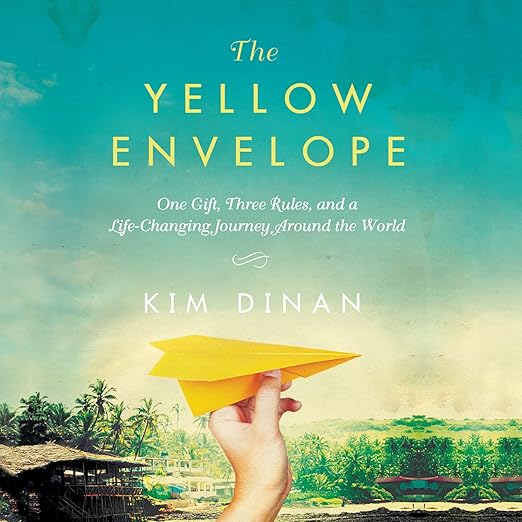
Kim Dinan's premise for this audiobook sounds almost too tidy: quit jobs, travel the world, give away money from a yellow envelope handed to you by philanthropist friends, learn something transformative. And yet The Yellow Envelope, narrated by Laurence Bouvard across nearly nine hours, resists the tidiness at every turn. What Dinan actually documents is messier, more specific, and more uncomfortable than any travel narrative built around a redemptive gift has any business being.
What Kim Dinan Delivers
Dinan and her husband Brian sell their belongings and leave for a trip through Ecuador, Peru, Nepal, and beyond. Before departure, generous friends hand them an envelope containing a check with only three rules: do not overthink it, share your experiences, and do not feel obligated to give it all away. On paper, this is the architecture of a feel-good story. In practice, Dinan treats it as a pressure test - on her marriage, on her own capacity for generosity, on the question of whether giving money actually creates connection or substitutes for it.
Reviewer J. Castle called it part travelogue, part introspective memoir, which is accurate, but the proportions lean heavily toward the introspective. Readers who approach it expecting a guided tour through South America and Nepal will find the interior focus surprising. Dinan is not writing a guidebook. She is writing about what extended travel does to a person when you strip away professional identity and stay in unfamiliar places long enough for the novelty to wear off and the real questions to surface. The destinations - Ecuador's markets, the Peruvian highlands, the streets of Kathmandu - are evoked rather than catalogued, felt rather than described for effect.
The envelope device works as a narrative structure because Dinan refuses to make the giving episodes straightforward. Each act of distribution generates fresh complications: Who actually deserves this money? Are we doing this for them or for ourselves? Does handing someone cash change the nature of the encounter, and not necessarily in the direction we hoped? These questions do not get resolved cleanly by the end of the book, and the willingness to leave them open is one of the things that keeps the memoir honest.
What Kim Dinan Gets Right
Bouvard's narration is a careful match for Dinan's prose. The writing is precise and often self-lacerating - Dinan is a genuinely skilled storyteller, as reviewer Daniel R noted in contrasting her with the travel bloggers who claim to be writers but lack her instincts for what to show and what to leave off. Bouvard does not soften the passages where Dinan is hardest on herself, and she does not rush through the quieter observations. The audiobook benefits from her ability to hold a steady tone across what is, structurally, a book that moves between exhilaration and doubt at irregular intervals without warning.
The marriage narrative runs through every chapter. Brian is a full presence in the story, and the relationship's friction - which Dinan names directly without dramatizing it for effect - is among the book's most valuable threads. Long-term travel does not fix relationships; it removes the routines and distractions that allow couples to defer the conversations they need to have. Dinan is aware of this and writes about it without assigning blame or manufacturing resolution. Bouvard's narration gives these passages room rather than hurrying through them toward the next destination.
Where Kim Dinan Loses Some Ground
Listeners should expect the travel narrative and the relationship narrative to compete for space, with the relationship often winning. This is not a travel book in the sense of place-driven description. Marlene, a reviewer who praised the book's honesty specifically, noted appreciating the courage required to document a marriage under genuine strain rather than present a cleaned-up version of the journey. That honesty comes at the cost of the kind of propulsive adventure-to-adventure structure that some travel audiobooks offer.
The pacing reflects the uneven rhythms of long-term travel. Some stretches are dense with incident and reflection; others feel like the between-days when nothing is resolved and the travelers are simply tired and uncertain. This is true to the experience and will resonate deeply with anyone who has done extended international travel. Those who prefer a more curated narrative arc, with clear forward momentum from opening to revelation, may find certain sections require patience.
The book also has a specific gender angle that several reviewers noticed. Reviewer Daniel R described it as geared toward female readers while remaining accessible to any listener interested in long-term travel. The interior focus - emotional, relational, identity-centered - is not exclusive to any readership, but listeners should know where the book's center of gravity lies.
Who Should Pick Up The Yellow Envelope
This audiobook suits listeners who want travel writing with genuine psychological weight - people interested in what long-term travel actually costs a relationship and a sense of self, not just what it reveals. It will appeal to anyone processing a major life transition or considering a decision to step off the conventional path. Armchair travelers looking primarily for exotic description will find the book's introspective density surprising. The audio format suits the intimate, diary-adjacent quality of Dinan's voice, making the listened version preferable for absorbing her more carefully considered passages. At under nine hours it is the right length for material that depends on sustained immersion rather than episode-by-episode engagement.
Good to Know
Is this audiobook primarily a travel story or a relationship memoir?
It is substantially both, but the relationship and personal development threads take priority over the travelogue elements. Dinan is candid about the strain the trip puts on her marriage with Brian, and those sections are among the book's most substantial. Listeners expecting immersive destination writing will get some of that, but the book stays close to the interior experience throughout.
Does the audiobook version capture the intimacy of Kim Dinan's writing style?
Yes, and Laurence Bouvard's narration is a strong reason for that. Bouvard reads Dinan's careful, self-aware prose with a composure that suits it - she does not theatricalize moments of vulnerability, which keeps the honesty intact. The audiobook format works particularly well for this kind of confessional travel memoir.
How does the yellow envelope device hold up across the full length of the audiobook?
Dinan uses it thoughtfully rather than as a recurring feel-good beat. Each giving episode raises different questions about generosity, motivation, and connection, and she does not treat any of them as simple victories. By the end, the envelope has become less about the money and more about what the act of giving demands of the giver and what it reveals about the relationship between giver and recipient.