Some books you read because you should. Others you read because they explain something in your bones that you have never had language for. Frantz Fanon's The Wretched of the Earth has been both things for different readers since its first publication in 1961, and it is worth being honest about which category you are approaching it from, because the listening experience will differ significantly depending on your answer.
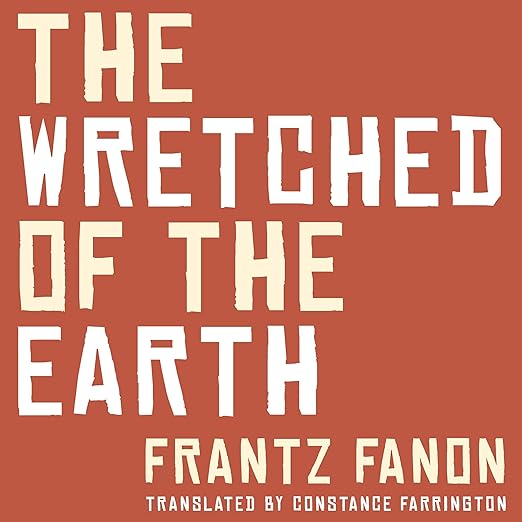
I came to this audiobook with a background in postcolonial literary theory from my graduate years, Fanon had been assigned, excerpted, quoted at length in other texts. But I had never listened to the full text in audio, and Aaron Goodson's narration for Echo Point Books and Media, released in September 2024 using Constance Farrington's definitive English translation, gave me a reason to do so from beginning to end. Sixty-three years after its composition, the book remains one of the most searching analyses of what colonialism actually does to the people it subjugates, not just economically or politically, but psychologically, at the level of identity, selfhood, and the capacity to imagine a future.
Reconstructing Consciousness Before Political Independence
For listeners approaching the text for the first time, some orientation is useful before beginning. Fanon was a Martinican-born psychiatrist working in Algeria during the French colonial period and the Algerian War of Independence. The Wretched of the Earth draws on his clinical work and his political commitments to argue that colonial subjugation is not merely an economic arrangement but a comprehensive assault on the colonized person's sense of self, their relationship to their own culture, and their capacity for political agency. The process of decolonization, he argues, is therefore not simply about transferring political power, it requires a fundamental reconstruction of consciousness that precedes and enables genuine political independence.
These arguments are not linear in the conventional nonfiction sense. Fanon moves between political analysis, clinical observation, sociological theory, and direct polemic in ways that demand active attention. The audio format suits some of this better than might be expected, the rhythmic quality of Fanon's prose, which Jean-Paul Sartre famously prefaced in the original French edition, has an oratorical momentum that comes through well when read aloud by a narrator who understands its structure.
Goodson Refuses to Soften the Hard Passages
Constance Farrington's 1963 translation remains the standard English text, and its relative age means it carries some of the period's rhetorical formality, which Goodson handles with care throughout. He does not try to modulate or soften the more confrontational passages, which is the right instinct, Fanon is making arguments about violence and revolutionary necessity that are meant to be uncomfortable, and a narrator who cushioned those edges would be doing the text a disservice. Goodson respects the argument by delivering it straight.
The production by Echo Point Books and Media, with audio engineering by Mike Thal, is clean and professional. At 9 hours and 20 minutes, this is not a brief listen, and the theoretical density of the later chapters, particularly those dealing with the pitfalls of national consciousness and the psychology of the colonized intellectual class, requires more active engagement than the more narrative-driven early sections. Listeners who approach it in longer, focused sessions will get substantially more from it than those who listen in fragmented increments.
Alongside Said and Malcolm X's Autobiography
The Wretched of the Earth's influence extends far beyond academic political theory. Its role in inspiring movements from decolonization struggles across the Global South to the American civil rights movement to contemporary political frameworks speaks to the durability of its core insights. Placing it alongside Edward Said's Orientalism and The Autobiography of Malcolm X, as the publisher's description does, is not an exaggeration of its significance, these three texts form a cluster of twentieth-century political thought that reshaped how entire generations understood the relationship between race, power, culture, and identity.
Listeners encountering Fanon for the first time may find the experience disorienting in productive ways. His analytical categories do not always map cleanly onto contemporary frameworks, and his positions on violence and revolutionary necessity remain genuinely contested rather than easy to categorize or dismiss. That is a feature of serious political philosophy rather than a flaw, and it is part of why the text remains vital rather than merely historical.
Clinical Chapters Ground the Argument in Suffering
It is also worth noting that Fanon's text is not only political philosophy in the abstract. The clinical chapters, in which he draws on his psychiatric practice in Algeria to describe the specific psychological damage done to colonized people and to colonial soldiers alike, are among the most disturbing and most original passages in the book. They are also among the most important, because they ground the political argument in observable human suffering rather than purely theoretical claims. Goodson handles these chapters with the same measured authority he brings to the rest of the text, neither flinching from their content nor dramatizing their difficulty.
This is not background listening by any honest measure. The Wretched of the Earth rewards concentration and benefits from occasional pauses to absorb what Fanon has argued before moving forward. Listeners with prior background in postcolonial theory, political philosophy, or twentieth-century African and Caribbean history will find it more immediately accessible, though Goodson's steady narration reduces the barrier for newcomers significantly. If you have been meaning to engage with this text for years and have repeatedly put it off, this free audiobook production at $0.00 on Audible is the practical occasion to finally do so.
Frequently Asked Questions
Is this audiobook appropriate for listeners with no prior background in postcolonial theory?
It is accessible but demanding. Fanon's prose has an oratorical power that helps in audio format, and Goodson's narration does not assume specialist knowledge. That said, listeners with some context for the Algerian War of Independence or twentieth-century decolonization movements will find the arguments considerably easier to follow from the start.
Is this The Wretched of the Earth audiobook available for free on Audible?
Yes, this Echo Point Books and Media production from September 2024 is currently available at $0.00 on Audible as a free audiobook. Confirm current pricing and availability on the Audible listing before downloading.