Black Blizzards That Turned Noon to Midnight
Timothy Egan does something in The Worst Hard Time that is genuinely difficult in historical nonfiction: he makes environmental catastrophe personal without losing the scale that makes it catastrophic. The narrative device is deceptively straightforward, follow a dozen families through the rise and fall of the Texas and Oklahoma Panhandle, document their choices and their suffering with the specificity of a novelist while maintaining the evidential standards of a journalist, but the execution requires a quality of attention and empathy that explains why this book won the National Book Award and why, listening to Jacob York's narration across nearly thirteen hours, you feel the weight of each individual life without ever losing sight of the larger disaster. This audiobook is one of the best arguments for long-form narrative nonfiction in the audio format.
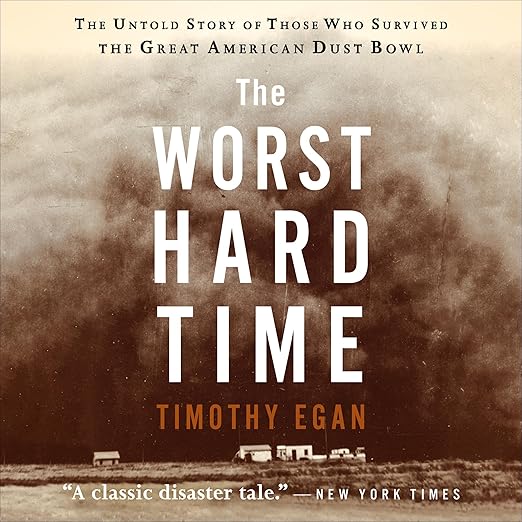
The dust storms themselves are described with an almost meteorological precision that Egan earned through research but renders with the sensory vividness of lived experience. The black blizzards that rolled across the High Plains in the 1930s, turning noon to midnight in minutes, burying fence posts, killing livestock, and filling human lungs with fine particulate matter, are not abstractions in Egan's telling. They are events that specific people survived or did not survive, and the families he follows, the Osteen family, the Lucas family, the Haas family, among others, become so fully realized as human presences that their encounters with the storms carry genuine dramatic weight.
Government Land Policies Behind a Man-Made Catastrophe
Jacob York's narration is exemplary in the way that serious nonfiction narration needs to be: committed, clear, emotionally present without being emotionally manipulative. He reads Egan's prose with the respect it deserves, which means giving weight to the documentary details as well as the human passages. The dust bowl's technical causes, the overplowing of native grassland that removed the only root system holding the High Plains topsoil in place, receive the same attention as the most devastating personal narratives. That balance is what the material requires and York sustains it across thirteen hours.
Egan's environmental argument is not implicit; it is the spine of the book. The Dust Bowl was not a natural disaster. It was a man-made catastrophe produced by a specific set of government land policies, economic incentives, and agricultural practices that removed a short-grass prairie ecosystem that had been stable for thousands of years and replaced it with wheat monoculture that could not survive drought. The families who stayed through the dust years, the Exodusters having already left, did so with a combination of stubbornness, poverty, and attachment to land that Egan renders with full sympathy rather than retrospective judgment.
The Joads Left, These Families Stayed
The audiobook format suits this particular story because the families Egan follows are best understood through the accumulation of detail over time rather than through any single dramatic event. The thirteen-hour runtime allows Egan's patient portrait of each family to develop across seasons and years, and York's narration gives the time passage a weight that a shorter, faster reading would dissipate. You spend enough time with these families that when the worst storms arrive, you are genuinely afraid for people you have come to know.
The historical moment has obvious contemporary resonance, which multiple reviewers have noted and which Egan himself acknowledges in the book's framing. Soil degradation, drought cycles, the political difficulty of addressing long-term environmental consequences within short electoral cycles, the particular suffering visited upon communities that were induced by government policy to settle land unsuitable for the agriculture that policy promoted: none of these problems have been solved. The Worst Hard Time is not a book about the past. It is a book about what happens when economic development outpaces environmental understanding, and it is set in the 1930s.
York's handling of the dialect and regional voice of the High Plains characters is careful and respectful. He does not exaggerate or caricature the speech patterns of Egan's sources and subjects, which is important for a book that is fundamentally about treating these communities with seriousness rather than regional condescension. The narration feels like journalism at its best: attentive to the people, not performing them.
For listeners who read John Steinbeck's The Grapes of Wrath, Egan's book provides the documentary foundation that Steinbeck's novel fictionally rendered. The Joads were Exodusters; the families in The Worst Hard Time were the ones who stayed, and their story is in some ways more difficult to comprehend. Understanding what kept them there, in the face of conditions that Egan documents with unflinching specificity, is one of the most absorbing questions the book pursues.
A Recovery That Was Real, Partial, and Slow
The book covers a large cast of families across a large geographic area over a period of roughly two decades, and keeping track of each family's specific situation across the thirteen-hour runtime requires a degree of active listening that the format demands. York does everything a narrator can do to keep the families distinct, but the material itself is dense with people, places, and events, and listeners who are easily confused by multiple narrative threads may need to take notes or listen in more concentrated sessions.
Egan's environmental argument is compelling and well-evidenced, but it is an argument, not a neutral account. His framing of the Dust Bowl as a preventable policy-driven disaster is the mainstream historical view, but it carries specific implications for how the book presents the government programs and the agricultural community's agency within the crisis. Readers who want a purely descriptive account without an environmental argument embedded in the narrative will find the book does not deliver that.
The final sections of the book, which describe the New Deal programs that eventually stabilized the High Plains and began the process of grassland restoration, arrive after so much documented suffering that the policy redemption they represent can feel almost insufficient. This is the correct emotional response to the material, but it means the audiobook does not end on an uplifting note proportional to the suffering documented. The recovery was real, partial, and slow, and Egan's accounting is honest about all three qualities.
York's Narration Elevates Already Excellent Material
Anyone interested in the intersection of American history, environmental policy, and human endurance will find this among the finest audiobooks in those combined categories. The National Book Award designation is entirely merited, and York's narration elevates already excellent source material into a listening experience that ranks among the best long-form nonfiction in the format.
Listeners who read or heard John Steinbeck's Grapes of Wrath and want the documentary companion to that fictional account will find Egan's book essential. The two works are complementary in the deepest sense, covering the same historical period from different angles, and having both in your listening history gives the 1930s High Plains crisis a completeness that either work alone cannot provide.
Climate-conscious listeners who want historical precedent for contemporary environmental debates will find The Worst Hard Time a rigorous case study in how policy-driven environmental destruction operates, and how long the consequences last. The book is not a polemic, but its conclusions are clear, and they are supported by thirteen hours of evidence that you will find difficult to dismiss.