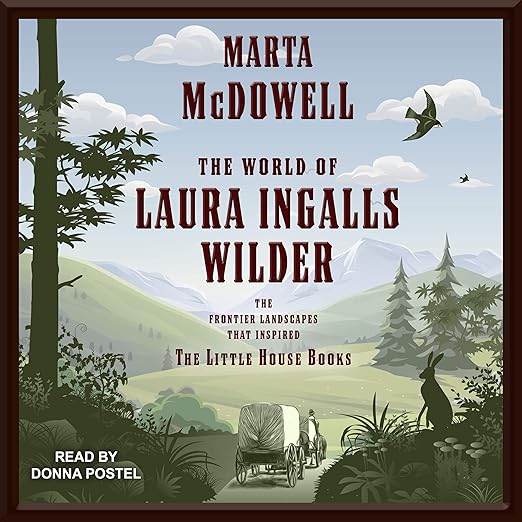
I grew up with Laura Ingalls Wilder the way a lot of readers did, breathlessly, chapters by flashlight, convinced I could have survived a Dakota blizzard if given the chance. So when I picked up Marta McDowell's The World of Laura Ingalls Wilder on a quiet Saturday afternoon, I wasn't expecting much beyond pleasant nostalgia. What I got instead was something closer to scholarship wearing a gardening apron, specific, surprising, and genuinely illuminating in ways that made me want to pull my old dog-eared copies off the shelf and read them again with entirely new eyes.
The audiobook clocks in at just over six hours, narrated by Donna Postel for Tantor Media. It's a comfortable, unhurried listen, precisely the right length for a book that asks you to slow down and pay attention to the plants underfoot rather than the plot ahead.
Mapping Wilder's Wagon Trail Through Wild Plants
McDowell's approach here is genuinely original. Rather than another biography tracing Wilder's personal history or another critical study of her contested relationship with her daughter Rose Lane Wilder, this book anchors itself in the natural world that shaped her writing. The author follows the wagon trail of the Little House series across the Northeast and Midwest, mapping the Ingalls and Wilder homestead claims against archival documents and then cataloguing the plants, crops, trees, and landscapes that populate the books.
What makes this work is that McDowell never loses sight of Wilder as a writer. The botanical observations don't sit separately from the literary analysis, they illuminate each other. When she points out which vegetables appeared in a particular scene, or traces the significance of wild plums to Wilder's sense of place, the effect is to make the books feel richer and more rooted in lived experience than ever. One reviewer here put it well: this reads like a love letter to the different species of flora and trees featured across Wilder's writings, with particular attention to the often-overlooked Almanzo Wilder's farming knowledge and skill. That attention to the partner figure is a smart editorial choice.
Postel's Measured Reading of Wilder's Own Letters
Donna Postel's narration is the right fit for this material. She doesn't perform the text so much as present it, with a measured pace and clear enunciation that suits a book dense with plant names, historical context, and archival excerpts from Wilder's own letters and diaries. Those diary and letter excerpts are among the audio's strongest moments, Wilder's voice, as filtered through Postel's reading, has a dry precision that makes her feel like a real person rather than a literary monument.
For a book rooted in a physical object that one reviewer called "gorgeous" and "over the top in excellence," the audio format does require some adaptation. The archival maps and botanical illustrations that anchor the print experience are obviously absent here. Listeners willing to supplement with a copy of the book, as at least one reviewer did, purchasing the hardcover after finishing the Kindle version, will get the richest experience. But the audio stands solidly on its own for anyone primarily interested in Wilder's words and McDowell's analysis rather than the visual components.
Half Narrative, Half Appendices and Gardening Guides
One reviewer flagged something worth noting: the text itself covers roughly half the book, with the remainder devoted to indices, appendices, and gardening guides. In audio form, some of that supplementary material translates awkwardly. Listeners expecting wall-to-wall narrative will hit a stretch of reference content that functions better on the page. That's a format limitation rather than a flaw in McDowell's writing, but it's worth setting expectations accordingly.
The author also intersperses her own recollections and memories throughout. One reviewer found this element uneven, noting there's no clear thematic logic to when McDowell inserts herself versus when she steps back. I'd agree that a tighter editorial hand might have clarified the book's point of view, it occasionally reads as if it can't quite decide whether it's a scholarly companion, a memoir, or a gardening guide. In practice it's all three, and most listeners will find the slippage charming rather than disorienting. But those seeking a focused critical study should know the book ranges widely.
Rewards Longtime Readers of the Little House Books
If you read the Little House books as a child and have carried them with you into adulthood, this is exactly the kind of companion that rewards that long affection. It's also genuinely useful for anyone interested in American natural history, pioneer-era botany, or the relationship between landscape and literary imagination. Listeners who come with no background in Wilder's work will find it harder going, the book assumes familiarity with the series and builds on it rather than introducing it. And anyone who has visited the Ingalls and Wilder homesites, or who dreams of doing so, will find McDowell's archival maps and geographical specificity deeply satisfying even in audio form. Skip it if you want plot-driven biography or a straightforward account of Wilder's life, this is slower, more lateral work than that, and it's better for it.