Quick Take
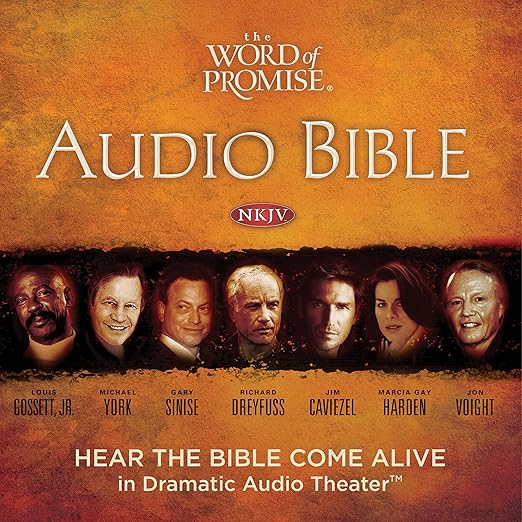
- Narration: A cast of over 500 actors anchored by Jim Caviezel as Jesus, Richard Dreyfuss as Moses, and Gary Sinise as David, with Michael York as primary narrator; the ensemble elevates the NKJV text into something genuinely theatrical.
- Themes: Scripture as lived drama, faith encounter through performance, the Bible as communal storytelling
- Mood: Reverent and immersive, with full cinematic production that places the listener inside the text rather than beside it
- Verdict: For Christian listeners who have struggled to engage with the Bible as continuous reading, this audio dramatization is a transformative alternative to approaching the text alone on the page.
Ninety-eight hours. That number needs to be present at the start of any honest assessment of The Word of Promise Audio Bible, because it is the defining fact of the listening experience. This is not background audio, not a commute companion, not something you can sample and evaluate in an afternoon. It is a complete Bible in dramatic audio theater form, and the commitment it asks for is proportional to the ambition it represents. I spent several Sundays with it over the course of a month, which is how one reviewer described using it, and that pace felt right.
The production context matters here: composer Stefano Mainetti’s original score, feature-film quality sound design, and a cast assembled with the kind of institutional seriousness you expect from a major theatrical production. Jim Caviezel plays Jesus. Richard Dreyfuss is Moses. Gary Sinise is David. Jason Alexander is Joseph. Marisa Tomei is Mary Magdalene. Stacy Keach is Paul. Malcolm McDowell is Solomon. Max von Sydow is Noah. Jon Voight is Abraham. Michael York serves as the primary narrator across the full text. This is not a perfunctory celebrity assembly; the casting has a logic to it, and the performances, at their best, reflect choices that illuminate the character of each biblical figure with real specificity.
What Dramatization Does for the Text
One longtime Christian listener described this production as a game changer after years of struggling to read the Bible straight through. The specific reason she gave is instructive: the changing voices make speaker transitions immediately audible, and emotional states that can feel ambiguous in print become legible through performance. That is exactly what skilled audio theater does for text-dependent material: it makes visible what the prose keeps implicit. Dialogue that has been read so many times it has become liturgically flattened regains its specific human urgency when delivered by a cast member who has made choices about what the character feels in that moment.
The New King James Version is the translation used throughout, which is a significant choice. The NKJV maintains much of the cadence of the KJV while modernizing syntax enough to aid comprehension. For listeners accustomed to more contemporary translations, the slight formality of the language is present, but the dramatic production largely absorbs it. The sound design and score do more work per verse than any annotation could, making the emotional contour of a given passage audible even when the language itself is unfamiliar.
The Ensemble and Its Standouts
Among the key castings, Gary Sinise as David is particularly well-chosen. David is a character who encompasses extraordinary emotional range across the Psalms and the historical books, from ecstatic praise to murderous jealousy to grief-stricken repentance, and Sinise brings each register with specificity. Jim Caviezel’s Jesus carries the cultural weight of his prior performance in The Passion of the Christ while navigating a wider tonal range across the Gospels. The result is not without its strangeness, listeners already familiar with Caviezel will arrive with associations, but the performance is committed throughout and does not rest on the prior association.
Michael York as narrator provides the through-line that holds the production together across 98 hours. His voice has the quality of someone reading with deep familiarity rather than performing for the first time, which is the right affect for the function he serves. He does not compete with the dramatic scenes; he contextualizes them. The balance between York’s measured narration and the full ensemble scenes is one of the production’s more skillful editorial achievements.
The Book of Job, which presents particular challenges for any dramatization given its frame-narrative structure and extended poetic debate, is handled with care that reflects the production team’s attention to the specific demands of each biblical book. The suffering and the interrogation of divine justice in Job are genuinely difficult to render without either sentimentalizing the pain or reducing the philosophical argument to background noise, and the casting choices in that section suggest someone gave it more thought than the obvious names alone would demand.
How to Actually Listen to 98 Hours
The production divides naturally along biblical book boundaries, which makes it possible to listen in sustained thematic sections rather than chronologically if you prefer. Several listeners described Sunday morning as their primary listening context, which creates a ritual structure that suits the material. The reviewer who described putting in headphones on Sunday mornings and working through an hour or two is describing the most sustainable engagement pattern for something of this length. What you cannot do, practically, is treat this as continuous background. The sound design is immersive enough that half-attention means missing significant passages, and the dramatic performances reward engaged listening rather than peripheral absorption.
Who This Is For and Who Should Consider a Different Format
For Christian listeners who have never successfully read the Bible cover to cover, this is a genuinely different approach that removes the reading barrier while keeping the complete text intact. For those who already engage deeply with scripture through study and annotation, this is a complement rather than a replacement. Non-religious listeners interested in the cultural text will find the dramatization more accessible than raw prose but should know that the production’s reverent frame does not step back for critical distance. This is made for believers and participates in that posture throughout the 98 hours, which is a feature for its intended audience and worth noting for others.
The production is divided into the Old and New Testaments with individual book boundaries clearly marked, which means navigating is considerably easier than the 98-hour total suggests. Someone who wants to listen specifically to the Psalms, or specifically to the Gospel of John, can locate those sections without working through the full sequence. That flexibility matters for listeners whose primary use case is devotional engagement with specific texts rather than sequential completion of the entire Bible.
Frequently Asked Questions
Is the Word of Promise Audio Bible available as a free audiobook through Audible’s membership, or does it require a credit purchase?
The listing shows $0.00 for Audible members, meaning it is included in the Audible Plus catalog and accessible as a free audiobook for subscribers without spending a credit. This is notable given the scale of the production.
How do the celebrity castings affect listeners who associate certain actors with other prominent roles?
Jim Caviezel in particular carries strong associations from The Passion of the Christ, and that background both adds weight and creates expectations. Most listeners find the association enhancing rather than distracting, though it is worth noting for those sensitive to that kind of cross-referencing.
Is the New King James Version text faithful to the original NKJV translation, or are there dramatization-driven modifications?
The production presents itself as a faithful rendering of the NKJV text with dramatic enhancement through performance, sound design, and score. The translation itself is not modified for theatrical effect.
Is there a practical way to listen to 98 hours of audio without it becoming overwhelming?
Several listeners recommend treating it as a sustained practice with consistent time blocks, one or two hours per session, rather than marathon listening. The production divides naturally along book boundaries, making it possible to approach by biblical book rather than chronologically straight through.