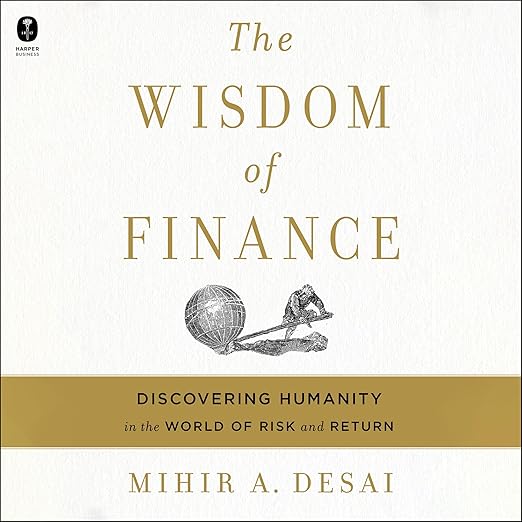
Quick Take
- Narration: Mihir Desai reads his own book with the cadence of a lecture delivered to a room of genuinely engaged students, warm, precise, and unhurried in a way that makes the material land rather than blur.
- Themes: Finance and the humanities, risk management and human choice, the ethics of capitalism
- Mood: Intellectually expansive and genuinely surprising, the kind of book that makes you want to read three other books
- Verdict: A rare work of financial nonfiction that earns its literary references rather than simply deploying them as decoration.
I have a particular wariness about books that promise to explain finance through the humanities. The genre has produced some genuinely illuminating works and a great deal of earnest but shallow analogizing, someone compares compound interest to a metaphor from Dante and expects the reader to feel enlightened. So when I sat down with Mihir Desai’s The Wisdom of Finance on a rainy Tuesday afternoon, I was cautious. I had about three hours of administrative work I needed to do, the kind that does not require active thought, and I put it on as background. By the end of the first chapter, I had stopped working entirely and was just listening.
Desai is a Harvard Business School professor, and this book originated as a graduation lecture to the MBA class of 2015, what he describes as his last lecture, a kind of intellectual farewell gift to students about to enter a profession that the 2008 financial crisis had left ethically bruised and publicly distrusted. That context matters. The book is not a detached academic exercise. It is Desai trying to remember, and help others remember, why finance was ever interesting or worth caring about in the first place. The framing question he takes from Josef de la Vega’s 1688 description of finance as both the fairest and most deceitful business in the world is not rhetorical, it drives every chapter that follows.
When Jane Austen Becomes a Risk Management Textbook
The method Desai uses is to take specific technical concepts from finance, leverage, options pricing, the Capital Asset Pricing Model, bankruptcy, and find their structural equivalents in literature, film, and philosophy. Jane Austen and Anthony Trollope become guides to risk management. Mel Brooks’s The Producers offers a lesson in fiduciary responsibility. Jeff Koons appears as an unexpected advocate for leverage. These are not superficial comparisons. Desai works through the mechanics carefully enough that by the end of each chapter, you understand both the financial concept and its human analogue more clearly than you did before. One reviewer who read the book twice still felt they could benefit from a book club discussion to fully absorb the implications, that is not a criticism but an accurate description of a book that gives you more than one pass can capture.
The most interesting move Desai makes is to run the parallels in both directions. He does not just use literature to explain finance, he uses the principles of finance to illuminate life choices. Bankruptcy, he argues, teaches us how to respond to failure. The logic of mergers applies to marriages. The Capital Asset Pricing Model demonstrates the true value of relationships. This bidirectional movement is what separates the book from lesser attempts at the same project.
The Author Reading His Own Work
Desai narrates the audiobook himself, and this turns out to be a significant advantage. He writes with the rhythm of someone who has given this lecture many times and refined the pauses and emphases through repetition. When he reads the de la Vega passage, he lets the paradox breathe rather than rushing past it. This is a book that lives in its sentences, and Desai clearly knows which ones matter. The result is closer to listening to a gifted teacher than to a standard audiobook narration. The 6.5-hour runtime moves at a pace that feels exactly right, enough time to develop each idea fully, not so much that any chapter outstays its welcome. Nobel Laureate Oliver Hart called it a fascinating new perspective on modern finance, and Sebastian Mallaby described it as lucidly witty and delightfully erudite, which are both accurate assessments.
What This Book Is and Is Not Offering
The Wisdom of Finance was longlisted for the 2017 Financial Times and McKinsey Business Book of the Year and selected as an Amazon Business and Leadership pick in the same year. These accolades reflect genuine achievement, not marketing momentum. But it is worth being clear about what the book does not do: it is not a practical guide to investing or financial planning, and it is not a work of economic theory. It is a work of intellectual synthesis that uses humanistic tradition to recover the moral dimensions of financial practice. Readers who want actionable frameworks will be disappointed. Readers who want to think differently about what finance is for will find this one of the more satisfying books published in that space in the last decade. The 4.4 rating across 718 reviews reflects a genuinely satisfied audience, and the reviews that praise it most enthusiastically are from readers who came with appropriate expectations.
The Longlisted Book and Its Lasting Relevance
The Wisdom of Finance was longlisted for the 2017 Financial Times and McKinsey Business Book of the Year and selected as an Amazon Business and Leadership pick in the same year. These accolades reflect genuine achievement rather than marketing momentum. But it is worth being clear about what the book does not do: it is not a practical guide to investing or financial planning, and it is not a work of economic theory. It is a work of intellectual synthesis that uses humanistic tradition to recover the moral dimensions of financial practice. Readers who want actionable investment frameworks will be disappointed. Readers who want to think differently about what finance is for and what it might mean to do it well will find this among the more satisfying books published in that space in the last decade. The 4.4 rating across 718 reviews reflects a genuinely satisfied audience, and the reviews that praise it most enthusiastically are from readers who came to it with appropriate expectations and left with their thinking genuinely shifted. One reviewer who described it as reminding him why he had studied finance in the first place was expressing something the book is deliberately designed to produce.
Frequently Asked Questions
Do you need a background in finance to follow The Wisdom of Finance?
No. Desai explicitly designed this book for both insiders and outsiders. Finance professionals will find a fresh frame for concepts they already know, while general readers will find the concepts introduced clearly through literary and cultural analogies before any technical language appears. The approach is additive rather than assuming prior knowledge.
Is this a free audiobook narrated by someone other than the author?
Mihir Desai narrates this recording himself, which works strongly in the audiobook’s favor. His academic lecture cadence translates well to audio. Yes, this is currently listed as a free audiobook on Audible at $0.00, check the current listing to confirm pricing before accessing.
How does this compare to other finance books that use narrative approaches, like those by Michael Lewis?
Michael Lewis typically narrates specific financial events through character-driven storytelling. Desai is doing something more structural, using literary concepts to reveal the underlying logic of financial instruments. It is less a financial thriller and more a work of intellectual synthesis. Readers who enjoy Lewis may find Desai slower but ultimately more philosophically rewarding.
The book was published in 2017, does it feel dated given how much has changed in finance since then?
The specific financial concepts Desai examines are foundational rather than topical, so the core arguments have not aged. The book’s discussion of trust, fiduciary responsibility, and the ethics of leverage if anything feels more relevant given subsequent years of market volatility and financial controversy. The literary and philosophical references are timeless by definition.