Quick Take
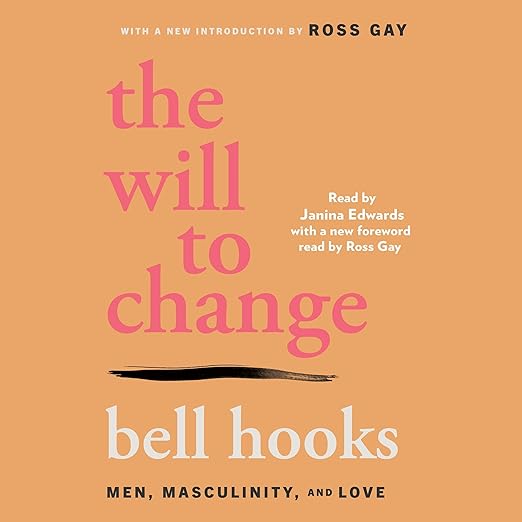
- Narration: Janina Edwards delivers a composed, respectful reading that serves the text’s intellectual seriousness without overwhelming it.
- Themes: Patriarchy as harm to men, emotional suppression and healing, love as political and personal practice
- Mood: Challenging and compassionate, dense with ideas but not cold
- Verdict: Bell hooks’s most underrated book speaks directly to men who have been told that feeling is weakness, and it does so with more precision than most books on masculinity dare to attempt.
I picked up The Will to Change during a long weekend when I had been reading almost exclusively in the social sciences and needed something that combined rigor with genuine empathy. Bell hooks delivers exactly that combination, and the experience of listening to Janina Edwards read it gave me space to sit with ideas that would have felt more confrontational on the page, encountered cold and alone.
The premise is deceptively simple: patriarchy hurts men, not just women. But hooks does not use this observation as a rhetorical cudgel or a way to redirect feminist discourse onto safer terrain. She uses it as a precise diagnostic lens for understanding why so many men resist love, intimacy, and self-knowledge, and why those resistances are not personal failures but predictable products of a system that punishes men for emotional openness from the earliest age. The argument is careful, the evidence is drawn from observation and cultural analysis, and hooks is honest about the limits of her own certainty.
Our Take on The Will to Change
What makes this book unusual in the crowded landscape of writing about masculinity is hooks’s refusal to treat men as simply the authors of patriarchal harm. One reviewer put it plainly: this book includes the important recognition and explanation of men’s experiences as survivors of the patriarchy. That framing does not absolve men of accountability for the harm the system enables through them, but it creates genuine space for men to engage with the critique rather than simply defend against it. This is rarer in feminist writing than it should be, and it is why the book finds male readers who feel seen rather than accused. Another reviewer described it as having given them a second life in their journey to healing, which sounds hyperbolic until you consider what it means to finally encounter language for something lived but never named.
Why Listen to The Will to Change
The audio format suits this material particularly well. Janina Edwards’s reading is steady and thoughtful, giving each section of hooks’s argument room to breathe and settle. At just over six hours, the book does not overstay its welcome. It moves through hooks’s central arguments in discrete, digestible chapters: the cultural performance of masculinity from boyhood, the suppression of grief and vulnerability, the relationship between power and love, the possibility of something different. One reviewer described the book as FANTASTIC and challenging at times, and both assessments are accurate. The challenge is productive rather than alienating, which is a genuine achievement in a text that asks readers to question assumptions that feel like facts.
What to Watch For in The Will to Change
Readers expecting a sociology textbook will find hooks’s approach more essayistic and intuitive than rigorously empirical. She draws heavily on personal observation, cultural analysis, and a feminist theoretical tradition that not all listeners will share or find immediately legible. Some of the arguments benefit from being lingered over rather than consumed at commuting speed. The book is also written from a position that assumes patriarchy is real and harmful, which is not a contested premise for most of hooks’s likely readership, but it is worth naming for listeners who come skeptical. If you engage on those terms, the ideas are demanding and rewarding in roughly equal measure.
Who Should Listen to The Will to Change
Men who have begun questioning the emotional norms of their upbringing will find the most direct value here, but the book also genuinely rewards women and nonbinary listeners who want to understand how patriarchy shapes the interior lives of men they love or work alongside. It works best for listeners who are already somewhat open to feminist frameworks, not because it preaches to the converted, but because some of the theoretical vocabulary becomes more accessible with prior exposure. If you have never read bell hooks before, this is a strong entry point, though All About Love is an even gentler introduction to her voice and concerns.
Frequently Asked Questions
Is The Will to Change primarily aimed at male listeners?
Hooks addresses men directly and frequently throughout, but multiple reviewers from varied backgrounds describe finding it meaningful. The argument that patriarchy harms men in specific and documentable ways is relevant to anyone trying to understand gendered behavior, not only to men examining their own conditioning.
Does Janina Edwards’s narration change the experience compared to reading the print version?
The narration is measured and clear, which works well for a text built around carefully constructed arguments. Edwards presents the emotional stakes steadily rather than performing them. Some listeners may want a more expressive delivery, but the restraint feels appropriate for hooks’s analytical register.
Is this book more theoretical or more practical in its approach?
More theoretical than a self-help book, but hooks consistently grounds her ideas in recognizable human behavior and cultural examples. The goal is understanding rather than a step-by-step program, which means the transformation it invites is conceptual first. Practical changes in behavior tend to follow from that kind of internal shift.
How does this compare to other popular books on masculinity?
Hooks approaches the subject from a feminist political theory tradition, which gives her analysis more structural depth than most popular books on masculinity. She is less interested in self-improvement hacks and more interested in naming the social forces that make those hacks feel necessary in the first place.