- Voice: Gregory Boyle reading his own work is the only right choice; his pauses and soft laughter carry decades of earned feeling.
- Big ideas: Tenderness as theology, kinship across social divides, redemption without transaction
- Atmosphere: Quiet and luminous, occasionally devastating
- Worth it?: One of the rare audiobooks where the act of listening feels like a form of spiritual practice in itself.
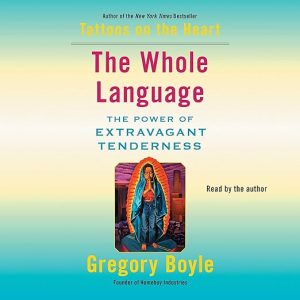
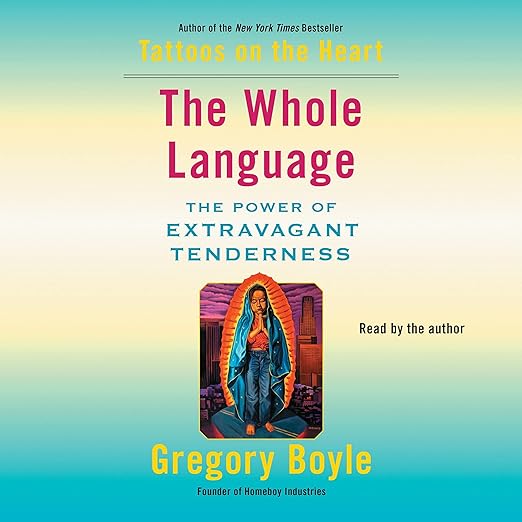
I came to The Whole Language having read Tattoos on the Heart years ago, a book I keep on the shelf that I return to in the way one returns to certain poems. I started this one on a Sunday evening with no particular agenda, and I want to say upfront that by the second hour I was no longer listening as a critic. I was listening as a person who needed what Gregory Boyle was offering, which I think is the response he aims for and consistently achieves.
The Whole Language is the third book from Boyle following Tattoos on the Heart and Barking to the Choir, and it continues his practice of weaving together stories from Homeboy Industries, the Los Angeles gang intervention program he founded over thirty years ago, with reflections on what those stories reveal about the nature of God, belonging, and human dignity. The book was written during the early months of COVID-19, and the context sharpens the sense of urgency behind Boyle's argument for tenderness as a sustaining practice rather than a luxury.
The two extended stories that anchor the book are representative of Boyle at his best. Saul, who killed his abusive stepfather in self-defense at thirteen and spent twenty-three years in juvenile and adult custody, comes to Homeboy and declares: I've decided to grow up to be somebody I always needed as a child. That sentence alone stopped me cold the first time I heard it. Boyle delivers it without emphasis, almost quietly, which is exactly right. The weight comes from the words, not from any added theatrical drama.
The second story involves Abel, who was shot thirty-three times and spent six months in a coma, and who now gives tours at Homeboy. When a new trainee joins him and Abel recognizes the person who put him in a coma, the exchange between them, brief and devastating, captures everything Boyle is arguing for. You give good tours, the trainee tells him. Both are on a path to wholeness. The book earns moments like this because it has spent enough time in the difficulty of the world to make the tenderness feel like something fought for rather than assumed.
Why Listen to The Whole Language
Gregory Boyle reads his own work, and I cannot imagine how this audiobook would function otherwise. His voice is not a performance instrument in any technical sense. He is not a trained narrator. What he has instead is the accumulated weight of thirty years of presence with people in profound suffering, and that weight is audible in every sentence. There are places where he pauses, where his voice catches almost imperceptibly, and those moments are worth more than any studio polish.
One reviewer who attended the book launch at Homeboy itself describes hearing Boyle read a selection and knowing immediately they were in for a treat. The ten hours unfold at a measured pace. Boyle is not a propulsive storyteller. He circles ideas, lets stories breathe, returns to themes from unexpected angles. Listeners who come in looking for a conventionally structured argument may find the rhythm unfamiliar. This is not that kind of book. It is closer to sitting with someone who has thought very carefully about very difficult things and is now, slowly, sharing what they found.
What to Watch For in The Whole Language
The Whole Language sits at the intersection of spiritual memoir, urban reportage, and pastoral theology. If you have followed Boyle's work through his previous books, this is a necessary continuation and, for some readers, the most fully realized of the three. One listener who has read all four of his books describes each one as confounding, challenging, and inspiring in equal measure, and says they believe they are better for having made the journey.
If you come from outside the Catholic or broadly religious tradition, the spiritual framework here is present and central rather than incidental. Boyle's theology is not doctrinaire, and the book is not evangelical in its posture. But it is rooted in a specific understanding of God's relationship to human dignity that shapes every argument. Secular readers open to engaging that framework on its own terms will find much of value. Those who cannot will encounter friction that Boyle, characteristically, would probably welcome as the beginning of a conversation rather than an obstacle to be smoothed over.
Who Should Listen to The Whole Language
The book's composition during COVID-19's early months gives it a particular texture. Boyle was writing at a moment when the institutions supporting people at the margins were under extraordinary strain, and when the idea of kinship across social barriers was being tested as severely as it ever has been. The result is not a book that engages directly with the pandemic as a subject, but one that reads as written from inside the knowledge of what happens when systems fail and human community becomes the only remaining resource. That context does not require knowing to appreciate the book, but knowing it adds a layer of meaning to everything Boyle describes as the work of Homeboy Industries during this period.
How does Gregory Boyle's self-narration compare to a professional narrator for an audiobook like this?
Boyle is not a trained narrator, but his reading carries an authenticity that no professional narrator could replicate. The pauses and weight in his voice come from decades of lived experience with the stories he is telling.
Is The Whole Language appropriate for listeners who are not familiar with gang intervention work or Los Angeles?
Yes. Boyle provides enough context that no prior knowledge is required. The stories are grounded in a specific place, but the themes of tenderness, kinship, and human worth are universal in their application.