Quick Take
- Narration: Justin M. Grant reads Ellen Hodgson Brown’s dense monetary history with clarity and appropriate gravity, handling technical terminology without losing the argumentative through-line.
- Themes: Privatization of money creation, monetary reform and public banking, the debt trap as systemic design
- Mood: Urgent and conspiratorial, with a reformist rather than nihilistic edge
- Verdict: A well-researched, passionately argued case for monetary reform that rewards patient listeners willing to sit with uncomfortable claims about how the financial system actually operates.
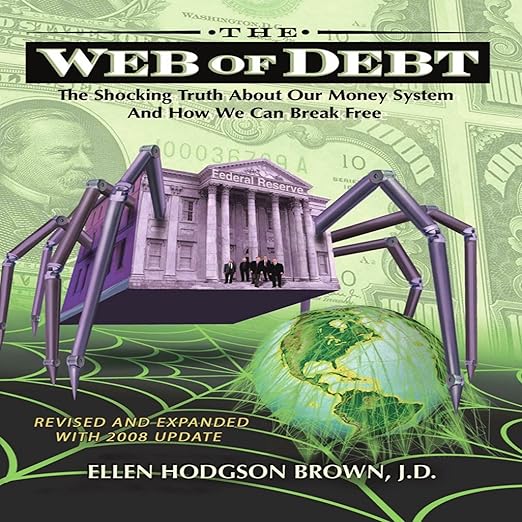
I came back to The Web of Debt on a long train journey, which felt fitting. There is something appropriate about listening to Ellen Hodgson Brown’s argument about the hidden architecture of money while you are sitting in a vehicle moving through a landscape that was built, maintained, and increasingly mortgaged through exactly the mechanisms she describes. I had read chunks of this book years earlier and found it provocative in ways I was not entirely sure how to evaluate. Listening to Justin M. Grant read the full nineteen hours gave me a better sense of Brown’s overall argument and where it succeeds and where it asks more of its audience than the evidence strictly supports.
First published well before the 2008 financial crisis and updated since, the book opens with a claim that most economics education carefully avoids: that money, as we encounter it in daily life, is not a neutral medium of exchange issued by a sovereign government but is instead a form of debt created by private banking institutions when they issue loans. The principal is created; the interest is not. This structural gap requires constant expansion of the money supply to service existing debt, which means inflation is not an accident or a failure of policy but a feature of the system as designed.
The Wizard of Oz as Monetary Allegory
Brown’s most striking interpretive move is reading L. Frank Baum’s The Wizard of Oz as a monetary allegory for the debates of the 1890s Populist movement, specifically the fight between gold standard advocates and proponents of silver coinage. The yellow brick road is gold, Dorothy’s slippers are silver (they became ruby in the film), and the Wizard is the private banking establishment. This reading has been proposed before by monetary historians, and Brown uses it as both a pedagogical device and a way of demonstrating that debates about money creation have deep roots in American political culture. It is an effective organizing metaphor that makes a genuinely complex subject accessible without oversimplifying it.
One reviewer with economics training described the book as an eye-opener to the financial weapons of mass destruction used by speculators and large transnational organizations to ruin entire nations, and the book does provide substantial historical evidence for that pattern. Brown draws on cases from colonial America, where several colonies successfully issued their own debt-free currency, through the battles over the Federal Reserve’s creation in 1913, to more recent debt crises in developing nations. The historical sections are the strongest in the book, grounded in specific episodes and documents that reward follow-up reading.
Where the Argument Strains
Brown is a lawyer by training, not an economist, and that shows in both the strengths and weaknesses of her case. She assembles evidence with the tenacity of someone building a legal argument, which means the book is more cumulative than analytical. Critics of monetary reform positions like hers have pointed out that the relationship between money creation, debt, and inflation is more complicated than the model she presents, and that sovereign public banking alternatives have their own documented failure modes. Brown acknowledges some of these objections but does not always engage them with the depth that a purely academic treatment would require. For listeners coming from a mainstream economics background, there will be moments where the argument requires a leap of interpretive faith that the evidence does not fully support.
That said, the questions she raises are genuine. The concentration of money creation in private institutions, the structural incentive to keep borrowers in perpetual debt, and the historical precedents for public alternatives to private banking are all areas that mainstream economic discourse often glosses over. Several of the book’s reviewers described it as changing their fundamental understanding of how the system works, and that response suggests Brown is reaching an audience that mainstream financial writing was not serving.
Nineteen Hours with Justin M. Grant
At nearly nineteen hours, The Web of Debt is a serious commitment. Justin M. Grant’s narration is workmanlike rather than inspired, but that suits the material. His delivery keeps pace with the argument without editorializing, which matters for a book whose claims are sufficiently heterodox that an overly enthusiastic read would undermine credibility. The technical terminology around monetary policy and banking is handled clearly, and the historical passages have enough variation in register to hold attention through what might otherwise be dense stretches.
It is also worth noting that Brown’s book belongs to a tradition of American monetary heterodoxy that stretches back through populist economics to the founding debates about banking. Reading it in that context places the argument differently than treating it as an isolated conspiracy theory. Whether or not you accept Brown’s conclusions, the historical account she builds of how debates about money creation have shaped American political life is genuinely illuminating and draws on primary sources that mainstream financial histories often leave in the footnotes. Grant’s narration handles the historical sections with particular care, giving the archival material appropriate weight without making it sound like a lecture.
Who Should Invest the Time
This free audiobook is for listeners who want to understand the monetary system critique that underlies a range of political positions from left-wing monetary reform to certain libertarian anti-Fed arguments, and who are willing to engage with a polemical text critically rather than as revealed truth. If you accept the Federal Reserve’s account of its own operations without question, this book will be destabilizing in productive ways. If you are already sympathetic to public banking reform, it will provide historical substance for positions you may hold intuitively. Listeners seeking a balanced, academically credentialed treatment of monetary theory should look elsewhere first, but Brown’s book is a useful addition to any serious reading on the subject.
Frequently Asked Questions
Is The Web of Debt suitable for listeners with no prior background in economics or monetary theory?
Yes, Brown writes accessibly and uses historical narrative and the Wizard of Oz allegory to ground abstract concepts. The argument is dense but not technically inaccessible, and no economics training is required to follow it.
How does Brown’s monetary reform proposal actually work, and does the audiobook explain the alternative clearly?
Brown proposes a return to government-issued, debt-free currency modeled on examples from colonial America and Abraham Lincoln’s greenback policy. She devotes considerable time to explaining the mechanics, drawing on Benjamin Franklin and Thomas Jefferson as historical precedents.
Is the book ideologically positioned, and should listeners with mainstream economics views expect to feel challenged?
Yes, it is explicitly heterodox. Brown argues that the private Federal Reserve system is the root cause of most economic inequality and instability, a claim that sits outside mainstream economics consensus. Listeners from that background should engage it as a provocative argument rather than a neutral analysis.
Does the audiobook come with the PDF mentioned in the Audible listing?
Yes, a companion PDF is available in your Audible library alongside the audio, which may be useful for following some of the more chart-dependent or historically detailed sections.