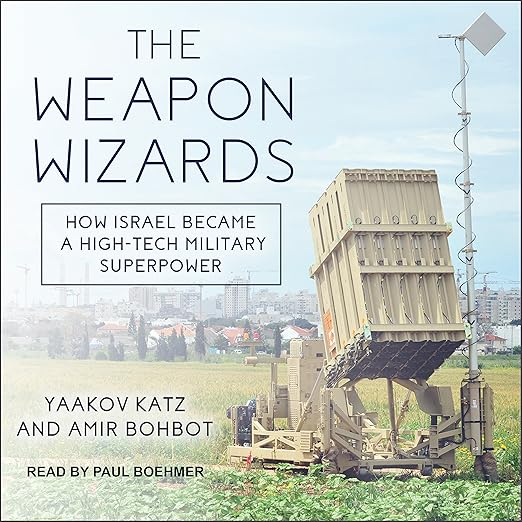
Quick Take
- Narration: Paul Boehmer reads with steady authority; his clear, measured delivery suits the documentary register of the material without adding artificial drama.
- Themes: Military innovation under constraint, the relationship between necessity and invention, Israel’s defense ecosystem
- Mood: Analytically absorbing, part geopolitical case study and part human story of engineers and soldiers
- Verdict: A well-sourced examination of how a small nation built a defense industry that now sets the terms for 21st-century warfare, told with enough human detail to hold non-specialists.
I tend to approach military technology books with a certain wariness. They often default to either hardware fetishism, dwelling on specifications while skipping over the human decisions that shaped them, or they bury the interesting material under geopolitical framework that quickly becomes dated. The Weapon Wizards by Yaakov Katz and Amir Bohbot manages to avoid both traps, at least most of the time, and does so by treating Israeli defense innovation as a story about culture and necessity rather than as a story about machinery.
The central argument of the book is compact and well-supported: Israel’s security situation, sustained conflict since its founding in 1948, combined with arms embargoes and the practical impossibility of fielding a large standing army, forced a particular kind of institutional creativity. The constraint became the engine. What Katz and Bohbot do well is follow that argument not just through policy analysis but through specific human stories: the officer who repurposed a hobbyist radio-controlled airplane with a thirty-five millimeter camera to fly reconnaissance over the Suez Canal, the engineers who rebuilt tank armor after Lebanon and produced Merkava designs that were later studied by armies worldwide.
The Culture of Calculated Risk
The book’s most durable insight, and the one that carries across to readers with no particular interest in military affairs, is its analysis of Israeli defense culture as an incubator model. Small bets are made quickly. Failures are documented and fed back into design cycles with unusual speed because combat feedback is constant rather than theoretical. The bureaucratic runway, to use one reviewer’s phrase, gets cleared faster when the stakes of delay are measured in immediate operational terms rather than procurement schedules.
This rings true whether or not you find the specific military context sympathetic. The same principles that produced the Iron Dome missile defense system, designed and deployed under timeline pressure that American or European defense procurement would have found impossible, show up in the book’s chapters on cybersecurity, on drones, on satellite development. The pattern holds across domains: problem identified under live conditions, small team given unusual authority, prototype tested quickly, refined through use. Readers who work in technology, medicine, or any field where institutional caution tends to slow development will find the case studies worth thinking about regardless of their politics.
Where the Pro-Israel Framing Becomes Visible
One reviewer noted a built-in spin in the book’s framing, and it is worth taking that observation seriously. Katz is editor-in-chief of the Jerusalem Post, and both authors have spent careers embedded in the Israeli defense and security establishment. The book is not propaganda in the crude sense: it presents real material, accurately sourced, and the reviewers who found it credible include readers who came in skeptical. But the civilian cost of weapons tested in live combat situations is not a primary concern of the text, and the political controversies that surround several of the weapons systems described, particularly in their export markets, receive less analytical attention than the innovation stories do.
This is a meaningful limitation. The book tells you a great deal about how Israel built these capabilities and relatively little about the full consequences of deploying them. For a reader approaching it as a case study in innovation and national strategy, that scope is arguably appropriate. For a reader hoping for a complete geopolitical accounting, it will feel selective. Knowing that going in lets you calibrate accordingly.
Paul Boehmer’s Narration and the Nine-Hour Listen
At nine hours and twenty-five minutes, this is a substantial listen, and Boehmer earns his place in it. His narration is documentary in register, clear and paced without being flat. He handles the transliterated Hebrew names and military designation numbers without stumbling, which matters more than you might expect over nine hours. The chapters on cyber warfare and on satellite development are technically dense, and Boehmer’s steady read prevents those sections from becoming fatiguing in the way that an overtly dramatic narrator might by pushing for tension that the material does not require.
The book works best in its middle sections, where the human stories behind specific weapons programs are told in full. The opening and closing chapters, which deal more heavily in strategic analysis and geopolitical argument, are solid but less distinctive. Listeners who find the opening chapter slow should continue: the drone chapter and the chapter on the Iron Dome’s development under rocket fire are among the more gripping technology narratives I have encountered in nonfiction audio.
Who Should Pick This Up and Who Should Pass
Readers interested in the intersection of military history, technology development, and national strategy will get a great deal from this. The sourcing is strong: Katz and Bohbot had access to senior Israeli defense officials and were able to report from inside programs that are usually closed to journalists. That access shows in the specificity of the material.
Readers who want a morally balanced account of Israeli military power will find the book’s framing frustrating. It is not the right book for that purpose, and Katz does not pretend otherwise. Readers who want a broader history of drone warfare or cyber strategy might find the Israel-centric focus limiting, though several of the book’s insights about how Israeli developments became global templates are genuinely useful context for that larger history.
Readers curious about where Israeli military technology has gone since this book was published in 2017 will find the chapters on cyber and drone development particularly durable. The specific programs described have evolved, but the institutional logic Katz documents, small bets, fast feedback from operational use, unusually short procurement timelines, has remained consistent. That consistency is itself an argument for the book’s relevance, and for the model it describes as something other than a product of unique historical accident.
Frequently Asked Questions
Is this book appropriate for readers with no military background?
Yes. Katz and Bohbot deliberately avoid technical jargon and focus on human stories and institutional culture rather than hardware specifications. Multiple reviewers with no military background found it accessible and engaging.
How balanced is the political perspective in The Weapon Wizards?
The book is pro-Israel in framing, as you would expect from two journalists embedded in the Israeli defense establishment. It presents accurate information but does not dwell on the political controversies surrounding Israeli weapons exports or their use in conflict. That limitation is worth knowing before you start.
Does the book cover Israel’s nuclear program?
One reviewer mentions nuclear weapons in passing, and the book does reference Israel’s nuclear posture briefly. However, the main focus is on conventional, drone, satellite, and cyber capabilities where Israel’s development story is more publicly documented.
How does Paul Boehmer handle the technical and foreign-language material in his narration?
Boehmer handles the transliterated Hebrew terms and military designation numbers clearly and without stumbling. His pace is controlled enough that the technically dense sections, particularly on cyber and satellite development, remain followable rather than fatiguing.