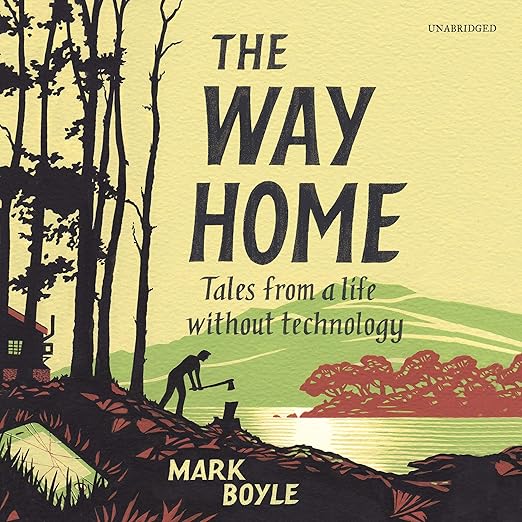
'It was 11:00 pm when I checked my email for the last time and turned off my phone for what I hoped would be forever.' That line opens The Way Home, and Gerard Doyle's audiobook narration picks up from there into a life with no running water, no car, no electricity, built around a wooden cabin on a smallholding by a stand of spruce. Mark Boyle previously wrote The Moneyless Man, and this follow-up finds him going further still, exploring 'the hard-won joys of building a home with his bare hands, learning to make fire, collecting water from the stream, foraging, and fishing,' per the synopsis. The premise is not abstract philosophy; it is a specific, physical inventory of skills relearned from scratch.
Gerard Doyle Narrates a Modern-Day Walden
Right away, the synopsis stakes a bold claim, calling this 'a modern-day Walden,' and reviewers seem to accept the comparison on its own terms rather than pushing back on it. Troy calls it 'easy to follow,' warns that it is not a practical how-to guide, and suggests it reads more like a 'this is why I live this way' manifesto than an instruction manual.
Michelle A's review supplies the most quotable irony among the five reviews here: reading a book about rejecting modern technology 'on my smartphone, using Kindle,' a contradiction the reviewer names directly before still recommending 'this marvelous book' to 'everyone,' as a way 'to broaden one's horizons.' That same review pushes back preemptively on an assumption some listeners might bring in, noting 'you don't have to be a weed smoking hippie to get something from the book,' adding that 'the author himself isn't one either.'
Mark Stumbles Through Words, Flowery Errors
Gerard Doyle narrates a memoir wendy's review describes as conversational rather than polished: 'I felt like I was deep in discussion with him and enjoyed his more casual style of writing.' Kindle Customer's review makes a related, more critical point about that same style, noting that 'Mark stumbles through his words and errors in the side of flowery,' though still calling the material 'thoughtful and concise' overall. A narrator's job with a writer this conversational is less about polish and more about preserving the sense of being talked to directly. wendy's review adds useful context to that impression: 'This is the second book I have purchased written by Mark,' a repeat reader who finished this one in a single sitting, 'unable to put it down,' and was already planning to buy another. Troy's review title captures the same quality from a different angle: 'More like reading a journal or diary than a book.' That diary-like structure maps naturally onto audio, where a first-person, day-by-day account benefits from the intimacy of a single voice reading it aloud rather than the visual distance of a printed page.
Per the synopsis, the book's core argument is that Boyle's radically simplified life reveals 'an elemental life, one governed by the rhythms of the sun and seasons,' set against 'a primal landscape of blood, wood, muck, water, and fire.' Bridgid's review backs up the sincerity of that framing, describing Boyle as a 'reformed environmentalist' who takes 'responsibility for making his own life clean, balanced, content' rather than performing activism from a distance, a distinction the review draws carefully rather than treating the two as interchangeable, which matters for a book this openly opinionated about how a life should be lived. Bridgid's review credits the prose rhythm specifically for a similar effect, noting 'even the pace of his writing made me slow down, breathe,' crediting sentence-level style for a mood shift rather than just the content. The synopsis ends on a broader note of its own, framing the whole project as a way of understanding 'what it means to be human at a time when the boundaries between man and machine are blurring.'
One Vote at 4.4, Reviews Since 2019
A rating counter here shows just one vote at 4.4, a figure no single whole-star rating could ever produce, yet five distinct written reviews sit just beneath it. What sets this case apart from similar mismatches elsewhere is timing: these five reviews span from June 2019, right after release, to April 2022, nearly three years later, which makes a simple explanation like the counter just has not caught up yet less convincing than it would be for a newer title. Something in how this listing tracks ratings over that multi-year stretch has clearly broken down. The listing itself signals how hard this book is to categorize even before the rating: it carries four separate genre tags at once, memoir, personal development, science and engineering, and sports and outdoors, alongside a Professionals & Academics label. That spread is unusual, and it reflects a book that resists a single shelf as much as Boyle's own life resists a single label.
Bridgid's five-star review stops short before finishing, its last line 'I hope he continues' trailing off without an object to complete the sentence. Separately, wendy's review contains what reads like a dropped word, 'I did think so at all' almost certainly means the opposite of what it says, a small reminder that this dataset preserves reviews exactly as submitted, typos included.
Resonate More With Like Minded Folks
This suits listeners drawn to memoir-as-manifesto: readers of Walden-style back-to-the-land narratives, off-grid living, or radical simplicity who want the reasoning behind a lifestyle rather than a step-by-step guide to copying it. Troy's review is the clearest signal here, predicting the book will 'resonate more with like minded folks than the general public,' which is an honest, useful expectation to set before pressing play. That same review adds one more useful calibration, describing the book overall as 'enjoyable' and something that 'may spark some self reflection,' language that undersells intensity in a way some listeners may find refreshing.
Listeners hoping for practical instructions, how to build a cabin, forage safely, or actually replicate this life, should look elsewhere; Troy's review is explicit on that point. Readers already sold on Walden-style narratives or Boyle's earlier book, The Moneyless Man, should move to the front of the line; anyone allergic to a narrator this conversational, per Kindle Customer's account of stumbled words and flowery asides, may find the style more distracting than charming, especially across a runtime that leaves plenty of room for both.
- Performance: Gerard Doyle narrates a conversational memoir that reviewers describe as casual rather than polished.
- What it covers: radical simplicity, off-grid living, environmentalism as personal practice rather than protest
- Feel: Reflective and unhurried
- Our call: A sincere modern-day Walden for readers curious about the reasoning behind off-grid life, not a how-to guide.
Frequently Asked Questions
How can The Way Home show a 4.4 rating from just one vote?
It technically can't. A single whole-star rating only ever displays as a flat number, 1 through 5, never a decimal like 4.4. Five written reviews sit next to that lone vote, spanning nearly three years from 2019 to 2022, which points to a tracking glitch rather than five readers somehow collapsing into one recorded vote.
Is The Way Home a practical guide to off-grid living?
Not really, according to its own reviews. Troy's review frames it as a memoir explaining why the author chose this life rather than a step-by-step how-to guide, and explicitly warns listeners looking for practical instructions to 'look elsewhere.' Off-grid systems, foraging, or cabin-building details are not the book's focus.
Do reviewers agree on Mark Boyle's writing style in The Way Home audiobook?
Mostly, but not entirely. wendy's review calls the style casual and enjoyable, like being 'deep in discussion' with the author, while Kindle Customer's more mixed review says Boyle 'stumbles through his words' and leans flowery, even while still recommending the book. Both reviews agree the underlying material is thoughtful regardless of style.
Does The Way Home audiobook work for listeners who aren't interested in off-grid living specifically?
It can, though reviewers suggest it resonates most with an already-sympathetic audience. Troy's review predicts the book will connect more with 'like minded folks than the general public,' so listeners without existing interest in simplicity or environmentalism may find the appeal narrower than the closest reviews suggest.