- Voice: Cori Samuel balances Kingsley's didactic narrator voice with a cast of comic aquatic creatures, letting Victorian sentence structure breathe rather than rushing it.
- Big ideas: Child labor reform, Darwinian evolution, Victorian moral fantasy
- Atmosphere: Whimsical but weighted with real historical argument
- Worth it?: A worthwhile listen for classic-literature curiosity, best approached with an adult ready to supply historical context.
Smuggling Darwin and Child Labor Into a Fairy Tale
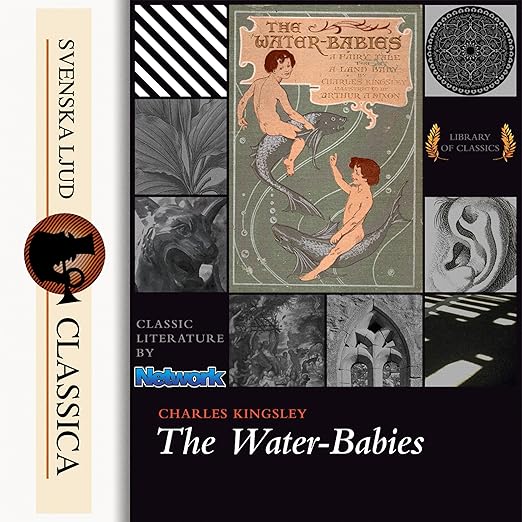
A worn paperback copy of The Water-Babies sat on my grandmother's shelf for as long as I can remember, spine cracked from decades of readings before I ever picked it up myself, and revisiting Charles Kingsley's 1863 fairy tale as an audiobook felt like finally hearing aloud a story I had only ever seen described secondhand. Cori Samuel narrates this Victorian classic about Tom, a maltreated chimney sweep transformed into a tiny aquatic creature after a near-drowning in a mountain stream, and the production treats the material with exactly the gentle seriousness a hundred-and-sixty-year-old children's story about class cruelty and moral transformation deserves.
Kingsley wrote this as a serial for Macmillan's Magazine across 1862 and 1863, and its full title, A Fairy Tale for a Land Baby, signals the dual audience he had in mind from the start: children for the fantasy, adults for the argument buried underneath it. As a Church of England clergyman writing barely three years after Darwin published On the Origin of Species, Kingsley used Tom's transformation to smuggle evolutionary ideas and a pointed critique of child labor into a bedtime story, decades before either topic was comfortable dinner-table conversation in Victorian England.
Tom's original trade was not a literary invention. Small boys were sent up narrow chimney flues well into the Victorian era specifically because their size fit spaces adult sweeps could not reach, and the practice caused real, well-documented injury and disease among child laborers. Kingsley's decision to make his protagonist a sweep, then have him die and be reborn clean, small, and finally cared for, reads as a direct rebuke of a labor practice British reformers were actively fighting to outlaw in the very years Kingsley was writing. That historical weight sits underneath every lighter fairy-tale beat.
Samuel Voices Otters, Salmon, and Moralizing Asides
One listener calls it an imaginative and charming introduction to both social justice and evolution for children and adults alike, and that double audience is exactly right. Tom's journey through the world of stream and sea creatures functions as adventure on the surface, encountering eccentric fairies with names like Mrs. Doasyouwouldbedoneby and Mrs. Bedonebyasyoudid, while underneath, Kingsley makes an argument about how badly Victorian England treated its poorest children. A reviewer who first heard this story read by her mother sixty-five years ago still returns to it, and calls the experience 'pleasantly pagan,' with moral lessons that land more lightly in memory than she expected.
Placed alongside its closest contemporary, Alice's Adventures in Wonderland, published just two years later in 1865, The Water-Babies reads as the more moralizing of the two Victorian fantasy landmarks, but also the more historically legible one: Carroll's nonsense hides its meanings, while Kingsley stays refreshingly explicit about what he wants a listener to think about class and cruelty. That directness is worth hearing in audio specifically, since Kingsley's narrator voice was clearly written to be read aloud to a child, addressing 'my dear little man' and similar asides directly, in a way that lands more naturally spoken than silently read.
Cori Samuel has no lengthy track record in this specific genre to draw on, but the demands of this particular text are clear enough to judge her against directly: Kingsley wrote a narrator's voice full of Victorian moral asides, addressed straight to the reader, alongside a cast of talking otters, salmon, and fairies who each need a distinct comic register without tipping into pure caricature. Samuel handles the shift between the storyteller's didactic commentary and the story's fantastical incident cleanly, letting the Victorian sentence structures breathe rather than rushing past them, which matters for a text this dependent on its narrator's patience.
Kingsley is remembered today as one of the founding voices of what Victorian critics called muscular Christianity, a movement that argued physical vigor and moral seriousness reinforced each other rather than competing for a young man's attention. That context explains a strand of The Water-Babies that can otherwise read strangely to modern listeners: Tom's transformation is framed explicitly as both a moral and physical cleansing, and the book's underlying argument, that a healthy body and a healthy conscience develop together, was a genuinely influential idea in how Victorian England thought about raising children, well beyond this one story.
Print editions of The Water-Babies have historically leaned heavily on illustration, elaborate Victorian and Edwardian artwork depicting Tom's underwater world, and an audio-only edition necessarily strips that visual layer away entirely. What is lost in illustration, though, is arguably regained in a text this explicitly aimed at spoken performance: Kingsley's prose was built for a narrator's voice from the outset, addressing listeners directly, and Samuel's reading restores something closer to the book's original serialized, read-aloud context than a silently read illustrated edition does.
Uncomfortable Victorian Attitudes Surface Without Warning
The genre tag on this listing files The Water-Babies under education and language-grammar content, which undersells what listeners are actually getting: a work of narrative fantasy fiction, not an instructional language course. A second, more important caveat concerns the book's age. Kingsley's Victorian attitudes toward race, class, and Irish immigrants surface in a handful of passages that read as genuinely uncomfortable to modern ears, and a family listening together should be ready to pause and talk through them rather than let them pass without comment.
One reviewer calls the book moralistic and sometimes a bit didactic, and that assessment is fair: entire stretches exist to deliver a lesson rather than advance the plot, and the extensive descriptive lists of aquatic creatures that same reviewer found tedious in print can feel even longer read aloud, without illustrations to break them up visually. Approach this one the way you would approach any classic written for a specific historical moment: for what it reveals about how Victorian England argued with itself about class and science, not for pacing that matches a modern children's audiobook.
Multi-Generational Listening, From Grandparent to Grandchild
This suits listeners drawn to the history of children's literature, parents willing to narrate historical context alongside the story itself, and anyone curious what a serious clergyman's response to Darwin looked like when filtered through a fairy tale. It also rewards multi-generational listening, given how many reviewers describe hearing it first from a parent or grandparent decades earlier, then returning to it as adults with a fuller appreciation for what Kingsley was actually arguing underneath the fantasy.
Skip it if you are looking for a modern-paced adventure story for young children with no historical footnotes required, or if Victorian-era attitudes toward race and empire are a hard line for your household without extensive framing. This is a book to listen to with context, not one to hand a child unsupervised and let the audio run on its own.