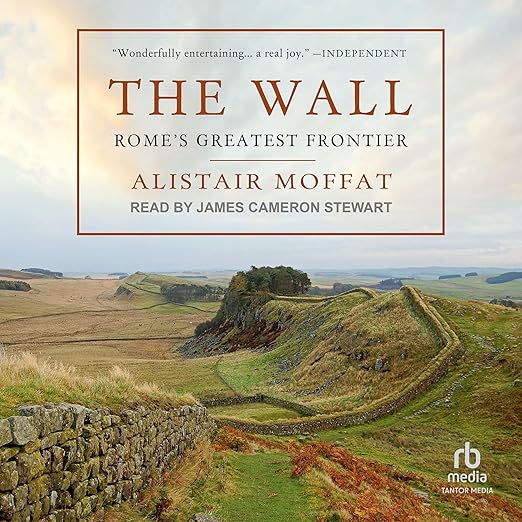
Quick Take
- Narration: James Cameron Stewart delivers a confident Scottish-accented performance that suits Moffat’s voice and the subject matter, the cadence matches the landscape.
- Themes: Roman imperial ambition, native British experience under occupation, the archaeology of everyday military life
- Mood: Scholarly but conversational, dense with research, lighter in delivery than the word count suggests
- Verdict: A thorough and often gripping history of Hadrian’s Wall that earns its twelve-hour runtime, though it sags noticeably in the final quarter when historical sources thin out.
I had been to Hadrian’s Wall once, on a research trip about a decade ago, and had come away with the same mixture of awe and puzzlement that large ancient monuments tend to produce. The scale is genuinely hard to absorb in person. Seventy-three miles of land wall, twenty-six miles of sea wall down the Cumbrian coast, forts the size of medieval castles, a ditch to the south that exceeds any surviving prehistoric earthwork. None of that made complete sense to me until I listened to Alistair Moffat work through the why of it.
The Wall arrives with strong credentials. Moffat is a Scottish historian with several books on Roman Britain to his name, and this account draws on both literary and archaeological sources including the Vindolanda letters, the extraordinary collection of writing tablets discovered near one of the Wall’s forts that document the daily life of Roman soldiers and their families in extraordinary detail. He promises in his introduction to do two things: put native Britons at the center of a story usually dominated by Romans, and weave everyday life into the military and political narrative. He largely delivers on both.
Building the Wall, Stone by Stone
The construction chapters are where the book is most completely itself. Moffat works through the logistics of building a structure containing more stone than all the Egyptian pyramids combined, completed in a decade by thirty thousand soldiers and laborers. The organizational challenge alone is remarkable. The quarrying, transportation, and assembly across varied and difficult terrain required a level of imperial project management that would impress contemporary engineers. Moffat does not let the mathematics become dry, he keeps returning to the humans involved, including the auxiliary regiments from across the empire whose inscriptions survive on the Wall’s stones and tell us where they came from.
One reviewer who praised the book’s thorough, even exhausting research relayed in conversational style captured the book’s tonal approach well. Moffat writes as someone who has clearly spent decades with this material but has not lost the ability to be surprised by it. The asides and tangents are often the most interesting passages in the book, and the decision to include them rather than maintain a purely linear narrative is an editorial choice that pays off consistently.
The Vindolanda Letters and the Life Inside the Garrison
The sections drawn from the Vindolanda tablets are remarkable. These writing tablets, preserved by the anaerobic conditions of the northern soil, contain birthday invitations, requests for warm socks, legal correspondence, and military supply lists. They document a world that no sculpture or official inscription could: the texture of daily life inside a remote garrison, the relationships between soldiers and their families, the small economies that sustained communities at the edge of empire. Moffat integrates this material with evident passion, and it gives the middle section of the book a vividness that the political chapters can only approach.
The native Briton thread is the book’s most ambitious undertaking and its most uneven. Moffat clearly intends to center peoples whose experience of the Wall has been systematically sidelined in favor of Roman sources, and there are passages where this works beautifully. But the archaeological evidence for native experience is thinner than the Roman record, and the book reflects that imbalance even as it tries to correct it.
Where the Final Quarter Loses Momentum
The most instructive review in this batch came from a reader who found the early chapters the strongest, specifically the pre-Wall and early Wall period, where documentary sources are richest. They noted that there is only so much historical material in the latter empire, which makes the narrative drag in the last quarter. This is an honest structural observation that prospective listeners should factor in. Twelve and a half hours is a long commitment, and the book does not sustain its peak energy throughout. The post-Roman sections are more speculative, and Moffat’s prose becomes correspondingly more cautious.
James Cameron Stewart’s narration is well-suited to the material, a Scottish accent for a history of the Scottish border lands feels appropriate, and his delivery handles both the scholarly passages and the more dramatic reconstructions without apparent effort. This is a production that takes its subject seriously, and for listeners who share that seriousness, twelve hours on Hadrian’s Wall rewards the investment. The subject matter is one of those topics that reveals more the deeper you go, and Moffat takes you deep enough that subsequent visits to the Wall itself, should you make them, will feel entirely different. What was once a scenic ruin becomes a legible document, and that transformation is what the best popular history achieves.
Who Should Listen and Who Should Skip
This is not an audiobook for casual dippers. Listeners who want a brief, colorful introduction to Roman Britain will find it more comprehensive than they bargained for, and the final quarter’s loss of momentum will feel more significant for that audience than for dedicated history listeners. For readers who want to genuinely understand Hadrian’s Wall, why it was built, how it functioned, who lived in its shadow, and what happened to it, this is the most complete general-audience treatment available in audio. The free audiobook version makes an excellent starting point for anyone whose curiosity was sparked by a visit, a documentary, or a television drama set in the north of England. It is not a casual listen, but it is a rewarding one, and Stewart’s narration makes the twelve-hour commitment feel well-paced rather than arduous.
Frequently Asked Questions
Do I need prior knowledge of Roman history to follow Moffat’s argument?
A basic familiarity with the Roman empire helps but is not required. Moffat provides enough political context to orient listeners, and the archaeological focus means much of the book deals in physical evidence rather than dynastic history. Listeners who know nothing about Hadrian specifically will be brought up to speed quickly.
How central are the Vindolanda letters to the book, and does Moffat explain what they are?
Moffat treats them as one of the book’s most important sources and introduces them fully. They are writing tablets discovered near a Wall fort that document everyday military life in remarkable detail, birthday invitations, supply requests, personal letters. Moffat uses them extensively for the daily-life sections.
Is James Cameron Stewart’s narration available as a chapter-navigable format, or is it one continuous track?
Standard Audible chapter markers are present. At twelve and a half hours, the ability to navigate by chapter is useful, particularly for returning to specific sections on the Wall’s construction or the native British material.
How does this compare to other Hadrian’s Wall books for a general audience?
Moffat’s dual approach, military and political history alongside everyday life drawn from the Vindolanda tablets, makes it unusually comprehensive for a general audience title. It is more detailed than introductory guides and more accessible than academic monographs. The native Briton focus also distinguishes it from histories that center Roman imperial experience exclusively.