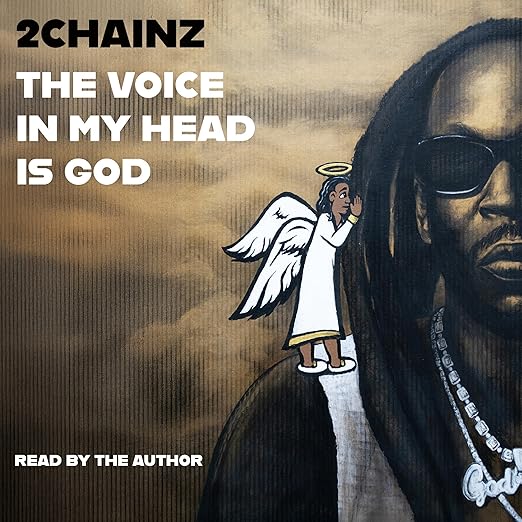
Tauheed Epps grew up in College Park, Georgia, with a single mother and a father serving prison time, and by fifteen he had been arrested. He also had a basketball scholarship and the streets never far behind, and those two trajectories did not point in the same direction. The story of how he became 2 Chainz, the Grammy Award-winning rapper, is one that has circulated in interviews and profiles over years. But THE VOICE IN MY HEAD IS GOD, narrated by 2 Chainz himself in this five-hour-and-six-minute audiobook, is his most personal accounting of the interior experience behind the biography. The argument at the center of the memoir is specific: it was not grinding ambition or fear or luck alone that changed his direction. It was faith, a voice he describes as having been present all along, insistent even when he was working hardest to drown it out.
That framing distinguishes this from the standard celebrity autobiography immediately. 2 Chainz is not primarily interested in behind-the-scenes industry stories, though they appear. He is interested in the experience of learning to listen, of distinguishing the inner voice that was guiding him from the noise of circumstances designed to override it. The memoir is an instant New York Times bestseller, and reviewer Floyd Dean notes that he does 'a great job of painting the picture for the reader,' which is accurate: the specific sensory and emotional detail of the early biography is rendered with the visual precision you would expect from a rapper who has spent his professional life turning experience into image and sound.
An Artist's Cadence Turns This Into Performance
The self-narration is the audiobook's most significant structural decision and its greatest asset. 2 Chainz's voice carries the full weight of the life he describes. When he recounts the streets being never far behind despite excelling academically, the credibility lives in his delivery in ways that no hired narrator could manufacture. His hip-hop cadence, the rhythms he brings from a professional life spent controlling how sound shapes meaning, transforms autobiography into something closer to a spoken performance. The pauses are meaningful. The emphases are chosen. This is an artist at work even when the material is personal testimony rather than lyric construction.
The memoir traces the relationships that shaped his development with care: his mother's sustaining effort, the early help from Ludacris that arrived at a precise moment, time spent with Lil Wayne. These are offered not as celebrity proximity evidence but as illustrations of the memoir's central thesis about divine timing. The right people arrived when they were needed, and recognizing them required being tuned to the right frequency. That framing, which could sound like retrospective mythologizing in a lesser writer's hands, feels earned here because 2 Chainz is equally specific about the moments when he was not listening, when the voice was present and he was choosing not to hear it. Reviewer Latise Jordan's response to the book's central argument, that God speaks daily and that building that relationship orders every step, reflects how directly the memoir addresses readers who already share that framework as much as those who are encountering it fresh.
The Voice That Never Steers You Wrong
For listeners who find faith memoirs overly sanctimonious or systematically divorced from the texture of real difficulty, this audiobook offers a different experience. 2 Chainz does not describe a conversion that erased what came before. He describes a gradual reorientation, a growing ability to trust a guidance that was always present but frequently overridden. The early biography is specific enough about self-destruction, doubt, and the genuine pull of the trap to make the later clarity feel achieved rather than simply declared. Reviewer D. Bailey notes that the book 'was better than expected,' which is the authentic response to a work that takes the spiritual framework seriously without allowing it to exempt the narrator from honest reckoning with the actual events of his life.
The audiobook explicitly positions itself as more than a memoir: as a 'way of thinking, of trusting yourself, and of listening to the voice that never steers you wrong.' That practical-wisdom dimension gives the book a prescriptive value beyond biographical interest. Listeners looking for a framework around discipline, self-trust, and attention to inner guidance will find the memoir delivers that alongside the biographical material rather than treating it as a separate motivational appendix.
Thirty-Nine Ratings, Still Building an Audience
With thirty-nine ratings at the time of writing, the audiobook is still building its listener base, though the five-star average and New York Times bestseller status reflect strong initial reception. Listeners approaching expecting a music-industry tell-all with backstage revelations and industry gossip may find the spiritual register more central and more demanding than they anticipated. The memoir is interested in interiority and guidance, not celebrity chronicle. Those who want the full behind-the-scenes career narrative may feel that certain periods of his life, the early music years, the industry navigation, are treated as illustrative moments rather than developed sequences.
At just over five hours, the audiobook is compact for a full memoir, and that compression means some biographical periods receive less room than they might warrant. The spiritual framework prioritizes the revelatory moments, the instances where the voice was heard and followed, over the more sustained narrative of career development. That is the right choice for what the book is trying to do, but listeners whose primary interest is the rap career rather than the spiritual autobiography should calibrate expectations accordingly.
Weighted Toward Interiority, Not Industry Narrative
This audiobook is for listeners interested in faith memoirs rooted in specific, difficult biography rather than triumphalist testimony. Fans of 2 Chainz who want to understand the interior life behind the music will find this genuinely revelatory. Listeners who respond to spiritual autobiography in the tradition of figures who connect faith to social circumstance, discipline, and genuine reckoning with failure will find the framework here coherent and earned. Those who want the full music-industry narrative with minimal spiritual framing will find the balance weighted more toward interiority than they prefer, but anyone willing to meet the memoir on its own terms will find a thoughtful and honest account of how one life changed direction.
The Short Version
- Narration: 2 Chainz narrating his own memoir is essential and irreplaceable. His hip-hop cadence transforms autobiography into something close to a spoken performance, with pauses and emphases that carry genuine meaning.
- Themes: Faith as inner compass navigating poverty and self-destruction, divine timing and mentorship, discipline and self-belief built through failure
- Mood: Raw, reflective, and quietly triumphant
- Verdict: An NYT bestselling memoir that earns its spiritual framework through honest biographical reckoning, narrated by 2 Chainz in the only voice that could make this story land the way it does.