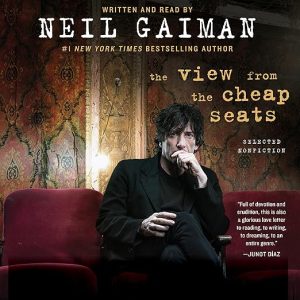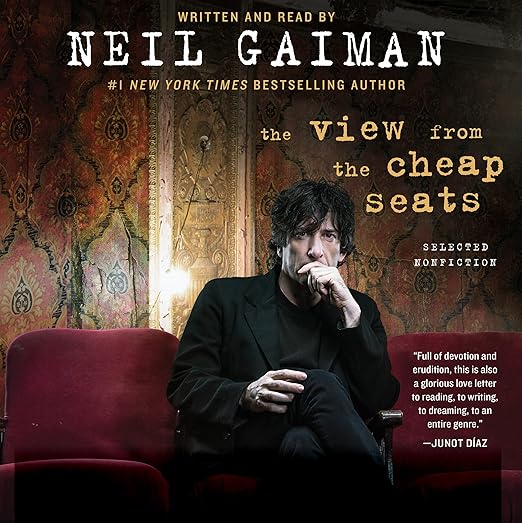
Neil Gaiman's collection The View from the Cheap Seats gathers more than sixty nonfiction pieces - speeches, essays, introductions, occasional journalism - and as an audiobook running fifteen and a half hours, with Gaiman reading every word himself, it is one of the more unusual listening propositions in recent nonfiction. The material spans decades and forms: short tributes to authors Gaiman admires, longer arguments for the value of fiction and libraries, travel pieces, meditations on America as an adopted country, the title piece about attending the Academy Awards in 2010. No single thread runs through all of it except Gaiman's sensibility, which is consistent and recognizable across every register from the playful to the genuinely moving.
The craft question at the heart of this audiobook is whether a collection assembled from such disparate sources holds together as a listening experience, or whether it dissolves into a pleasant but shapeless sequence of short pieces. The answer, over fifteen hours, is mostly yes - it holds - because Gaiman's voice (literal and literary) provides the connective tissue that the book's structure cannot.
The 2013 Libraries Lecture, Included in Full
What this collection does best is reveal the architecture of Gaiman's thinking about stories and their purposes. The famous 2013 Reading Agency lecture on libraries and the future of reading, Why Our Future Depends on Libraries, Reading and Daydreaming, is here in full, and it remains one of the most quotable defenses of fiction ever delivered to a general audience. So is the Newbery Medal acceptance speech, and several introductions to works by Gene Wolfe, Ray Bradbury, Terry Pratchett, and others - pieces that were written to serve specific occasions but that read, in collection, as an ongoing argument about what literature can do and why it matters.
One reviewer described the collection as wonderful and boring and inspiring and tedious all at different times, and this is the most honest characterization available. Not all sixty-plus pieces are equal. The introductions to specific books occasionally assume a familiarity with the subject that general listeners may not have, and a few of the shorter tributes feel more ceremonial than revelatory. But the best pieces - the library lecture, the reflection on September 11, the title essay about sitting in the cheap seats at a Hollywood ceremony and feeling the strangeness of celebrity culture - are Gaiman at full strength, and full-strength Gaiman is worth the stretches between peaks.
The Catch in His Voice for Pratchett
The self-narration argument here is stronger than for almost any other collection. Gaiman is a performer as much as a writer, and the rhythm of his sentences is calibrated to the spoken word in a way that becomes fully apparent only when he reads them aloud. The 1993 speech to comic shop owners, in which he compares speculation in first-issue comics to the Dutch tulip bubble, lands as comedy in a way that the same text on a page might not. The tributes for Terry Pratchett gain weight from the catch in Gaiman's voice that no hired narrator could have placed there. One reviewer who first saw Gaiman deliver that 1993 speech in person noted the extraordinary quality of the original performance, and the audiobook captures some of that quality even across the distance of a recording studio.
Listeners who have read Gaiman's fiction and wondered about the reading life and cultural commitments that shaped it will find the collection genuinely illuminating. The references are wide: Gene Wolfe's prose precision, Ursula Le Guin's moral imagination, the specific pleasures of secondhand bookshops, the American road trip as a literary form. The picture that assembles is of a writer formed by enormous reading and genuine enthusiasm rather than by academic training, and that distinction matters for understanding why his fiction takes the shapes it does.
A Motley Bunch Best Read Out of Order
The book rewards non-sequential listening better than most collections. Because the pieces are varied in length and tone, it is perfectly reasonable to treat the audiobook as something to dip into over weeks rather than to listen through in order. The longer essays - the library lecture, the reflections on America - repay the most sustained attention. The shorter tributes and introductions work well as palate cleansers between more demanding listens. One reviewer noted that the collection is a motley bunch of speeches, articles, introductions and essays, and that assessment is accurate; embracing the motley quality rather than fighting it is the right approach.
The section on comics and sequential art deserves particular attention. Gaiman is one of the few literary figures who has argued seriously and publicly for comics as a form worthy of the same critical attention as prose fiction, and the pieces here - including the 1993 speech - make that argument with specific examples and genuine passion. For listeners who share the interest, this strand of the collection is the most energetically sustained.
A Scrapbook of a Mind, Organized by Theme
Gaiman fans who have read American Gods, Sandman, or The Ocean at the End of the Lane will find this an essential supplement - it explains the intellectual and literary context from which those works emerged. Writers of any kind will find the craft observations scattered throughout the essays genuinely useful rather than generic. Listeners who are neutral on Gaiman's fiction but interested in the defense of genre fiction, libraries, and reading culture will find the major essays sufficient reason to spend time with the collection, even if they skip the shorter tributes. Those expecting a memoir with narrative arc should know this is not that - it is a scrapbook of a mind, organized loosely by theme but not by chronology or argument.
- Performance: Neil Gaiman narrating his own essays is the only version worth considering - his cadences are built into the sentences, and his delivery turns even the introductory pieces into something worth listening to closely.
- What it covers: The moral responsibility of storytelling, the culture of genre fiction and comics, what libraries and bookshops mean
- Feel: Warm, discursive, and occasionally profound - the feel of an evening conversation with someone who has read everything
- Our call: An audiobook best savored in pieces rather than consumed in sequence, rewarding the patient listener with more than sixty small windows into how one of fiction's most curious minds actually works.
Is The View from the Cheap Seats audiobook best listened to in order or as individual pieces?
Both approaches work. The audiobook has no overarching narrative arc, so individual pieces hold up independently. That said, listening in sequence builds a cumulative sense of Gaiman's preoccupations that is harder to get from sampling.
Does this audiobook require familiarity with Gaiman's fiction to be enjoyable?
No. The essays address broader subjects - libraries, storytelling, American culture, specific authors - that do not require prior knowledge of Sandman or American Gods. Familiarity with his fiction adds context, but the collection stands independently.
Are there specific audiobook pieces in the collection that are significantly stronger than others?
Yes. The 2013 Reading Agency lecture on libraries and daydreaming, the title piece about the Academy Awards, and the tributes to Terry Pratchett are widely considered the strongest. Some of the shorter book introductions assume familiarity with niche subjects.
How does Gaiman's narration compare to the experience of reading the essays on the page?
Most listeners find the audio version preferable for the longer speeches and tributes, where Gaiman's delivery provides emotional register that the text alone only suggests. For the shorter introductions, the difference is smaller.