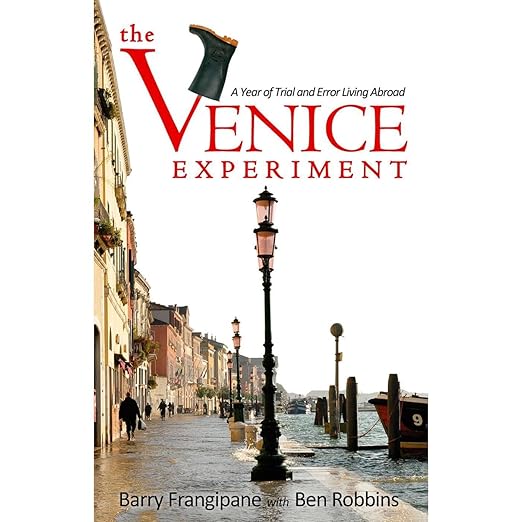
- At its heart: Expatriate life, Venetian community and culture, humor in displacement
- Vibe: Warm, observational, and gently comic with real affection for place
- Short version: Frangipane's memoir of a year in Venice is light-footed enough for the beach and specific enough to hold real value for anyone who has ever wanted to leave tourism behind.
Barry Frangipane's The Venice Experiment: A Year of Trial and Error Living Abroad is the kind of audiobook that works best when you already have Venice somewhere in your imagination. At five hours and forty-two minutes, narrated through a Virtual Voice, it takes you into the inner life of a city that most of its visitors see only through glass, canal-side, camera in hand. Frangipane and his wife Debbie spent a full year as residents rather than tourists, and the book that came from that experience is less a travel memoir than a community portrait. The difference is significant.
Most travel writing about Venice is consumed by aesthetics. The light on the water, the decay and beauty existing in the same stone, the labyrinthine impossibility of the streets. Frangipane acknowledges all of that, but what interests him more is the social fabric. How does a city built on millions of tree trunks driven into mud sixteen centuries ago, a city with no cars and no flat terrain and a perpetual flooding problem, actually function as a place where people live? The answer involves a surprisingly close-knit community of people who have developed very specific ways of navigating both the physical environment and the strangers who keep arriving to photograph it.
Frangipane and Debbie are those strangers at the start, and the book's comedy derives largely from how far they are from understanding the social codes of their neighborhood. The bureaucratic encounters are genuinely funny in the way that only truly exasperating bureaucracy can be, once enough time has passed. The high tides that periodically flood their ground-floor apartment are described with the resigned humor of someone who has learned, the hard way, what acqua alta actually means as a daily practical reality rather than a picturesque atmospheric effect. One reviewer described Frangipane's humor as inexhaustible, and that word choice is right. It never runs out because the material keeps delivering.
A Virtual Voice Trade-Off Behind a 4.2 Rating
The cast of characters Frangipane assembles around his narrative is what elevates this beyond a standard fish-out-of-water memoir. The neighbors, shopkeepers, fellow residents, and local figures who gradually admit the Frangipanes into Venetian society are sketched with enough specificity that they feel real rather than representative. Reviewer A. S. Baesel described living in Venice vicariously through the book, and that sense of genuine immersion is what distinguishes the better travel memoirs from the forgettable ones. Frangipane earns it not through lyrical description but through careful attention to the people around him.
The book's rating of 4.2 across 505 listeners is solid without being spectacular, and the Virtual Voice narration is a genuine limiting factor for listeners sensitive to synthetic narration. The text is conversational and warm in register, which means the absence of a human narrator's tonal flexibility is more noticeable here than it would be in a dry nonfiction text. Listeners who can adjust to the format will find the material consistently engaging. Those who find Virtual Voice narration a significant barrier to immersion may want to consider the print edition, which will likely serve the warmth of Frangipane's prose better.
Small Vignettes Building a Cumulative Portrait
Frangipane is a storyteller first and an analyst second. The book is built from vignettes, observed episodes, funny and touching encounters. It is not structured as a guide to expatriate life, nor does it aim to provide a comprehensive sociological portrait of Venice as a city under tourist pressure. Readers looking for a more critical or journalistic take on the city, its declining permanent population, or the economic and environmental pressures it faces, will find that this book touches on those themes lightly without dwelling on them. The tone is celebratory and affectionate rather than concerned.
The memoir covers one year, and the arc follows the Frangipanes' gradual integration into Venetian social life rather than building toward a single climactic event or revelation. If you prefer memoirs structured around dramatic arcs or clear narrative resolutions, the episodic quality here may feel shapeless. The pleasures of the book are cumulative rather than dramatic. You need to be the kind of reader or listener who can be satisfied by the accumulation of well-told small stories, each one drawing the city a little more clearly.
There is also something genuinely useful about encountering Venice through a writer who is committed to its people rather than its aesthetics. The tourists and the residents see different cities, and Frangipane spent a year crossing from one side of that line to the other.
A Year in One of the World's Most Improbable Cities
Anyone with a genuine interest in Venice, either from personal visits or long-standing fascination, will find this audiobook rewarding in the specific way that good travel memoir rewards: by filling in the texture behind the images you already carry. Listeners who have spent time in the city will recognize specific encounters and places. Those who have not yet been will come away with a much richer sense of what the city is actually like to inhabit rather than visit. Skip it if you want structural drama or critical depth, or if Virtual Voice narration substantially limits your engagement. Approach it if you want warmth, humor, and the pleasure of a year in one of the world's most improbable cities, told by someone who clearly loved every exasperating minute of it.
Before You Listen
How does the Virtual Voice narration affect the listening experience for this audiobook?
The Virtual Voice narration is functional but limits the warmth that a skilled human narrator would bring to Frangipane's conversational prose. Listeners who are sensitive to synthetic narration may find the print edition serves the humor and tone better. Those who can adjust to the format will find the content carries the experience.
Is The Venice Experiment audiobook a practical guide to living abroad or purely narrative?
It is purely narrative. The book is a collection of vignettes from a year of cultural immersion, not an advice guide or relocation manual. Readers looking for practical guidance on expatriate logistics should look elsewhere, but for the texture and humor of the actual experience, this delivers well.