Quick Take
- Narration: Ann Richardson brings scholarly material to life with a measured, clear delivery that respects the academic weight of the research without becoming dry, a capable match for dense but rewarding content.
- Themes: gendered labor and economic power in Norse societies, textile production as historical record, women’s agency in pre-modern communities
- Mood: Quietly revelatory and methodical, like watching an excavation proceed in real time
- Verdict: Rigorous, fascinating, and genuinely groundbreaking, a rare academic work that earns a general audience without watering itself down.
I was deep into a stretch of fiction listening when a colleague in medieval studies mentioned Michèle Hayeur Smith’s research on North Atlantic textiles. She described it the way academics rarely describe their own adjacent fields, with undisguised enthusiasm. She said something like: this is one of those books that changes what questions you think to ask. I put it on the list immediately, and I spent a Saturday afternoon and the better part of a Sunday evening working through all seven hours of it. By the end I had a notebook with more questions than answers, which is exactly the right result for scholarship of this kind.
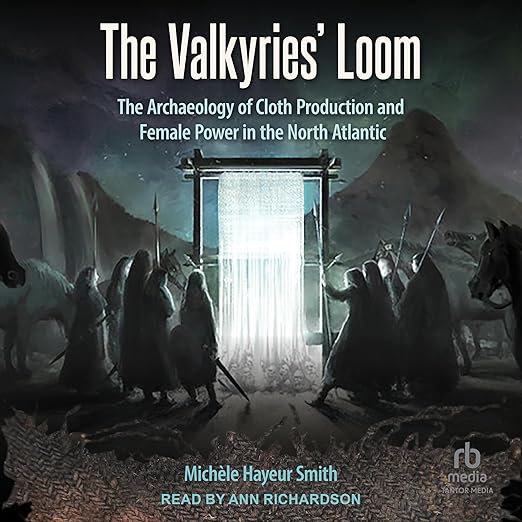
The Valkyries’ Loom is based on Hayeur Smith’s systematic comparative analysis of textile collections held in Iceland, Greenland, Denmark, Scotland, and the Faroe Islands. These are materials, she notes, that are largely unknown even to archaeologists. Through fragments of cloth spanning a thousand years, she reconstructs the economic significance of vaðmál, the wool cloth produced by Norse women, and traces how that cloth shaped international trade, national identity, and community survival during the climate disruptions of the Little Ice Age. The Valkyries of the title come from the poem Darraðarljoð in Njál’s Saga, in which Óðin’s female warrior spirits weave the cloth of history on a loom strung with human entrails. It is a striking image, and Hayeur Smith uses it precisely: these women were, in a material and economic sense, making history.
Our Take on The Valkyries’ Loom
What distinguishes this book from more speculative feminist history is the rigor of the underlying archaeology. Hayeur Smith is not projecting modern frameworks onto ancient material and calling it discovery. She is reading the cloth itself, the twist directions of the yarns, the weave structures, the dimensions of the fragments, and asking what those technical choices reveal about the women who made them. A spinner and weaver who reviewed the book noted that terms like S twist and Z twist were immediately familiar, and that this technical fluency runs through the whole work. The archaeology is not decorative. It is load-bearing.
The section on the Little Ice Age is unexpectedly gripping. As temperatures dropped across the North Atlantic between roughly 1300 and 1850, the communities Hayeur Smith studies had to adapt their textile production to survive, changing fiber sources, adjusting weave structures, trading in new ways. Watching her read those adaptations out of fragments of cloth is something close to reading a civilization’s problem-solving in real time. This is what good archaeology feels like from the inside.
Why Listen to The Valkyries’ Loom
Ann Richardson narrates with the steady confidence of someone who has done her preparation. The Norse names and Old Icelandic terms appear frequently, and Richardson handles them consistently and without the tentativeness that plagues many narrations of Scandinavian material. The seven-hour runtime feels well-suited to the depth of the material, not padded, not compressed. A supplemental PDF accompanies the audiobook, and for a book this rich in references to specific artifacts and textile patterns, that document is worth downloading and having at hand.
One reviewer who picked the book up as research for a fantasy series involving seiðr magic found it “packed full of amazing information” and particularly valued the cultural context provided by the Saga quotations Smith weaves throughout. That is a useful signal about the book’s range: it is academically rigorous enough to be cited in serious research, and grounded enough in story and cultural meaning to speak to readers who are simply curious about how these societies actually worked.
What to Watch For in The Valkyries’ Loom
The most pointed criticism in the reviews comes from a listener who felt that Hayeur Smith applies a modern gender-political lens to ancient peoples in ways that distort rather than illuminate. This is a genuinely contested methodological question in archaeology, and the criticism is not frivolous. Hayeur Smith is explicit about her project being a “gendered archaeology of the North Atlantic”, she is interested in recovering women’s labor from historical erasure, and that interest shapes her interpretive choices. Readers who find that framing anachronistic will find points of friction throughout. Readers who find it necessary and overdue will find it handled with more care than the criticism suggests.
Who Should Listen to The Valkyries’ Loom
This book belongs in the hands of anyone interested in Norse history, textile history, women’s economic history, or the archaeology of the pre-modern North Atlantic. It will also reward readers of books like Judith Bennett’s History Matters or Adrienne Mayor’s The First Fossil Hunters, scholarship that takes seriously the question of what material objects can tell us about the people who made them. Casual listeners looking for Viking drama should probably look elsewhere; this is careful, dense, and demanding. But it is also, in its patient way, genuinely thrilling.
Frequently Asked Questions
Do I need a background in textile production or archaeology to follow this book?
No, though some familiarity with textile terminology will help. Hayeur Smith defines the technical terms she uses, and Richardson’s narration makes the more specialized vocabulary accessible. Listeners with weaving or spinning experience will recognize concepts immediately; those without will build a working vocabulary fairly quickly.
How heavily does the book draw on the Norse sagas versus archaeological evidence?
The primary evidence is archaeological, the cloth fragments themselves. The sagas appear as cultural context, not as historical proof. Hayeur Smith uses the Darraðarljoð poem and other saga references to illuminate how Norse societies understood the significance of textile work, while grounding her economic and social arguments in the material record.
Is this a good resource for writers working on Norse or Viking fantasy settings?
Unusually so. The level of detail about daily textile production, trade routes, climate adaptation, and the social organization of women’s labor is exactly the kind of grounded specificity that distinguishes well-researched historical fiction from generic Viking aesthetics. Several reviewers came to it specifically for this purpose.
How does the book handle the debate around gender categories in pre-modern Norse societies?
Directly and with awareness that it is contested territory. Hayeur Smith argues for the significance of gendered labor divisions in Norse textile production based on the archaeological evidence, while acknowledging the limits of what the material record can tell us about how those societies understood gender identity itself. The methodology is careful, even where the interpretive framework is explicit.