Quick Take
- Narration: Jeffrey Ito brings a measured, contemplative delivery that suits the text’s meditative register, though the stripped-down production omits some of the translation’s supplementary material.
- Themes: Self and universal consciousness, the nature of the deathless soul, wisdom beyond the reach of senses
- Mood: Still and expansive, best heard in quiet
- Verdict: Eknath Easwaran’s translation is among the most accessible paths into these ancient texts, and Ito’s narration serves it with appropriate gravity.
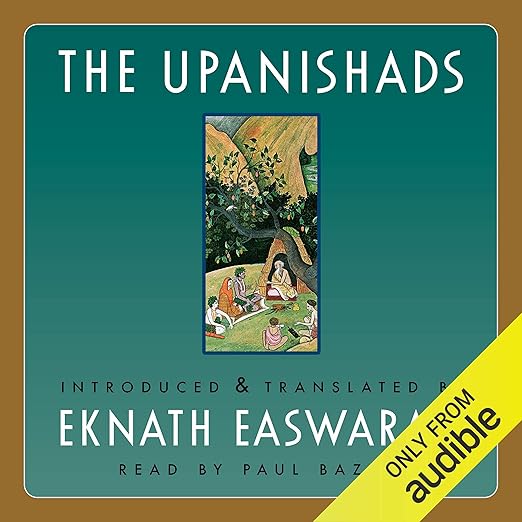
I first encountered Easwaran’s translations of classical Indian texts through a comparative literature course, and what struck me then, and still strikes me now, is how resolutely he refuses to let the philosophical density become a barrier. These are not texts that reward impatience. But they do reward presence, and the audiobook format, when handled correctly, can create exactly the kind of sustained attention they require. I came back to this recording of The Upanishads on a quiet Tuesday morning with coffee, which one reviewer has described as exactly the right setting, and found that the experience holds up well in audio.
The Upanishads are among the oldest and most influential texts in human religious and philosophical thought, emerging roughly between 800 and 200 BCE as a departure from the ritualistic focus of the earlier Vedic texts. Where the Vedas prescribed action, the Upanishads asked questions: What is the self? What is consciousness? What lies beyond death? The answers they offer are not answers in the conventional sense but extended investigations, conducted through dialogue, parable, and poetic insight. Easwaran’s selection draws from the principal Upanishads and five others, with a framing introduction and foreword that orient the Western reader without condescending to them.
Our Take on The Upanishads
What distinguishes Easwaran’s approach from a purely academic translation is the insistence on relevance. He understood that for most Western readers, these texts are not ancestral documents but voluntary encounters, chosen because something is missing or sought. His introductions contextualize the sages and their visions not as historical curiosities but as living inquiries into questions that remain unanswered. One reviewer put it simply: this book is written for the western reader, therefore it is very easy to understand. That accessibility does not come at the cost of rigor, but it does come at the cost of some of the technical density that Sanskrit scholars might prefer. For the majority of listeners, this is the right trade-off.
The audio production should be noted for what it includes and what it does not. This recording covers Easwaran’s Foreword, Introduction, and translation but omits the short chapter introductions written by other contributors and the Afterword. Depending on what you are looking for, this may or may not matter. The core of Easwaran’s editorial vision is present, and Jeffrey Ito’s narration of the translated passages themselves is carefully done. But listeners who have read the print edition and value those supplementary materials should know they are listening to an abridged version of the full book’s apparatus.
Why Listen to The Upanishads
Jeffrey Ito brings a voice that does not impose itself on the material. This is the correct instinct for this kind of text. The Upanishads are not narratives that benefit from dramatic interpretation; they are philosophical and spiritual inquiries that benefit from clarity and pacing. Ito reads with measured rhythm, giving phrases space to settle before moving forward. The running time of just under two hours is actually a feature rather than a limitation: these are selections, not the complete corpus, and the concision makes the recording manageable as a repeated listening experience rather than a once-through.
One reviewer made the comparison to seeds of thought that the Buddha later refined, which captures something true about the intellectual genealogy here. If you approach these texts from a background in Zen, Vipassana, or contemporary mindfulness practice, you will find familiar territory rendered in unfamiliar and often more direct language. The concept of Atman, the individual self as identical with Brahman, the universal, sits at the heart of what these sages were working toward, and Easwaran renders it in language that rewards slow re-listening rather than fast comprehension.
What to Watch For in The Upanishads
The attribution note is worth paying attention to. The publisher is listed as Swami Paramananda, and the ASIN metadata reflects some overlap with other Upanishad recordings in the catalog. Listeners should confirm they are accessing the Eknath Easwaran translation specifically, as several versions of the Upanishads are available in audio and they differ significantly in approach, depth, and accessibility. Easwaran’s is the most widely recommended for Western readers new to the material.
The omission of the chapter-level introductions does leave certain passages without the contextual framing that makes them most legible. If you find yourself lost during a particular Upanishad’s more abstract passages, the print edition’s supplementary material would be worth consulting alongside the audio.
Who Should Listen to The Upanishads
This recording is well-suited for listeners curious about Hindu philosophy and Vedantic thought who want an introduction that does not require prior Sanskrit study. It also works for practitioners of meditation or contemplative spirituality from any tradition who want to encounter the texts that informed so much of what they practice. Listeners who want the full scholarly apparatus, including the omitted introductions and Afterword, would be better served by the print edition. But as a standing-alone audio encounter with some of the most significant spiritual writing in human history, this earns its place.
Frequently Asked Questions
Does this audiobook include all of Easwaran’s translation or just selections?
The recording covers selections from the principal Upanishads and five others, following Easwaran’s curated translation. It includes his Foreword and Introduction but omits the short chapter introductions and the Afterword by other contributors, so it is a partial rendering of the print book’s full apparatus.
Is this a good starting point for someone with no background in Hindu philosophy?
Yes, Easwaran’s translation is specifically designed with Western readers in mind. His introductory material provides the cultural and historical context needed to make the texts accessible, and his language bridges ancient Sanskrit concepts into modern English without oversimplifying them.
How does listening to the Upanishads differ from reading them?
The audio format lends itself particularly well to these texts because the meditative pacing of Ito’s narration mirrors the contemplative quality of the material itself. That said, the print edition’s supplementary chapter introductions may be missed by listeners who want fuller context for each text.
At under two hours, is this recording too short to do justice to the Upanishads?
The brevity reflects the fact that this is a curated selection rather than the complete corpus of Upanishadic literature. For a first encounter, the length is appropriate and allows for repeated listening, which is often more valuable with these texts than a single long sitting.