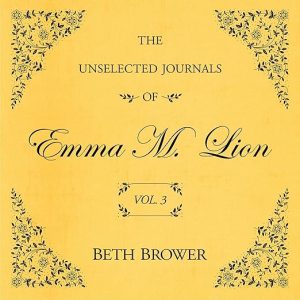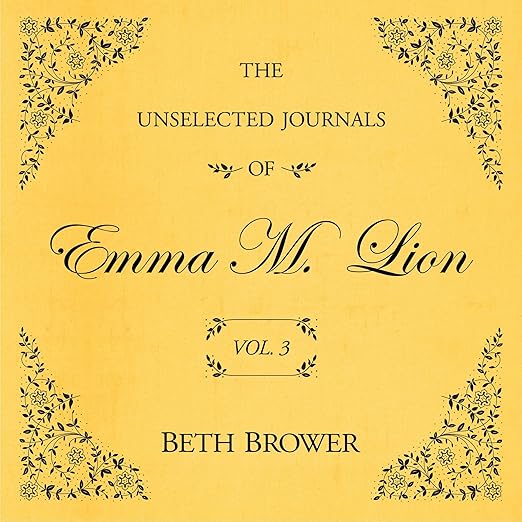
Emma M. Lion's 1883 London opens on what she calls 'a day ordained by the fates,' and that line, from the very first page of this Unselected Journals of Emma M. Lion: Vol. 3 audiobook, sets the tone for the whole entry: wry, self-aware, faintly theatrical about its own minor domestic catastrophes. Emma has returned to her London neighborhood of St. Crispian's for a charmed, studious life, only to have those plans sabotaged yet again by her eccentric Cousin Archibald, her formidable Aunt Eugenia, and the neighborhood's odd cast of regulars.
Tami Allen Finishes an Entry in a Day
Brower writes Emma's world as a first-person journal, which means every observation arrives filtered through Emma's specific, slightly self-mocking sensibility, the sideways amusement the synopsis itself promises. That structure rewards a narrator who can treat the prose as something composed and revised by the character herself rather than simply spoken aloud, and it's exactly the demand Genevieve Gaunt's performance is built to meet. Reviewer Tami Allen calls Emma 'a delight' and specifically praises how the short-book format lets her finish an entry 'in a day,' which fits how episodically Brower structures Emma's misadventures.
The synopsis includes an unusually detailed production note, and it's worth taking seriously: Gaunt trained at Cambridge, played Pansy Parkinson in the Harry Potter films, and has narrated Ian Fleming's The Spy Who Loved Me, while director Tamsin Collison has over 500 audiobooks to her credit, including Thandiwe Newton's War and Peace. That's a genuinely literary pedigree behind a book that could easily have been treated as disposable comfort reading, and the production, recorded at London's Strathmore Studios for independent publisher Echo Point Books & Media, sounds like it took the material as seriously as Gaunt and Collison's resumes suggest they would.
Brower has built her career largely around this same fictional world, later Unselected Journals volumes and companion St. Crispian's stories keep expanding Emma's neighborhood rather than moving on to unrelated settings, which suggests an author with real long-term investment in this specific voice and place rather than treating it as a one-off exercise. That commitment shows in how fully realized the neighborhood's minor characters feel even in passing mentions, Cousin Archibald and Aunt Eugenia included, three volumes in.
Three volumes in, Emma's specific blend of self-importance and self-awareness has become the series' real hook, more than any single plot thread.
2LZ Praises One Consistent Narrator Across Volumes
Gaunt's approach treats Emma's journal voice as written prose being performed rather than as naturalistic speech, a distinction that matters for comic Victorian pastiche: the humor lives in Emma's word choice and self-aware asides as much as in what actually happens to her, and a narrator who flattens that into conversational delivery would lose most of the joke. Reviewer 2LZ describes reading the Kindle edition alongside listening to the audiobook and calling it 'the nicest reading experience,' specifically because the narrator stays consistent across the whole series, a continuity that matters for a character this voice-dependent.
Fans of Wodehouse's comic misadventures or Austen's social comedy of manners will recognize the lineage here, epistolary self-deprecation, a small social world rendered enormous through the narrator's attention, though Brower's version leans further into modern comic rhythm than either of those models. At six hours and forty-seven minutes, this third volume moves at a genuinely brisk clip for the amount of incident packed in, and reviewer Kris, who says the series transported her to the Victorian era among 'the most delightful characters,' is emblematic of how quickly listeners tend to move through all three volumes once they start.
The opening line alone, calling a chain of minor mishaps 'a day ordained by the fates,' is a useful preview of Brower's whole comic technique: elevating small domestic frustrations to mock-epic scale. Gaunt's performance leans into that inflation rather than undercutting it, treating Emma's overstatement as sincerely felt in the moment even when the actual stakes, an inconvenient cousin, an awkward social call, are objectively minor, which is exactly what makes the joke land rather than feel condescending toward the character.
Gaunt's own critical work, she reviews books for The Spectator and interviews authors for literary festivals, plausibly sharpens exactly this kind of close attention to voice and register; the same skill a literary critic brings to evaluating prose is audible in how precisely she calibrates Emma's specific blend of self-regard and charm.
Worth Knowing, a Companion PDF Comes Too
This is book three of an ongoing series, and while each volume is fairly self-contained in its day-to-day incidents, the running jokes about Archibald, Aunt Eugenia, and the neighborhood's regulars land considerably better with the accumulated context of volumes one and two. New listeners technically can start here, but the fuller comic payoff is designed for readers already invested in Emma's world.
The journal format means plot moves more through accumulated incident and voice than through a driving central conflict, so listeners wanting strong narrative momentum or a clear external stakes-driven plot may find the pacing meandering by design. It's also worth knowing a companion PDF comes with the purchase, useful for following any specific period detail or illustration referenced in the text, though the audiobook itself works perfectly well without ever opening it.
It's also worth knowing this audiobook comes from Echo Point Books & Media, an independent publisher based in Brattleboro, Vermont, rather than a major New York house; the production quality, recorded at London's Strathmore Studios with an accomplished director and cast, doesn't show any sign of a smaller budget, but listeners used to tracking major-imprint releases specifically should know to look for this one under an independent label.
Classical Training Elevates This Genre Fiction
Listeners already partway through Emma's journals, and anyone who loves Victorian-set comic fiction with a genuinely literary narrator behind it, are the clear audience; the production quality alone, Gaunt's performance and Collison's direction, makes this a strong pick for anyone who cares as much about narration craft as plot.
Listeners who enjoyed Cambridge-educated actors bringing real classical training to genre fiction elsewhere, the way certain Austen or Dickens adaptations benefit from theatrically trained casts, will find that same quality elevating what could have been a slighter comic series into something with real staying power.
Readers wanting a tightly plotted mystery or romance rather than an episodic comic journal, or anyone unwilling to start from volume one, should expect this specific entry to reward patience more than urgency.
Before You Listen
Do I need to listen to the earlier Unselected Journals of Emma M. Lion audiobooks before Vol. 3?
It's strongly recommended. The running jokes about Emma's family and neighborhood land better with the context from volumes one and two.
How long is the Unselected Journals of Emma M. Lion: Vol. 3 audiobook?
Six hours and forty-seven minutes.
Who narrates the Unselected Journals of Emma M. Lion series, and is it the same narrator throughout?
Genevieve Gaunt narrates, and reviewers confirm she stays consistent across the whole series.