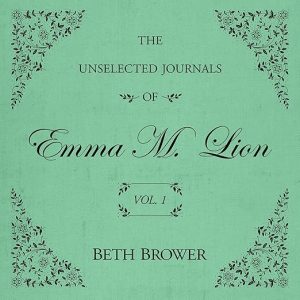
St. Crispian's, London, 1883: a young woman named Emma M. Lion has just returned to the neighborhood with almost nothing to her name, an eccentric cousin already scheming nearby, and a formidable aunt who disapproves on principle. This audiobook, the first volume of Beth Brower's ongoing series, presents itself as Emma's own private journal, unedited and unselected, which means the reader gets her exact voice, dry asides included, rather than a tidied-up third-person account of her attempts at a charmed and studious life in Lapis Lazuli House.
I put this one on during a slow Sunday afternoon expecting a light diversion and found myself charmed within the first chapter, mostly because the journal conceit is handled with real discipline rather than as a gimmick. Emma is self-aware about her own self-incrimination as a narrator, which gives the comedy an extra layer that a straightforward comic novel would not have.
Gaunt Went from Pansy Parkinson to Emma Lion
Genevieve Gaunt narrates, and her casting here is not incidental. She read English at Cambridge with a double first, has narrated Ian Fleming's The Spy Who Loved Me, and got her start playing Pansy Parkinson in the Harry Potter films, and all three of those credentials show up in how precisely she calibrates Emma's voice. Gaunt treats the journal entries as composed writing rather than casual speech, which is exactly right for a character who is performing wit for an imagined future reader even while insisting the pages are private. The effect is a narration that sounds literary rather than merely chatty, closer to how you would read Jane Austen's free indirect style aloud than how you would read a modern first-person comic novel.
Director Tamsin Collison, credited in the production notes with over 500 audiobooks and dramas to her name, including Thandiwe Newton's recording of Tolstoy's War and Peace and a full-cast dramatization of Mansfield Park, brings a level of polish to this three-hour production that a lot of indie literary fiction in audio does not get. It was recorded at The Strathmore Studios and produced by Echo Point Books and Media, an independent bookseller in Brattleboro, Vermont, and that small-press attentiveness is audible in the pacing choices around Emma's more self-deprecating lines.
Cozy Victorian and Edwardian pastiche fiction has built a small but devoted audio following over the past decade, and production values matter enormously to that audience, since the appeal depends on period atmosphere holding up under close listening. This particular production, helmed by a director with Thandiwe Newton's War and Peace on her resume, sits closer to the higher end of that spectrum than the average small-press audio release, which is worth knowing if you have been burned before by thinly produced independent historical fiction.
Gaunt's own sideline reviewing books for The Spectator is worth mentioning again here specifically, since it means the person reading Emma's very literary, self-consciously written journal entries is herself a working literary critic, someone whose day job involves noticing exactly the kind of small structural and tonal choices Brower has built into this book. That professional overlap between narrator and material is not something every audiobook can claim, and it shows in how deliberately Gaunt paces the entries that are clearly staged for effect versus the rarer moments where Emma's guard slips.
Wodehouse Is the Closest Match for the Jokes
Reviewer Alina B. calls the series 'delightful and engaging, with some laugh-out-loud moments,' and I would add that the comedy here works because it is specific rather than broad. Cousin Archibald's scheming and Aunt Eugenia's formidability are not cartoon obstacles; they are rendered with the same close, slightly rueful observation Emma turns on herself. The synopsis notes that audiences have compared Brower's writing to Austen, Oscar Wilde, P.G. Wodehouse, and L.M. Montgomery, and of that list, Wodehouse feels like the closest match for the rhythm of the jokes, even though the emotional register underneath sits closer to Montgomery's warmth.
Reviewer Angiegirl, who says she fell for Brower's writing through an earlier book called The Q, frames this series as a set of novellas rather than a single continuous novel, and that structural honesty matters for anyone deciding how to approach it. At just over three hours, this is closer to a long short story collection's worth of runtime than a full novel, and Gaunt's performance is calibrated for that scale: intimate, unhurried, comfortable letting a scene breathe rather than rushing toward a plot payoff that a three-hour runtime was never going to deliver in volume one alone.
Unselected Means the Entries a Diarist Would Cut
The word 'Unselected' in the title is doing real work too. A more conventional Victorian pastiche might promise a polished, selected set of highlights from Emma's life. Brower instead promises the rejects, the entries a more careful diarist might have left out, and that framing sets up the reader to expect exactly the self-incriminating honesty the synopsis describes rather than a curated best-of. It also explains why Carla Terry's complaint about missing background rings true structurally rather than as a flaw: an unselected journal, by definition, assumes context the writer never bothered to spell out for a stranger.
Carla Terry Wanted More Background Than This
That novella length is also the book's most legitimate limitation, and reviewer Carla Terry names it directly in a more measured three-star review, writing that she enjoyed the book but found it 'lacking some background and character development.' I had the same reaction to the ending specifically, which closes on a note of comic momentum rather than resolution. This is volume one of an ongoing series told through journal fragments, not a complete standalone arc, and listeners who want Emma's various predicaments meaningfully resolved by the final chapter should adjust their expectations accordingly before pressing play.
One practical audio note is worth flagging here: the listing indicates a companion PDF becomes available alongside the audio in your library, which suggests some supplementary material, likely illustrations or period context, was designed with a print-adjacent reading experience in mind. None of that content is described in detail in the listing itself, so audio-only listeners should not expect it to be essential to following the story, but it is worth knowing the PDF exists if you want the fuller intended package.
Austen and Montgomery Fans Will Love Emma
Readers who already love Austen's comedy of manners, Wodehouse's plotting, or L.M. Montgomery's warmth toward flawed, funny young women will find Emma an easy character to fall for, and Gaunt's literary, unhurried narration style rewards listeners who enjoy prose for its own construction rather than pure plot momentum. Anyone drawn to the epistolary or journal-format tradition, where the pleasure comes from a distinctive first-person voice rather than external event, is squarely the intended audience here.
This shorter runtime and open-ended structure will frustrate anyone who wants a complete, tidily resolved story in a single sitting, since volume one functions more as an introduction to Emma's voice and circumstances than a finished arc. If a three-hour commitment to an unresolved comic novella sounds like more setup than payoff to you, it may be worth waiting until a few more volumes are out and approaching the series as a longer binge instead.
A Few Questions About The Unselected Journals of Emma M. Lion: Vol. 1
Does Genevieve Gaunt's narration suit the Victorian journal format of this audiobook?
Yes. Gaunt, a Cambridge-trained actor who has narrated Ian Fleming's work, treats Emma's entries as composed writing rather than casual speech, which fits the self-aware journal conceit closely.
Is this audiobook similar to Jane Austen or P.G. Wodehouse?
The synopsis itself invites Austen, Wilde, Wodehouse, and Montgomery comparisons, and Wodehouse's comic rhythm feels like the closest match, with Montgomery's warmth underneath.
Do I need to read the PDF that comes with this audiobook to follow the story?
No. A companion PDF is included in your library alongside the audio, but the listing does not indicate it is essential to following Emma's narrative as an audio-only listener.