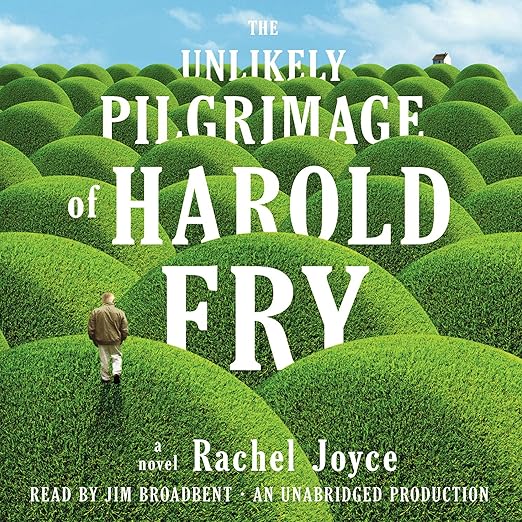
Harold Fry has just retired, his wife Maureen seems irritated by nearly everything he does including how he butters his toast, and nothing distinguishes one quiet day from the next until a letter arrives from Queenie Hennessy, a woman he has not heard from in twenty years, writing from hospice to say goodbye. Rachel Joyce's debut novel turns Harold's short walk to the corner mailbox into something else entirely: convinced that as long as he keeps walking, Queenie will live, Harold sets off on foot from Kingsbridge toward her hospice in Berwick-upon-Tweed, six hundred miles away, still wearing his yachting shoes. This audiobook is narrated by Jim Broadbent, and pairing an Oscar-winning character actor with a novel about an ordinary Englishman's extraordinary walk turns out to be one of the more inspired casting choices in the genre.
Broadbent's reading carries a non-studio, lived-in quality that suits Harold specifically: this is a character defined by hesitation, understatement, and things left unsaid for decades, and a narrator with Broadbent's own gift for quiet, precise emotional restraint (the same instinct that won him an Academy Award for Iris) renders that interiority without ever overplaying it into sentimentality.
The novel's road-to-publication credentials are unusually stacked for a debut: a New York Times bestseller, a Man Booker Prize longlist placement, and a spot among the Washington Post's best books of its year. Those are not house-style marketing claims, they are external, verifiable recognitions that place Joyce immediately alongside far more established literary novelists on her first outing.
Joyce came to this novel from a career writing for BBC radio drama, and the story itself began as a radio play before she expanded it into a full novel, a detail that helps explain why the prose reads so naturally aloud: this is material that was built for the ear well before Jim Broadbent ever stepped into a recording booth.
The road-trip-on-foot structure also solves a real narrative problem: rather than staging Harold's internal reckoning through conversation or flashback alone, Joyce gives him physical distance to cover, which turns memory into something that arrives in measured doses, one mile and one encounter at a time, rather than all at once in a single cathartic scene.
Nine hours and fifty-seven minutes is a comfortable length for this material, long enough for the accumulation of small encounters along the road to build real weight without overstaying a fairly simple premise. Few debut novels manage to be this quietly ambitious while still reading so effortlessly, a combination that likely explains why it found readers so quickly across different countries and reading cultures.
Highlights
Reviewer Melissa's description gets at the book's actual shape better than any plot summary: 'this is a story about a man who goes for a walk; he starts walking and keeps walking. He has no plan and is wearing the wrong shoes.' The simplicity of that sentence mirrors the novel's own structure, small, plain, accumulating meaning through repetition and distance rather than incident.
Reviewer Larry Hoffer offers the sharpest comp-title framing available, citing Waking Ned Devine and The Englishman Who Went Up a Hill But Came Down a Mountain alongside 'some Forrest Gump-ian characteristics, without the Southern accent or the meteoric run through historical events.' That last qualifier does real work: Harold's journey stays small and personal rather than becoming a vehicle for touching famous events, which is exactly what keeps the book from tipping into whimsy.
Paula McLain's blurb frames the book's stakes in the sharpest terms of the whole chorus, calling it a story about whether 'we begin to live again, and live truly, as ourselves, even in middle age, when all seems ruined,' a question pitched squarely at any listener who has ever wondered whether a long-settled life still has room left for change. Helen Simonson's blurb, invoking her own Major Pettigrew's Last Stand, is an apt comparison beyond simple flattery: both novels find their force in an outwardly unremarkable Englishman whose reticence conceals something larger.
Nancy Horan's blurb closes the chorus on a note worth repeating for any listener still deciding whether to commit nearly ten hours to this: she calls it a story that 'moved and inspired' her specifically as 'funny' and 'poignant' at once, a combination this genre promises constantly and delivers on rarely enough that its repetition across five separate literary blurbs carries real weight.
Weak Spots in The Unlikely Pilgrimage of Harold Fry
The genre tagging here, comedy-humor alongside literature-fiction, undersells how much grief and regret actually run through this book. Reviewer Anna Buttimore's account is the corrective: she describes Harold as 'the sort of man who thanks the speaking clock, a gentle-man in the truest sense,' living through a marriage gone quiet and a dying friend's final letter. Real gentle wit runs throughout, but the emotional core is reconciliation and mortality, not farce.
The advance-praise chorus attached to this edition (Nancy Horan, Paula McLain, Helen Simonson, and others) places Joyce in specific literary company worth naming: Erica Wagner of The Times calls it 'a book with a savage twist' beneath its gentleness, a fair warning that the ending carries more weight than the cozy walking-tour premise initially suggests.
Berwick-upon-Tweed sits about as far from Kingsbridge as two points in England can plausibly be, nearly the full length of the country, and that specific, real geography matters: Joyce is not inventing a vague fictional distance for symbolic roundness, she is routing Harold through an actual, walkable cross-section of England, small towns, motorway verges, and unglamorous stretches included.
Queenie Hennessy herself remains almost entirely offstage for the length of the novel, present only through the letter that starts everything and the memories Harold carries of her, and that absence is a deliberate choice: the book is never really about Queenie as a fully drawn character, it is about what Harold's walk toward her reveals about everyone he left standing still, Maureen especially.
Is This One for You?
Fans of quiet, character-driven British fiction, readers of Major Pettigrew's Last Stand and gentle-odyssey stories in the Forrest Gump lineage, and anyone drawn to grief and reconciliation narratives without melodrama will find this exactly suited to them.
Listeners who have ever sat with a friendship or a marriage left unfinished, words that should have been said and were not, will find Harold's particular species of regret rendered with unusual precision rather than the softened, generically wise version this kind of premise could easily have settled for, and newcomers to Joyce's work will find this a fully satisfying entry point on its own.
Listeners craving momentum and incident, chapter after chapter of things actually happening, should recalibrate expectations before starting, since Harold's journey is deliberately slow and internal, closer to meditation than adventure despite the six-hundred-mile setup.
Common Questions
Is this audiobook more comedy or more drama, given its genre tags?
It leans far more toward gentle drama and reconciliation than the comedy-humor tag suggests, with real grief and mortality running underneath the wit, per reviewer Anna Buttimore's account of the book's actual tone.
Does Jim Broadbent's acting background translate well to audiobook narration?
Yes. His performance has a non-studio, unpolished quality that reviewers and prior listeners consistently note as a genuine asset for Harold's own hesitant, restrained character, rather than a limitation.
Is this audiobook part of a series, or does the story conclude on its own?
It is the first book credited under the Harold Fry name, and the pilgrimage itself resolves fully within this single audiobook.