Quick Take
- Narration: Prechtel self-narrates with the cadence of an oral tradition, dense, incantatory, and occasionally overwhelming in the best sense of that word.
- Themes: Indigenous spiritual wisdom, ecological grief, the politics of cultural erasure
- Mood: Lyrical and urgent, demanding patience and full presence from the listener
- Verdict: One of the more unusual and demanding listens in contemporary spiritual memoir, not for those seeking comfort, but for those genuinely searching for something they cannot name.
I first heard about Martin Prechtel through a friend who had spent time in Guatemala and described his writing as unlike anything she had read, that it operated according to a different logic, that it was asking something of the reader rather than delivering information to them. I put The Unlikely Peace at Cuchumaquic on while walking through a forest preserve on an early autumn morning, and I will say that context helped. This is not a book you can half-listen to. It pulls at your attention the way a piece of complicated music does, you can let it wash over you, but you miss something essential if you do not engage.
Prechtel’s biography is extraordinary. He grew up on a Pueblo Indian reservation in New Mexico, spent years in Guatemala apprenticing under a Tz’utujil Maya shaman, rose to become a village leader, and fled the country during the brutal civil war that destroyed much of what he had come to love. The Unlikely Peace at Cuchumaquic draws on all of that experience to make an argument about what is being lost as indigenous cultures disappear, not as an academic or an advocate but as someone who lived inside one of those cultures and watched it be dismantled by forces internal and external.
Our Take on The Unlikely Peace at Cuchumaquic
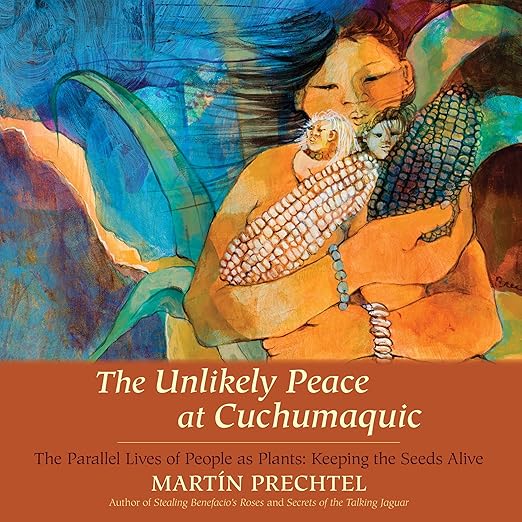
The central metaphor of the book, seeds, operates at multiple levels simultaneously, which is characteristic of how Prechtel thinks and writes. Seeds are literally at stake: the book is concerned with the loss of heirloom seed varieties to industrial agriculture and genetic modification. But seeds are also the metaphor for cultural transmission, for the spiritual inheritance that one generation passes to the next, for the specific kind of human excellence that only survives if it is practiced and shared rather than documented and archived. When he argues that viable seeds of spirituality and culture lie dormant within us and need to sprout into broad daylight, he is making a claim about both agricultural and metaphysical ecology at the same time.
Reviewers who have returned to this book multiple times, and several describe exactly that, note that the layers accumulate on re-reading. One described approaching it at the slowest pace, rereading every line, sensing that the images Prechtel conjures are vitally important. That is an unusual relationship for a reader to have with a book, and it speaks to what Prechtel is doing: he is writing in a tradition that expects the reader to be present and receptive rather than simply extracting information.
Why Listen to The Unlikely Peace at Cuchumaquic
The self-narration is essential to the experience. Prechtel’s voice carries the weight of an oral tradition in which the storyteller’s presence is part of the transmission. At eighteen hours and thirty-three minutes, this is a long listen, and there are passages that require you to slow down and sit with what you have just heard rather than moving immediately to the next idea. That is not a flaw in the production; it is the nature of the material.
The ecological argument, that our current environmental crisis is inseparable from the destruction of the cultural and spiritual frameworks through which indigenous peoples understood themselves to be in relationship with the natural world rather than in dominion over it, is developed with a specificity and personal authority that separates this from more generalized books on the same theme. Prechtel is not making an abstract argument. He is describing what he saw in Guatemala, what was lost, and why he believes the loss matters for everyone, not just the Tz’utujil.
What to Watch For in The Unlikely Peace at Cuchumaquic
This book demands significant time and attention. Listeners who approach audiobooks primarily as background entertainment will find this one resists that mode entirely. The prose is dense and rhythmic, built on extended metaphors and a narrative logic that sometimes circles back rather than proceeding linearly. If you need a clear argument delivered efficiently, this is not the right book. If you are willing to follow a more associative, lyrical structure, it rewards that willingness substantially.
The spiritual framework Prechtel works within is specifically rooted in Tz’utujil Mayan tradition, supplemented by his Pueblo background. Readers who approach spirituality from a secular or strongly skeptical position may find the cosmological claims challenging to engage with. The book does not argue for these claims in analytic terms; it inhabits them and invites the reader to inhabit them too.
Who Should Listen to The Unlikely Peace at Cuchumaquic
For listeners interested in indigenous wisdom traditions, ecological spirituality, and memoir written at the intersection of personal and cultural history, this is an essential title. It is also for readers who are drawn to lyrical, demanding prose that operates on multiple levels simultaneously. It is not for those seeking straightforward environmental non-fiction or a linear narrative with a clear resolution. Think of it as closer to poetry than to argument, though the underlying argument is serious and urgent.
Frequently Asked Questions
Do I need prior knowledge of Mayan spiritual traditions to follow Prechtel’s argument?
No prior knowledge is required, but the book does not explain its cosmological framework analytically. Prechtel inhabits the tradition and expects the reader to follow him inside it. Listeners who prefer frameworks explained in secular terms may find some passages opaque on first encounter.
How does the self-narration affect the listening experience at eighteen-plus hours?
Prechtel’s voice carries an oral-tradition weight that makes the self-narration essential rather than merely authentic. Reviewers who have read the book multiple times describe the audio as the preferred format because the voice is inseparable from how the material lands.
Is this a book primarily about Guatemala, or does it have broader application?
Prechtel uses his Guatemalan experience as the primary source material, but the book’s argument is addressed to contemporary Western society as a whole. He is arguing about what all of us have lost, not only about what happened in one specific place.
How does the ecological argument in this book compare to more mainstream environmental audiobooks?
Prechtel approaches ecological crisis through spiritual and cultural loss rather than policy or science. This is not a book about carbon emissions or conservation strategy; it is an argument that the crisis is fundamentally a crisis of meaning and relationship. Listeners looking for environmental science or activism frameworks will need to look elsewhere.