Quick Take
- Narration: Cynthia Farrell brings Olive’s wry self-awareness to the foreground effectively, her timing on the food-poisoning setup and the running bad-luck comedy is solid, and she keeps the emotional register shifts from feeling like intrusions on the comedy.
- Themes: Luck and its discontents, fake relationships, the comedy of enforced proximity
- Mood: Sunlit and quick, summer afternoon energy that earns its Hawaiian backdrop
- Verdict: One of the cleaner executions of the enemies-to-lovers premise, with a protagonist worth spending nine hours with and a setup that generates genuine comic friction rather than contrived misunderstanding.
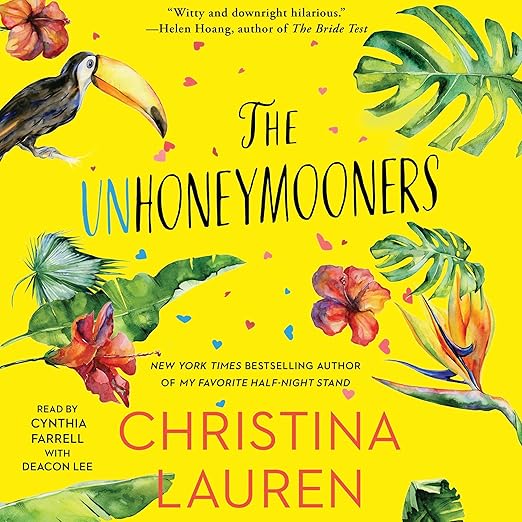
I listened to The Unhoneymooners on a day in February when winter had been going on too long and I needed exactly what the book promised: sun, banter, and a fake honeymoon in Maui. It delivered all three efficiently and without apology, which is precisely the correct ambition for this kind of romantic comedy. I have been tracking the Christina Lauren catalog for a few years now, and this is one of the titles I recommend most readily to readers who want an on-ramp to the genre without the structural complications some of their other books carry.
The setup is genuinely clever. Olive Torres is the unlucky twin, she has been laid off, she seems to attract minor catastrophes, and on her sister Ami’s wedding day she is stuck being civil to the best man, Ethan Thomas, whom she has strongly and specifically disliked for years. When the entire wedding party gets food poisoning except for Olive and Ethan, there is a free honeymoon in Hawaii suddenly up for grabs, and neither is willing to let the other take it. The result is a truce, a flight to Maui, and ten days of pretending to be newlyweds. The structure is as clean as romantic comedy setups get.
Why the Enforced Proximity Generates Real Friction
The reason the premise sustains nine hours rather than collapsing after the initial joke is that Christina Lauren are careful to give the enforced proximity genuine stakes beyond whether the two protagonists will admit their feelings. Olive has actual reasons to dislike Ethan, not just the contrived incompatibility that props up weaker entries in the genre. Her suspicions about him involve her sister’s wellbeing, and the book takes that thread seriously enough that the resolution of the central conflict means resolving two separate problems, not one.
One reviewer noted that the book had her laughing at times and crying at other times, that is an accurate account of the tonal range. The comedy runs highest in the food-poisoning sequence and in the early Maui scenes where the charade is most fragile. The emotional register shifts in the final act when the book’s deeper conflict surfaces, and that shift is well-managed. Cynthia Farrell’s narration handles both registers without making either feel like an intrusion on the other.
Cynthia Farrell and the Difficulty of First-Person Romance
First-person romantic comedy in audio lives or dies by whether the narrator can make the protagonist’s interiority feel genuine rather than performed. Farrell’s Olive is self-deprecating without being tiresome, funny without milking the laughs, and convincingly wrong about things in ways that feel like character rather than plot convenience. Her pacing is well-calibrated, the quick-fire banter scenes do not blur together, and the slower, emotionally heavier scenes do not drag. One reviewer described the book as having outstanding characters; I would credit Farrell’s interpretation equally alongside the writing.
The Ethan perspective is primarily available through Olive’s observations and their dialogue, and Farrell’s choices there are adequate rather than exceptional. The romance depends more on what Olive reveals about Ethan through her evolving assessment than on direct access to his interiority, and within that constraint Farrell works well.
The Third Act and Its Familiar Mechanics
A reviewer giving the book four stars noted that it had some problems in the third act after keeping her fully engaged through the first two. That observation recurs frequently enough in the broader readership to be worth addressing. The third-act conflict in The Unhoneymooners requires both protagonists to be less perceptive than the narrative has established them to be, and the resolution of the central misunderstanding turns on a coincidence that works emotionally but feels slightly engineered. These are genre conventions rather than personal failures of the book, and listeners who have read widely in romantic comedy will find them familiar rather than disqualifying.
At nine hours and fourteen minutes, this is a compact listen that does not overstay its welcome. The Hawaiian setting contributes atmosphere rather than substance, which is probably the right call, making the location more prominent would have slowed the pacing that keeps the comedy alive.
Who Should Listen and Who Should Skip
Listen if enemies-to-lovers comedy with a structurally tight premise and a likable first-person narrator sounds right for your current needs. The Unhoneymooners is one of the genre’s more reliable texts, it does what it does cleanly and without pretension. The nine-hour runtime is also a genuine virtue for listeners who want something complete but not sprawling.
Skip if you require dual narration to engage with romantic comedy, the entire book is Olive’s perspective, and Ethan’s inner life is never directly available to the listener. Also skip if third-act misunderstandings in romantic comedy actively frustrate you; this one is present and fairly conventional.
Frequently Asked Questions
Does The Unhoneymooners connect to other Christina Lauren books, or is it standalone?
Fully standalone. While Christina Lauren has published books with overlapping characters in some series, The Unhoneymooners has no narrative connection to their other titles. You can start here without prior knowledge of the catalog.
Is the food poisoning humor handled tactfully, or is it played for gross-out comedy?
It is played for situational comedy, the humor is in the logistics and social awkwardness of the wedding falling apart rather than in graphic physical detail. The food poisoning is the setup mechanism that gets Olive and Ethan to Hawaii alone; it is not the ongoing joke once the story gets underway.
How closely does The Unhoneymooners resemble The Paradise Problem? I see Christina Lauren wrote both.
Both are standalone romantic comedies with fake-relationship premises. The key difference is premise depth: The Paradise Problem leans harder into class conflict and inherited wealth as an ongoing structural element, while The Unhoneymooners is more focused on the contained situation of the fake honeymoon and a secret Ethan is holding. The Unhoneymooners is generally considered the cleaner execution of the two setups.
Are there content warnings for this book beyond standard romantic comedy?
Mild romantic and some mildly steamy content, consistent with Christina Lauren’s general register. The primary emotional tension involves a family secret that Olive uncovers partway through, which lands with genuine weight before the comedic resolution, listeners sensitive to family-betrayal themes should know that element is present.