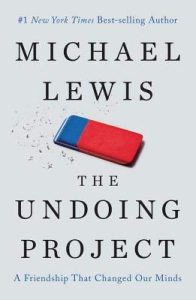
I came to The Undoing Project later than I should have, having assigned myself Kahneman's Thinking, Fast and Slow first and then set Lewis's account of the collaboration aside for what turned out to be two years. When I finally listened, I understood immediately why this is the book that readers often recommend first when someone expresses interest in behavioral economics. Lewis does something that Kahneman's own writing, meticulous and rigorous as it is, could not do: he restores the human story behind the ideas.
The book's central subject is the collaboration between Daniel Kahneman and Amos Tversky, two Israeli psychologists whose partnership produced some of the most consequential research in the history of social science. Their papers on systematic human cognitive error, what they called heuristics and biases, created the field of behavioral economics, influenced medicine, public policy, finance, and professional sports, and eventually won Kahneman the Nobel Prize in Economics. Tversky died in 1996, before the Nobel was awarded; the relationship between the two men, its extraordinary productivity and its eventual fracturing under the weight of unequal recognition, is the emotional engine of Lewis's account.
Our Take on The Undoing Project
Michael Lewis is a narrative journalist rather than an academic historian, and his method is to find the human story inside the data story, the relationships and personalities that generated the ideas, and to use that human story as the frame through which the ideas become comprehensible to a general audience. He has applied this method to Wall Street in Liar's Poker, to baseball analytics in Moneyball, and to the 2008 financial crisis in The Big Short. In each case, the ideas arrive through the people rather than despite them.
With Kahneman and Tversky, this method produces one of Lewis's most fully realized books. The subject matter is ideally suited to his approach: two men of extraordinary intellectual force, with contrasting personalities, coming together at a historically specific moment in Israeli academic life, producing work that neither could have produced alone, and eventually discovering that the world could not hold their collaboration and their separate identities simultaneously. The friendship is a great one in the literary sense; it has the architecture of tragedy as much as intellectual biography.
Why Listen to The Undoing Project
Lewis is careful to explain the actual research, not just its applications and reputation, and this is where The Undoing Project earns its serious-nonfiction credentials. The experiments that Kahneman and Tversky designed to reveal systematic errors in human judgment, the representativeness heuristic, availability bias, prospect theory, the framing effect, are explained with enough precision that listeners come away with a genuine understanding of what was proven and why it mattered. Lewis resists the temptation to simplify to the point of distortion, which is a real risk when presenting academic psychology for a general audience.
The applications section is where the book's influence becomes most tangible. When Lewis traces the impact of Kahneman and Tversky's work on medicine, showing how doctors and patients systematically misframe risk and probability, and on professional sports through the analytics revolution that Moneyball had already documented, the scope of the research becomes viscerally clear. These were not ideas that stayed in journals; they migrated into every domain where human beings make decisions under uncertainty, which is to say everywhere. The breadth of that reach is one of the things that makes the book feel important rather than merely interesting.
What to Watch For in The Undoing Project
Jason Reynolds brings a journalist's authority to Lewis's prose. He reads with forward momentum, understanding that Lewis's chapters build toward revelations that the narration should not forestall by being too deliberate. At the same time, he slows appropriately for the experimental descriptions and the moments of biographical intimacy, particularly in the chapters that deal with the deterioration of the Kahneman-Tversky friendship under the pressure of public recognition. Those passages have real emotional weight, and Reynolds handles them without overreach.
The almost-eleven-hour runtime feels well-paced throughout. Lewis structures his books like thrillers, with carefully managed reveals and a sense of propulsion that makes you want to know what happens next even in a story where the broad outlines are historically documented. Reynolds honors that structure in the narration, keeping the pace alive without losing the book's intellectual seriousness. The performance is one of those that you stop noticing as a performance because it integrates so completely with the material.
Who Should Listen to The Undoing Project
There is a real argument that The Undoing Project is best encountered in audio rather than in print. Lewis's sentence-level craft benefits from being heard; his rhythm and momentum are partly acoustic qualities that translation to audio enhances rather than compromises. Reynolds's narration adds a quality of presence, of being told this story by someone who understands it, that feels appropriate for a book about how ideas pass between minds.
Listeners already familiar with Kahneman's own work will find Lewis's account a complement rather than a substitute: where Thinking, Fast and Slow gives you the science in its own terms, The Undoing Project gives you the science as human achievement, embedded in two specific lives and one extraordinary partnership. Either is a legitimate entry point; but Lewis provides what Kahneman, by the nature of his project, could not offer: emotional access to the human cost of the collaboration. For a book that is nominally about cognitive science, The Undoing Project carries genuine grief in its final chapters, and Reynolds's narration honors that weight without sensationalizing it. That combination of intellectual rigor and human feeling is what makes this one of the more lasting works of popular nonfiction of the past decade.
- Narration: Jason Reynolds brings a narrative journalist's authority to Lewis's prose, reading with the same confidence and clarity that made the text a bestseller.
- Themes: Friendship and intellectual collaboration, the architecture of human error, how ideas change history
- Mood: Intellectually absorbing with an unexpected emotional depth about friendship and loss
- Verdict: Michael Lewis at his best: a dual biography that illuminates behavioral economics through the extraordinary friendship of Kahneman and Tversky.