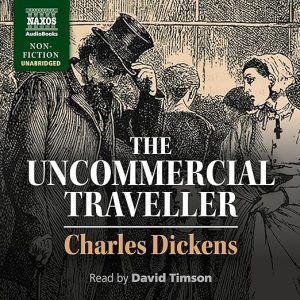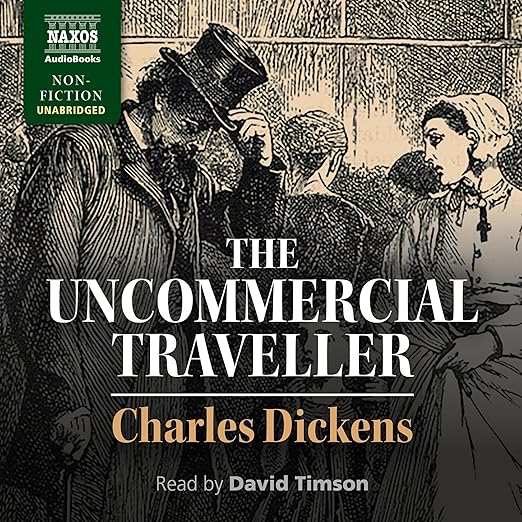
Charles Dickens invented a persona for these sketches and named him the Uncommercial Traveller: a wanderer who goes about on no specific business, observing Victorian England with the warmth and fleet-footed wit familiar from the novels, but without the structural obligations of fiction. This audiobook, narrated by David Timson across 17 hours and 40 minutes, brings that persona to life in a format that suits the material with unusual precision. Dickens at his best was a writer of accumulated detail, of streets and faces and the specific weight of places, and the audio format allows that accumulation to build at its natural pace rather than at the speed of a reader's eye moving down a page.
The Uncommercial Traveller was first published in All the Year Round between 1860 and 1869, making it among the last sustained non-fiction writing Dickens produced before his death in 1870. The sketches are semi-autobiographical: Dickens writing about what he actually saw, in the places he actually visited, mixed with memory and imagination in proportions that he did not always disclose. The subjects range across the full texture of mid-Victorian life. Railways. Theatres. Docklands. Hospitals. The police. Mortality. Modernization. Tom-cats. A sherry bill belonging to a man named Mr. Indignation Cocker. The breadth is characteristic. Dickens's eye did not sort experience into subjects worthy of his attention and those unworthy of it. Everything was material, and the Uncommercial Traveller is the most direct record of that indiscriminate curiosity at work.
The Review
The comparison to a Victorian blogger is accurate and worth developing. These sketches have the quality of first-person observation written directly from experience, without the editorial distance that the novel form requires. When Dickens describes a wilderness of dirt, rags, and hunger, he is not building toward a plot point or establishing a character's moral situation. He is reporting what he saw and asking what it means. That directness is both the text's strength and its challenge. Readers who love Dickens in the novels may find the absence of narrative structure liberating or disorienting depending on what they came looking for and what they expect the writer's voice to be doing at any given moment.
One reviewer noted that some chapters were very interesting while others were impossible to get through. That is an honest response to the text. The sketches are uneven, and the unevenness is real rather than a failure of the listener's attention. Dickens wrote them across nearly a decade and under varying conditions of attention and inspiration. The best ones, the meditations on mortality, the London street observations, the remembrances of childhood and the past, achieve a quality of prose that stands with the best writing in the novels. Others are occasional, topical, and primarily of historical rather than literary interest to modern readers. A 17-hour audiobook that contains both extremes requires a listener who is prepared to settle in for the full range rather than demanding consistent excellence across every sketch.
What Makes The Uncommercial Traveller Worth Hearing
David Timson is the primary reason to choose the audiobook format. His narration of Dickens has attracted consistent praise from publishing reviewers over the course of his career, with Publishers Weekly's assessment of true artistry representing a specific critical judgment rather than generic positive language. Timson locates the Uncommercial Traveller's particular register: funny and affecting by turns, the voice of a man who notices everything and has opinions about all of it, but whose opinions are generally in the service of human sympathy rather than of judgment or superiority. The tonal range across 17 hours is genuinely demanding, and Timson manages it with the flexibility that separates a career Dickens narrator from a competent general reader.
The length is worth addressing directly because it is a real consideration. At 17 hours and 40 minutes, this audiobook is not a casual commitment. But the digressive nature of the material, its quality of going wherever the Uncommercial Traveller's attention leads without apology, actually suits extended listening more naturally than concentrated reading. These sketches were written for serial consumption over years, and they reward the kind of patient, ambient engagement that long audiobooks support. A chapter during an afternoon walk. Another during a commute. The accumulation of the Uncommercial Traveller's London over weeks of listening produces a different and arguably more authentic encounter with the material than a compressed reading session allows.
The Caveats
The unevenness is real and should not be minimized for prospective listeners. Dickens at his least inspired is still Dickens, and there is pleasure in the prose even in the weaker sketches, but listeners who expect every section to reach the level of the most celebrated passages will find the experience frustrating in ways that patient listeners will not. The rating of 3.9 across 135 reviews reflects a genuine split: readers who love Dickens and find this collection a treasure, and readers who found the less focused sketches harder to sustain than the novels they came from.
The topical references also require occasional patience. Dickens was writing about specific events, places, and figures of his time, and some of those references have become obscure to modern readers without annotation. Timson's narration does not add explanatory footnotes, and listeners who want historical context for the more topical sketches may want to have a general Dickens biography or Victorian reference available for the passages that depend most heavily on period context. This is not a significant barrier to engagement, but it is worth naming for listeners approaching the text cold, particularly for the sketches that engage directly with Victorian institutional life, the police, the hospitals, and the docklands material where the specific conditions Dickens is describing have changed beyond recognition.
Who Should Pick Up The Uncommercial Traveller
Dickens readers who have worked through the major novels and want to hear the writer's voice in a more immediate, observational mode will find this audiobook a valuable and genuinely different extension of their engagement with his work. Listeners interested in Victorian social history who want primary source prose rather than modern historical narration will find Dickens's reportage exceptionally vivid and specific. Those coming to Dickens for the first time should begin with the novels rather than here. And listeners who require consistent narrative momentum and structural resolution should know the sketches do not provide that quality. For anyone who loves Dickens's prose for its own sake, who wants to hear that particular sensibility wandering through London and observing what it finds there, The Uncommercial Traveller with Timson narrating is as close as the audio format can bring you to the experience of reading Dickens at his most unguarded and most honest.
- Narration: David Timson, consistently praised for what Publishers Weekly called 'true artistry' in his Dickens narration, brings the Uncommercial Traveller's wit and compassion fully to life across 17 hours.
- Themes: Victorian urban life, social observation, memory and modernity
- Mood: Rich, digressive, and flickering between comedy and melancholy in the way Dickens does best
- Verdict: An audiobook that rewards Dickens readers who want to hear the novelist thinking aloud, wandering through London and beyond, without the formal demands of novel structure.
Before You Listen
Is this audiobook appropriate for listeners who have never read Dickens before?
First-time Dickens readers are better served by one of the major novels. The Uncommercial Traveller assumes some familiarity with Dickens's voice and with Victorian England, and its pleasures are most accessible to listeners who already have a relationship with his writing style. Those new to Dickens should begin with David Copperfield, Great Expectations, or Bleak House.
How does the audiobook handle the unevenness of the material? Are all the sketches equally engaging?
The honest answer is no. The sketches vary considerably in quality and topical accessibility. Some are among the finest observational prose Dickens wrote. Others are occasional pieces tied to specific Victorian events that have lost much of their contemporary relevance. Timson's narration keeps the weaker sections listenable, but listeners should approach this as a collection with variable peaks.
At 17 hours and 40 minutes, how should a listener approach the pace of this audiobook?
The sketches were written for serial rather than continuous consumption, and the audiobook suits that approach. Listening in discrete sessions of a chapter or two at a time, across several weeks, produces a more natural engagement than attempting to listen in compressed blocks. The digressive quality of the writing actually benefits from ambient, extended listening.
David Timson is praised specifically for his Dickens narration. What makes his performance in this audiobook notable compared to other narrators?
Timson has spent his career with Dickens and understands that the Uncommercial Traveller requires a vocal quality that is warm and witty without condescension. His range across the comic and affecting passages, and his ability to sustain that tonal balance across 17 hours, is what Publishers Weekly's 'true artistry' assessment is pointing toward. He makes the weaker sketches listenable and the best ones genuinely moving.