Quick Take
- Narration: Kate Mulligan handles the investigative narrative frame and the historical reconstruction with a steady warmth that serves the material’s emotional weight without becoming manipulative.
- Themes: Holocaust survival and loss, the ethics of silence, family responsibility across borders
- Mood: Quiet, devastating, and meticulously researched, the kind of nonfiction that accumulates its grief rather than declaring it
- Verdict: One of the more quietly extraordinary pieces of Holocaust nonfiction to emerge in recent years, built from a single unanswered letter into a full reckoning with the consequences of inaction.
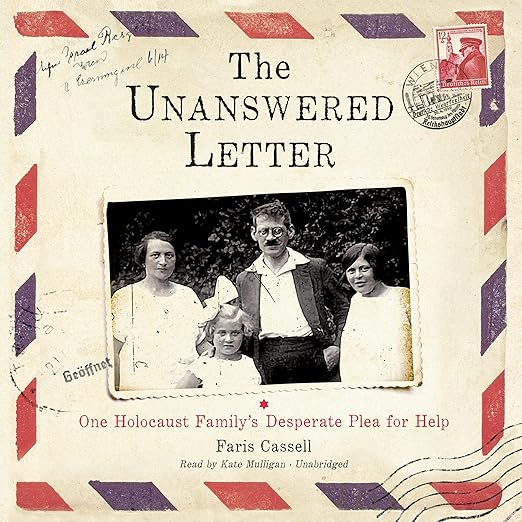
There is a sub-genre of Holocaust nonfiction that begins with an archival discovery and expands outward into something larger than anyone anticipated. The Unanswered Letter belongs firmly to that tradition, and it is one of the best examples of it I have encountered. Journalist Faris Cassell found, decades after the fact, a desperate letter written in August 1939 by a Jewish man named Alfred Berger in Vienna. He had found the address of an American family sharing his last name through a directory and had written to strangers begging to be sponsored out of Europe. The letter was never answered. The question Cassell spent over a decade pursuing is: what happened?
The letter’s opening lines, quoted in the synopsis, carry all of the horror of what they represent: By pure chance I got your address… I beg you instantly to send for me and my wife. Written just days before Germany invaded Poland, in a city already transformed by the Anschluss, by a man who understood exactly what was coming. And then silence, on the other end, from a family in America that apparently received the letter and chose not to respond.
Our Take on The Unanswered Letter
What distinguishes Cassell’s book from other Holocaust investigative narratives is the scope of its research and the structural decision to follow multiple branches of the Berger family simultaneously. Reviewer Dawn Omaha, who describes herself as having read many books on the Holocaust, notes that this book stands out for the breadth and depth of the story and the astonishing level and quality of research. Each family member, she observes, followed a different trajectory, which allows the book to illuminate multiple aspects of the Holocaust experience, escape, hiding, deportation, survival in different countries, through a single family’s story rather than restricting itself to a single narrative thread.
Cassell’s investigation spans archives and offices in Austria, Belarus, Israel, and the Czech Republic. She interviewed descendants. She found letters, photographs, sketches. The accumulation of evidence gives the book an intimacy that purely historical accounts cannot achieve, you are not reading about statistics or policy. You are reading about specific people making specific decisions in a city that was taking them apart.
Why Listen to The Unanswered Letter
Kate Mulligan is an excellent narrator for this material. The book operates in two registers simultaneously: Cassell’s first-person investigative present, and the reconstructed past of the Berger family. Mulligan moves between those registers with clarity, giving the historical sections warmth and the investigative sections appropriate journalistic restraint. She does not impose emotion on the text, she allows the material’s own weight to do the work, which is exactly right for a subject where the facts themselves are devastating enough that no additional manipulation is needed.
At fifteen hours and thirty-one minutes, this is a substantial audiobook, and reviewer M. James notes barely being able to put it down, listening until finished with many tears shed. That level of engagement over fifteen hours speaks to how well Cassell has structured the investigation: there is genuine suspense in the archival search even when you know the general outlines of what happened to European Jews in this period. The specific question, did the American Bergers know, did they choose not to act, could they have saved Alfred and his wife, sustains the inquiry throughout.
What to Watch For in The Unanswered Letter
The book does not offer easy answers about the American Bergers’ inaction. Reviewer M. James raises the question of whether the Los Angeles Bergers could have afforded to sponsor Alfred and Hedwig, which Cassell addresses with appropriate care rather than condemnation. The ethical weight of the unanswered letter is real, but Cassell is too careful a journalist to flatten the American family into simple villains. The moral complexity of people who may have failed to act for reasons that were not entirely venal is central to what makes the book serious.
Reviewer EAD’s note that Cassell shows how ordinary people were forced to or, worse, were willing to participate in the persecution and murder of Jews points to the book’s broader argument: this is not just the story of one family, but of the systems and social pressures that made inaction and complicity possible at every level from Vienna to Los Angeles.
Who Should Listen to The Unanswered Letter
Readers of narrative nonfiction with an interest in Holocaust history, investigative journalism, or the ethical questions raised by archival discovery will find this essential. It works well alongside Deborah Lipstadt’s historical writing, Erik Larson’s In the Garden of Beasts, or Ariel Sabar’s Veritas, books that use deep investigation of specific stories to illuminate larger historical and moral questions.
This is not easy listening, and it should not be. But it is carefully and compassionately done, which matters enormously for a subject that is easily mishandled. Come prepared for the weight of it, and come prepared to think.
Frequently Asked Questions
Does The Unanswered Letter reveal definitively why the American Bergers never responded to Alfred’s letter?
Cassell investigates this question carefully across the full decade-long research process, and the book provides what evidence exists without offering a single definitive condemnation. The moral complexity of the silence, whether it was ignorance, fear, financial limitation, or something else, is treated with journalistic care rather than resolved into simple blame.
How does Kate Mulligan handle the dual narrative structure of present-day investigation and historical reconstruction?
Mulligan distinguishes clearly between Cassell’s first-person investigative voice in the present and the reconstructed historical narrative of the Berger family. She brings warmth to the historical sections and appropriate restraint to the journalistic frame, allowing the material’s own emotional weight to carry rather than imposing additional manipulation.
Is The Unanswered Letter primarily about the Berger family or about the Holocaust more broadly?
It is rooted in the specific story of the Berger family, but because Cassell follows multiple branches of the family simultaneously, each following a different trajectory through the Holocaust, it illuminates multiple aspects of the broader history. Reviewer Dawn Omaha notes that this multi-branch approach covers far more of the historical spectrum than a single-person narrative could.
How does The Unanswered Letter compare to other narrative Holocaust nonfiction at a similar level of research depth?
It belongs in a tradition with books like Erik Larson’s In the Garden of Beasts and Daniel Mendelsohn’s The Lost, deeply researched, archivally grounded, and built on a specific investigative question rather than broad historical survey. What distinguishes Cassell’s work is the epistolary starting point: the single letter creates a specific moral question that the investigation pursues with unusual focus.