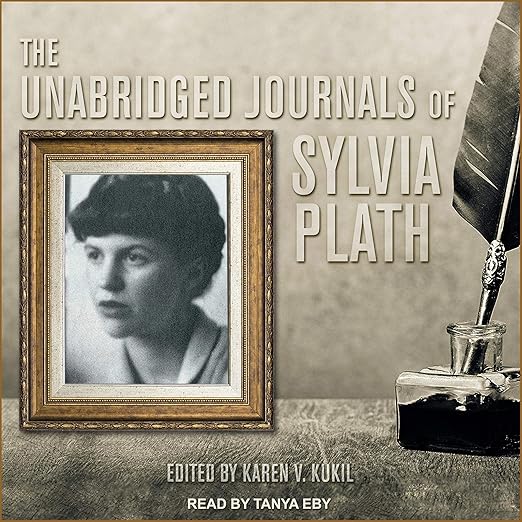
- Performance: Tanya Eby reads twenty-three notebooks and fragments alone across thirty hours and twenty-six minutes, with nothing stating how the dated entries and headings are handled.
- What it covers: A working writer's private record, desperation and discipline, the archive standing behind the poems.
- Feel: Intimate, unshaped, relentless.
- Our call: Completeness is the whole argument here, and it only pays off if you already know the poems.
Most of the writing under this audiobook is recent. Four of the five responses carry 2024 or 2025 dates. The fifth is dated April 28, 2007, twelve years before Tantor Audio published this recording, and that fifth entry is the one making an argument for the book instead of simply approving of it. That gap is a useful measure of how a title like this collects its readers: slowly, one at a time, and long after anybody stopped calling it new. The tag on this record, Diaries and Correspondence, is for once exactly right.
Eby Reads the Two Journals Hughes Unsealed
If you need to know exactly what you are getting, the publisher's paragraph is unusually precise. These are the journals published in their entirety, faithfully transcribed from twenty-three journals and journal fragments owned by Smith College. The edition takes in two journals that Plath's husband, Ted Hughes, unsealed just before his death in 1998. A heavily abridged version of the diaries had appeared in 1982, and the point of this one is everything that earlier version left out. That is a specific editorial claim, and it is made plainly, with nothing left to inference.
When a publisher says entirety, thirty hours and twenty-six minutes is what entirety costs. Tanya Eby reads all of it, and the assignment is stranger than a novel of the same length would be. Journals are not written to be read aloud. They carry no chapter structure, no narrative shaping and no consistent register, and they repeat themselves because nobody was keeping score. Twenty-three notebooks of that read by one person is a real feat of sustained attention, and not one writer here has thought to mention it. Tantor Audio dates the release to May 28, 2019, and nothing breaks the recording into parts or names a single chapter.
One Vote Counter, Five Five-Star Responses
Anyone looking at the badge will notice that the arithmetic refuses to close. The counter says one vote, and the page shows five written responses graded at five stars apiece. A 4.8 is not something one whole-star grade can produce, whatever rounding you apply, and five fives will not produce it either. Whatever that badge is measuring, it is not what the page displays. Every visible grade also sits above it, which is a second small puzzle: five people awarded five stars, and the number on top still stops short of five. It is a small thing, and on a book whose whole selling point is completeness, an incomplete number sitting at the top has a certain irony about it.
Listeners hoping for guidance from the column will find affection where they wanted assessment. One entry, in its entirety, says the writer is in love with this book and that it is truly so worth it. Another arrived by way of Gilmore Girls, read out of pure curiosity as somebody who also writes their thoughts down, admits to being most curious about Plath's last moments, and reports two weeks spent reading and a strange sense of departure at the finish. A third grades the physical condition of a paperback. A fourth is a grandparent relaying a granddaughter's verdict at second hand.
Nothing else on the page does what the 2007 entry does. It calls the journals an archive of mid twentieth-century America and a gold mine of insight into one of the world's premiere writers, and it describes arriving at Plath sideways, well outside any course of study. It also breaks off two words into its own next sentence, and that is a real loss, because it was plainly about to say something about the entries themselves. That is the closest this record comes to a critical account, and the display cut it short. Its date also puts it seventeen years ahead of the next-oldest entry on the page.
Grades Pooled Though the Objects Aren't the Same
By the time you reach the third response you are reading about paper again. It says the paperback is loved and the copy has no flaws whatsoever, which is a statement about manufacturing rather than about Plath. On a thirty-hour recording it means nothing at all, and it carries the same five stars as the notes that discuss the writing. That is the recurring hazard of a page like this one: the grades are pooled, and the objects being graded are not the same objects.
For a book of this sort, the honest warning concerns the material rather than the format. The publisher's paragraph does not hedge. It promises the intensity of Plath's personal and literary struggles, her frequent desperation, and the bravery with which she faced her demons, and it notes that the poems everyone knows came in the last seven months of her life. One response says outright that curiosity about those last moments was the reason for picking the book up. Thirty hours inside that, with no narrative shaping to carry you between the hard passages, is a heavier commitment than the runtime alone suggests. No content note appears in any field.
For This Material, Completeness Is the Whole Argument
Three kinds of listener will get real value here. Anyone who already knows the poems and wants the workshop behind them, since the description places the famous work in the last seven months of a life the notebooks document year by year. Anyone who keeps a journal and wants to see what a serious one looks like across years, which is precisely what one of these writers describes wanting when it says it also writes its thoughts down. And anyone drawn to the archive itself, the twenty-three notebooks at Smith College with two of them unsealed only in 1998, an editorial fact the publisher puts in its second sentence. The word unabridged is doing honest work in the title, and for this material completeness is the entire argument.
It is not the format for a first encounter. Do not start here if you have never read the poems, because the journals assume the life and the work and explain neither, and thirty hours of assumed context makes for a long walk in the dark. Do not start here either if you need structure, because nobody listening can skim, check a date at the head of a page, or turn back when a name recurs eleven hours later. Plath kept these notebooks for herself, and hearing thirty hours of them read aloud is an intimacy the printed edition lets you put down more easily.
Does an unabridged journal work as an audiobook?
It is the hardest sort of text to take in by ear. Journals have no chapters, no narrative shape and no consistent register, and nobody listening can skim, check a date, or turn back when a name recurs hours later. Tanya Eby carries all thirty hours alone. If the archive whole is what you are after, this is the only way to have it.
How reliable is the 4.8 badge on this audiobook?
Not very. The counter records a single vote while five written responses sit underneath it, and every one of those five is graded at five stars. A 4.8 cannot be produced by one whole-star vote, and it cannot be produced by five fives either. The number is measuring something the page does not display.