- Big ideas: small business tax strategy, IRS compliance, deduction maximization
- Atmosphere: Confident and instructional, with the energetic pitch of someone who has cracked a code they want to share
- Worth it?: A practical tax planning overview for small business owners who want plain-English guidance on deductions and business structures, best supplemented by a tax professional for entity-specific decisions.
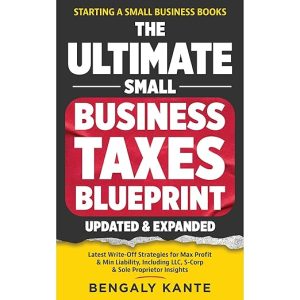
THE ULTIMATE SMALL BUSINESS TAXES BLUEPRINT lands in a crowded category - small business tax guides pitched at owners who are intimidated by the IRS and convinced they are overpaying. Author Bengaly Kante makes the case that most small business owners do face real, solvable problems: missing deductions, incorrect business structure choices, and confusion about compliance requirements that ends up costing them money. This audiobook, rendered via Virtual Voice synthesis at five hours and twenty-seven minutes, sets out to address those problems in plain English rather than the technical language that makes most tax literature inaccessible to non-specialists. The synthesized narration is functional and consistent, though listeners who prefer human narration for dense instructional content should factor that into their format decision.
Case Studies That Explain the Why Behind Rules
The book's strongest quality is the one multiple reviewers independently identified: it explains the "why" behind tax rules, not just the mechanical "how." One reviewer described moving from being an anxious filer to a confident planner after working through the material, which is the outcome a practical tax guide is meant to produce. Another called it the kind of tax book that transforms the traditionally intimidating world of business taxation into an accessible and actionable resource - a description that captures both the ambition and the actual reach of the content.
Kante covers the key pillars that small business owners consistently struggle with: business structure choices across LLC, S-Corp, sole proprietor, and freelancer categories; deduction identification and documentation; IRS compliance and audit-risk reduction; and year-round tax planning rather than reactive annual filing. The scope is appropriate for the runtime - five hours is enough to address each area at a useful introductory level without going deep enough into any single area to replace a qualified accountant's advice for entity-specific situations.
The real-life case studies that reviewers mention are one of the book's more effective features. Abstract tax concepts land differently when anchored to specific scenarios: a freelance consultant who structured their business incorrectly and paid a deductible cost over multiple years, or an e-commerce operator who discovered deductible categories they had not been claiming. The audiobook format suits case-study learning particularly well - the scenarios play out like short narrative units that the listener can absorb before the next principle is introduced.
Focused Listening Beats Background Play Here
The audio format suits this material better than might be expected for a tax guide. The plain-English approach Kante takes means that even when the synthesized narration flattens some of the natural emphasis a human narrator would add to key points, the content is clear enough to follow without visual aids. The done-for-you checklists and templates mentioned in the synopsis are the one area where the audiobook format shows its limits - listeners who want those physical tools will need to seek out the print or ebook edition to access them directly.
At five hours and change, this is a listening commitment well-suited to a focused work session rather than background play. Tax strategy requires active attention, and Kante's structure rewards listeners who are tracking the principles rather than absorbing the material passively. The chapter-by-chapter approach - moving from business structure through deductions through compliance through planning - allows a listener to stop and take notes at the end of each section, which is how the material is best processed.
One reviewer noted the guide breaks everything down in a way that's actually understandable and useful, whether you are running a side hustle, a full-time business, or a small company. That range is accurate - the audiobook explicitly addresses multiple business structures and sizes rather than assuming a single listener profile. Sole proprietors and LLC owners will find direct application throughout; S-Corp owners will find the structural discussion most useful; freelancers will likely connect with the deduction-identification sections most readily.
Loud Marketing, Sober Content, Flat AI Delivery
The title and synopsis have the high-energy marketing register common to self-published business guides - "slash your tax bill," "little-known loopholes," "IRS maze" - which signals a positioning choice that the content itself somewhat outgrows. The underlying material is more sober and more genuinely useful than the framing suggests, but listeners who are put off by that register should push past it, because the actual tax guidance is practical and plainly argued.
The Virtual Voice narration is the format caveat to name directly. Synthesized narration has improved substantially in recent years, and at five hours the content is dense enough that the functional consistency of Virtual Voice is workable. But for a tax guide where the listener needs to absorb precise numerical thresholds, entity-specific distinctions, and compliance requirements, a human narrator's natural emphasis and pacing would add value. Listeners who learn best from audio instruction may want to complement this with the print edition for reference.
Made for US Solo Owners Filing Reactively
This audiobook is well-matched for small business owners who feel they are making tax decisions reactively rather than strategically - filing under pressure rather than planning throughout the year. Solo practitioners, freelancers, LLC holders, and small company operators in the US market are the primary audience. The plain-English approach to business structure choices is particularly useful for early-stage owners who have not yet determined whether their current structure is optimal for their tax situation.
Listeners who already work regularly with a CPA or tax attorney, or who have existing comprehensive tax strategy in place, will find this more review than revelation. And listeners seeking guidance on individual tax situations rather than business entity taxation should know the audiobook is explicitly oriented toward business owners rather than general personal finance listeners. The 185-review base and 4.7 rating suggest this is a guide that delivers on its core promise for its target audience.
Before You Listen
Does this audiobook cover all common small business structures - LLC, S-Corp, sole proprietor, and freelancer?
Yes. Kante explicitly addresses all four structures and discusses how business entity choice affects tax liability and available strategies. Each structure is treated in enough detail for a business owner to understand whether their current setup is working for them or worth reconsidering.
Is the audiobook version of THE ULTIMATE SMALL BUSINESS TAXES BLUEPRINT as useful as the print edition for reference?
The audiobook delivers the instructional content well, but the done-for-you checklists and templates mentioned in the synopsis are better accessed in print or ebook format. Listeners who want the full toolkit alongside the audio guidance may want to pair both formats.
Does the audiobook require prior tax knowledge, or can a complete beginner in small business finances follow it?
It is designed for non-specialists. Kante's stated approach is to explain the 'why' behind tax rules in plain English rather than technical language. One reviewer specifically described moving from anxious filer to confident planner after working through the material, which reflects the entry-level orientation.
Does the Virtual Voice narration affect how usable the audiobook is for dense tax content?
It is functional but worth noting. Synthesized narration delivers the content consistently and at a workable pace. For listeners who need the natural emphasis a human narrator would place on key figures and distinctions, pairing the audiobook with the print edition for reference sections is a reasonable approach.