Quick Take
- Narration: Cindy Kay’s narration is polished and intelligent, matching Kelleher’s essayistic rhythm without over-smoothing the more personal passages. A strong pairing.
- Themes: The hidden costs of desire, beauty as complicity, memoir and cultural history braided together
- Mood: Curious and unsettling in equal measure, like turning over a beautiful stone
- Verdict: Kelleher writes about aesthetics the way great food critics write about taste: sensuously, precisely, and with full awareness of what pleasure costs.
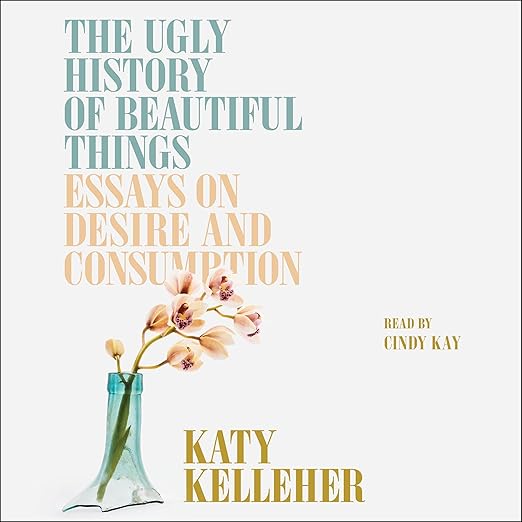
I started The Ugly History of Beautiful Things on a slow afternoon when I had lipstick on my desk and silk on my mind, though not for reasons I can explain beyond the accident of what I happened to be wearing. Within the first chapter I discovered that the lipstick contained crushed beetle shells and the silk had a history of labor conditions I had preferred not to think about. Katy Kelleher has written a book that is, in the most productive sense, uncomfortable. By the end of its nearly nine hours I was more aware of what I desire and why, and less comfortable with those desires, and more committed to them anyway. That is a difficult trick to pull off in a single essay collection, let alone in audio form.
Kelleher is a Paris Review contributor and a writer with a background in home, garden, and design journalism. That combination gives the book its distinctive double register: she can tell you the crushed beetle name (carmine, from the cochineal insect) and the long history of European trading empires built on its extraction, and then immediately place that knowledge inside the texture of her own vanity routine. The personal and the structural are never far apart, which is what prevents the book from becoming a guilt-dispensing machine.
Our Take on Essays That Make Beauty Complicated
The collection covers silk, perfume, flowers, cosmetics, gemstones, marble, porcelain, and several other objects of desire, approaching each through a combination of natural history, social history, and memoir. The silk essay is one of the strongest: Kelleher traces the industry from ancient China through the European silk roads, the brutal conditions of nineteenth-century textile mills, and the contemporary fast-fashion supply chain, all while weaving in her own troubled relationship with a prom dress. The perfume chapter, which reveals the musk of rodents and the secretions of various animals embedded in luxury fragrances, is both genuinely astonishing and genuinely revolting in equal measure.
One reviewer described her as a writer’s writer generating a highlight reel of enviable sentences, which is accurate but slightly undersells the intellectual ambition. Kelleher is not writing beautiful prose about ugly things as a rhetorical exercise. She is genuinely trying to work out an ethical framework for desire, one that does not require either denial or complacency, and the essays are the thinking-through of that problem rather than the presentation of a solved solution.
Why Listen to Kelleher Through an Essay Collection Format
Essay collections in audio are a format that divides listeners sharply. Some find the episodic structure ideal for commutes, each chapter functioning as a complete listening unit. Others find the lack of narrative propulsion makes it easy to drift. Kelleher’s essays are long enough to develop genuine complexity but structured well enough that each one earns its conclusion. The running thread of her autobiographical material, returning throughout the collection to her childhood foraging for stones and shells, her teenage beauty rituals, her adult domesticity, gives the collection more coherence than most.
Cindy Kay’s narration deserves credit for maintaining that coherence. Kelleher’s prose has an essayistic cadence that can be difficult to navigate in audio: the sentences are crafted for the eye, with parenthetical qualifications and precise word choices that can disappear quickly in listening. Kay manages the pace well, giving those sentences room without slowing the momentum to a halt.
What to Watch For in the Gemstone and Porcelain Chapters
The essay on gemstones is the most explicitly political section of the collection, and it is the one most likely to produce genuine discomfort. Kelleher traces the diamond industry’s marketing creation of the engagement ring as an emotional necessity, the history of blood diamonds, and the ongoing devastation of artisanal mining communities, while being honest that she owns diamonds and has no immediate plans to stop. That honesty is the book’s ethical position: she is not interested in performative renunciation. She is interested in clear-eyed understanding as a precondition for ethical action.
The porcelain chapter surprised me most. Kelleher’s account of burnt cow bones baked into bone china is the kind of detail that reframes an everyday object permanently. Her discussion of the enduring appeal of what she calls the beautiful dead girl, appearing in decorative arts history across centuries, is the book’s most unusual and ambitious section, making a feminist argument through aesthetic history that I found genuinely original.
Who Should Listen to The Ugly History of Beautiful Things
Listeners who enjoy essay collections with intellectual and autobiographical depth, readers who responded to titles like Jenny Odell’s How to Do Nothing or Robin Wall Kimmerer’s Braiding Sweetgrass in terms of the careful attention brought to familiar things, or anyone with a professional or personal interest in design, aesthetics, and material culture will find this a rich listen. Those looking for a straightforward sustainability polemic or a guilt-free appreciation of beautiful objects will find Kelleher too honest for either position. The book asks you to hold complexity, and that is what it delivers.
Frequently Asked Questions
Is this book primarily memoir, cultural history, or environmental critique, and how does Kelleher balance those registers?
It is genuinely all three, with the balance shifting from essay to essay. The strongest sections integrate all three elements at once, using Kelleher’s personal experience as the emotional anchor for broader historical and ethical arguments.
Does Cindy Kay’s narration suit Kelleher’s essayistic prose style?
Yes. Kay handles the precision of Kelleher’s sentences without over-dramatizing them. The narration is intelligent and measured, which fits the intellectual tone of the essays well.
Does the book argue that we should stop buying beautiful things?
Explicitly not. Kelleher acknowledges the moral imperative to understand our desires while resisting the conclusion that desire itself is corrupting. The book argues for clear-eyed engagement rather than renunciation.
Which essays in the collection are considered strongest by readers?
Reviewers consistently highlight the gemstone and perfume chapters as particularly striking. The sections on silk, marble, and porcelain also receive strong praise. Individual responses vary, but the collection’s quality is generally consistent across essays.