Quick Take
- Narration: David Colacci brings clean, authoritative delivery suited to military chronicle, steady under the weight of casualty figures, respectful without tipping into ceremony.
- Themes: Pacific Theater ground combat, the cost of strategic necessity, frontline testimony versus command perspective
- Mood: Precise and somber, with the accumulated weight of a unit history written by men who were there
- Verdict: The best single-volume audio account of Iwo Jima for listeners who want chronological depth over cinematic drama.
My grandfather never talked about the Pacific. He talked around it sometimes, mentioned Guam in passing, referred to certain months of 1945 as a bad stretch, but the specifics never came. When he died, his service records told a story he had chosen to leave in silence. I thought about him often during the seven and a half hours I spent with this audiobook, not because it provided the emotional catharsis of personal narrative, but because it gave me the operational context he would have inhabited. The shape of those bad months, mapped in detail.
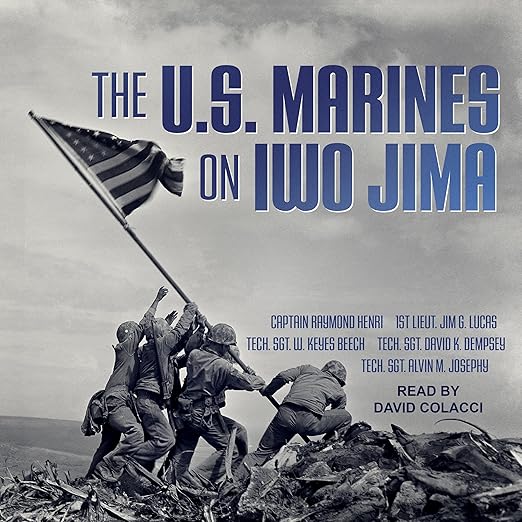
The U.S. Marines on Iwo Jima is an unusual document. It was written by five official marine combat correspondents who were present during the battle. Raymond Henri and four colleagues moved through the fighting and recorded what they witnessed and learned from interviews with frontline troops. Published shortly after the war, it represents something rarer than either a commanding officer’s memoir or a journalist’s dispatch: a step-by-step operational account produced by people who understood both the ground-level experience and the institutional structures shaping it.
The Ground-Up Chronicle
What distinguishes this account from the wave of popular Iwo Jima histories that followed it is the way it builds the battle from preparation through conclusion in strict chronological sequence. The audiobook opens with the months of planning and rehearsal that preceded the February 1945 landing: the intelligence failures, the debates about timeline, the decisions made at the command level that would determine how 60,000 marines encountered a volcanic island laced with interconnected tunnels and defended by roughly 21,000 Japanese soldiers who had spent months burrowing into the rock.
The battle unfolds in stages the correspondents tracked personally. The initial landings on the black volcanic sand, where men sank ankle-deep with every step and the terrain itself resisted movement. The flag-raising on Mount Suribachi, which the book contextualizes within the larger battle rather than treating it as the climax it later became in popular memory. The grinding, slow, extraordinarily costly weeks that followed Suribachi’s capture, as marines fought northward through a landscape that had been turned into a honeycomb of defensive positions.
Reviewer R. Bixby wrote that the book created the feeling of walking alongside the troops, and that is an accurate description of what the correspondents’ ground-level perspective produces. The book is not a tactical manual. It keeps the fighting human and located in specific terrain and specific bodies, rather than losing itself in unit designations or grid coordinates.
The Weight of One Third
The statistic the synopsis foregrounds, that one third of the 60,000 marines who landed ended the battle dead or wounded, functions as the book’s constant background frequency. It shapes every section. The planning chapters carry the knowledge of what those plans cost. The accounts of individual assaults on fortified positions accumulate their own arithmetic. The correspondents do not editorialize about the numbers. They let the documentation do the work, which is the right choice.
The book was produced in the institutional context of an official history project, which means it has both the advantages and limitations of that format. It is methodical, comprehensive, and scrupulously documented. It does not produce the psychological intimacy of a survivor memoir, and it does not pursue the revisionist analytical angles that post-Cold War historiography has opened up around the Pacific campaign’s strategic necessity. What it does is tell the story of the battle accurately and in full, from the men who were there.
David Colacci as Chronicler
Colacci is a reliable choice for this material. His voice carries the kind of measured authority that military history requires. He moves through the technical passages involving landing craft designations, battalion positions, and artillery coordinates without losing the thread of narrative, and he handles the passages of direct testimony with appropriate weight. He does not perform emotion for the listener. He trusts that the documented facts will produce it. For a seven-and-a-half-hour account of continuous ground combat, that restraint is essential.
There are moments when the prose itself reflects its 1940s composition. The correspondents wrote in a register that was formal and occasionally given to the patriotic framing that was standard for official documents of the period. Colacci navigates this without either playing it up or flattening it, which is the right calibration.
Who Should Listen and Who Should Look Elsewhere
This audiobook is at its best for listeners who want a structured, chronological account of the battle written by people who were there. It is the ideal companion for anyone who has seen the films about Iwo Jima and wants to understand what those dramatizations compressed or simplified. It is also a valuable primary-adjacent source for anyone studying Pacific Theater military history.
It is not the book for listeners seeking personal survivor narrative or psychological memoir. Reviewer H. Rhinehart is right that it is among the most important single-volume accounts of the battle. It is a work of institutional history rather than intimate testimony, and it should be approached in that spirit.
Frequently Asked Questions
Is this the same text as older print editions sometimes called ‘The U.S. Marines on Iwo Jima: The Battle and the Flag Raising’?
The core work is the same across editions, written by Raymond Henri and four fellow marine combat correspondents. The audiobook version running seven hours and thirty-six minutes covers the full battle chronologically, from preparation through the island’s capture. Different print editions have used variant titles but contain the same underlying text.
How much of the audiobook covers the famous flag-raising on Mount Suribachi?
The flag-raising is covered but is not given outsized prominence relative to the full battle. The correspondents were present during the entire campaign, and the book is proportional in its treatment. Suribachi receives its chapter, but the weeks of combat that followed it, which produced the majority of the casualties, receive equal or greater attention.
Does David Colacci’s narration handle the technical military terminology well?
Yes. Colacci navigates the unit designations, landing craft identifiers, and tactical terminology without interrupting narrative flow. The book does not require listeners to have deep military knowledge, but Colacci’s delivery ensures the technical passages are clear rather than distracting.
How does this compare to James Bradley’s ‘Flags of Our Fathers’ as an Iwo Jima listen?
Bradley’s book follows the families of the flag-raisers and is a personal, retrospective narrative focused on specific individuals. This is an institutional chronicle focused on the entire battle from the perspective of men who were there contemporaneously. They complement each other well, with ground-level operational detail here and retrospective personal inquiry in Bradley’s work.