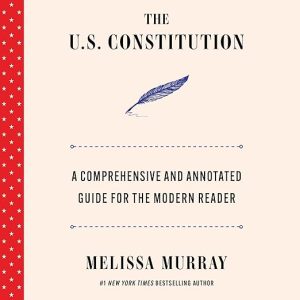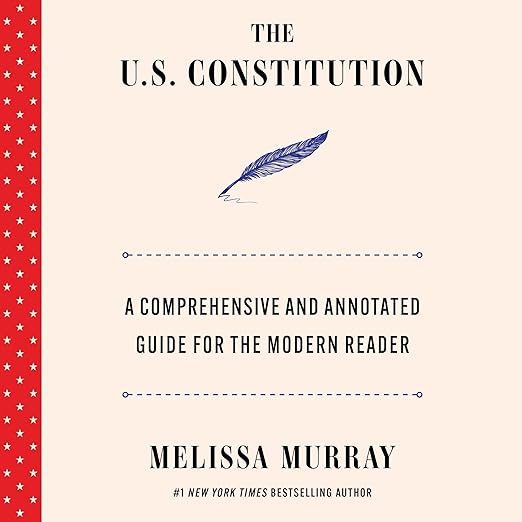
Melissa Murray has spent years demystifying American law for audiences who are not lawyers, and The U.S. Constitution audiobook is the distilled version of that project. As the co-host of Strict Scrutiny, a podcast that breaks down Supreme Court decisions with both rigor and frankness, Murray has already proven she can hold a general audience through dense constitutional material. This audiobook extends that skill to the founding document itself, annotating each amendment with historical context and connecting it to contemporary legal debates in ways that make the text feel alive rather than archived.
The context in which Murray produced this matters. She opens the book by framing the Constitution not as a relic but as an active instrument, one that sits at the center of ongoing disputes about voting rights, reproductive autonomy, presidential power, and the scope of federal authority. For listeners who have been following Supreme Court decisions over the past decade, that framing will feel appropriate rather than alarmist. Murray is a constitutional law professor at NYU, a frequent MSNBC contributor, and someone who has spent real professional hours thinking about what these words actually mean when courts apply them. That expertise comes through in every annotation.
Murray's approach to the amendments is annotation-forward. She does not simply read the text and move on. Each amendment gets historical background, context for why it was ratified, and at least one example of how it has been interpreted or misread in modern jurisprudence. The First Amendment gets its usual complexity around free speech and religious establishment. The Second gets a careful treatment that acknowledges competing interpretive traditions without retreating into vagueness. The Fourteenth gets the serious attention it deserves given its role in modern civil rights and equal protection doctrine.
What Murray does especially well is tracing how the same constitutional text has yielded wildly different outcomes at different moments in American history. She points to Reconstruction-era amendments and explains both their original promise and the ways subsequent courts narrowed their reach. The story of the Fourteenth Amendment in particular, how it was ratified to protect formerly enslaved people and then applied for decades primarily to protect corporations, is a story that illuminates how interpretation functions as a form of power. This kind of longitudinal analysis is exactly what makes constitutional law feel dynamic rather than settled, and it is the kind of context that most civics education simply does not provide.
Murray's Office-Hours Voice Carries the Amendments
The audio format serves this material well for a specific reason: Murray's voice carries the weight of explanation without losing the conversational register she has honed on Strict Scrutiny. Listening to her narrate is not like listening to a legal brief; it is closer to sitting in on an office-hours session with a professor who has had enough conversations with confused students to know exactly where the misunderstandings live. At just over ten hours, the runtime is substantive but not exhausting. You can move through the amendments steadily without feeling rushed, and the structure means you can return to individual sections without losing context.
The audiobook also benefits from Murray's evident comfort with the spoken format. She knows that audio requires slightly more explicit signposting than written text, and her narration reflects that. She tells you what she is about to cover, covers it, and then anchors it to the broader argument she is building. For listeners who have never studied law formally, that structure is genuinely useful and prevents the kind of detail-overload that legal writing can produce when it lands on unprepared readers.
A Selective Guide, Not a Full Treatise
A few things are worth managing expectations around before you start. This is not a neutral reference document. Murray has a clear interpretive lens: she is interested in how the Constitution can and should protect individual rights, and she is skeptical of readings that narrow those protections. That perspective produces some of the book's most interesting passages, but it also means that listeners looking for a purely balanced survey of competing constitutional theories may want to supplement with other sources. Murray tends to flag her own viewpoint when it is operating, which is useful, but the book is advocacy-adjacent in ways that a strict legal reference text would not be.
The title also slightly undersells the scope. This is less a complete constitutional commentary and more a selective guide to the amendments, with particular emphasis on those that intersect with current political controversies. If you are hoping for deep analysis of the structural provisions in Articles I through VII, the book is lighter there. The amendments are where Murray's energy concentrates, and that is where the book is most valuable. Listeners should also note that constitutional interpretation is a rapidly evolving area; some of the cases Murray discusses as ongoing disputes may have moved significantly by the time you are listening.
Strict Scrutiny Fans Get the Missing History
Strict Scrutiny listeners will find this a natural companion to the podcast, filling in historical background that the show assumes you already have. Engaged general readers who want to understand what people are actually arguing about when constitutional debates surface in the news will get real value from Murray's annotations. Law students who have already done a semester of con law will find the framing familiar, though Murray's examples and prose clarity make it useful for review.
Listeners seeking a comprehensive and genuinely neutral legal treatise should look elsewhere. And anyone wanting the full structural analysis of original constitutional articles, rather than the amendments, will find the coverage uneven. But for the audience Murray is speaking to, namely thinking Americans who want to engage with the founding document on its own terms and understand how it operates today, The U.S. Constitution audiobook does exactly what it sets out to do.
In Brief
- Read by: Melissa Murray narrates her own work with the natural authority of a seasoned law professor and podcast host, striking a tone that is direct without being lecture-heavy.
- At its heart: Constitutional interpretation, amendment history, Supreme Court culture
- Vibe: Accessible and sharp, with genuine urgency underneath the calm
- Short version: If you have ever wanted a guide to the U.S. Constitution that respects your intelligence without requiring a law degree, Murray delivers exactly that.
Frequently Asked Questions
Does the audiobook cover all amendments or just the major ones?
Murray covers all amendments with annotations, though her analysis is more detailed on those with active contemporary relevance, including the First, Second, Fourth, Fifth, and Fourteenth. The earlier amendments receive appropriate historical context without becoming the book's main focus.
Is this audiobook appropriate for someone with no legal background?
Yes. Murray explicitly designed her approach for general audiences, drawing on her Strict Scrutiny podcast experience. She defines legal terms as they arise and grounds abstract doctrine in specific, recognizable cases and controversies.
How does this audiobook differ from the Strict Scrutiny podcast?
The podcast responds to current Supreme Court decisions in real time. This audiobook takes a step back to cover foundational constitutional history and amendment-by-amendment analysis, functioning as the background text the podcast assumes rather than a replacement for it.