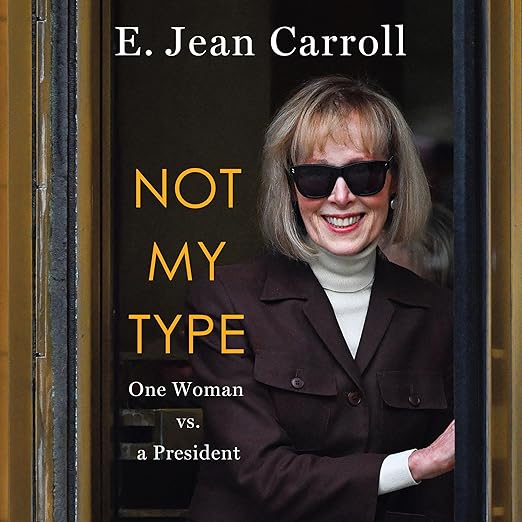
Two civil trials against Donald Trump form the spine of Not My Type, and E. Jean Carroll insisted on narrating her own account rather than handing the cross-examination scenes to a professional voice actor. The audiobook covers the trials that made headlines, Carroll's defamation and sexual abuse claims, the courtroom testimony, the deposition where opposing counsel asked her to list every person she'd ever slept with, and Carroll's own choices around what to wear to court on any given day. The Washington Post put the case for audio over print bluntly in a blurb quoted directly in the synopsis: hearing Carroll describe the courtroom battle in her own voice is 'an experience too delicious for the printed page.'
Reclaiming a Specific Public Denial as the Title
Carroll spent over twenty-five years as Elle magazine's advice columnist before any of this, which means she came into the trial, and into this memoir, with decades of practice turning other people's messes into something readable and funny. That instinct doesn't disappear when the mess is her own; Not My Type applies the same voice, wry, unbothered, occasionally savage, to an experience that could easily have been written as pure trauma narrative instead. The synopsis's own framing captures the tightrope: hilarious and life-affirming material about being sexually assaulted and taking the case to civil court, which sounds contradictory until you actually hear her deliver it.
The book resists the two easiest paths available to this kind of memoir. It doesn't collapse into grim victim narrative, and it doesn't perform triumphant vindication either; instead it stays specific and observational, noting the exact detail of a $750-an-hour court-appointed psychiatrist she tries to cheer up with a Hunter S. Thompson anecdote, or the deliberate look she and her team construct to connect her younger self, the one attacked decades earlier, with the older woman now sitting in the courtroom.
The title itself is a direct rejoinder: the phrase echoes a specific public denial made about Carroll at the time of the original incident, and reclaiming those exact words as her own book's title is characteristic of the wit running through the entire memoir. Rather than letting someone else's dismissal define the narrative, Carroll turns the phrase into the frame for telling the story entirely on her own terms.
Voice Cracking, Then Dripping With Snark
A reviewer who bought both formats put it plainly: reading the print edition alone 'would come across as sarcastic,' but hearing Carroll narrate it herself made it feel like 'your friend was leaning in and telling you some juicy gossip.' That's about as clean an argument for choosing audio over print as a review can make, and it matches exactly what the format actually delivers here.
Press coverage quoted directly in the synopsis describes Carroll's voice cracking from strain in places, then dripping with exquisite snark moments later, sometimes within the same passage, and self-narration is the only way that specific range comes through intact. A hired narrator, however skilled, would be reconstructing emotional beats secondhand; Carroll is simply remembering out loud.
BookPage Starred the Audiobook Itself
At just over twelve hours, the book covers both trials in enough detail to function as a genuine behind-the-scenes account rather than a surface summary, giving listeners a seat, as the synopsis puts it, in a better spot than the jury box itself.
BookPage gave the audiobook itself a starred review, not just the printed book generally, crediting Carroll's own delivery with turning painful subject matter into what the outlet called a moving and serious listening experience that is also a lot of fun. A starred, audio-specific citation from an outlet that reviews both formats is a meaningful, format-specific endorsement rather than a general nod to the material.
Carroll's decades at Elle taught a specific skill this memoir draws on constantly: distilling a messy, emotionally loaded situation into a few precise, quotable sentences without losing the human stakes underneath the wit. That's a harder trick to pull off across a full-length memoir than in a monthly column, and the audiobook format, hearing her actually deliver those precise sentences rather than reading them cold, makes the skill more visible than the page alone would.
No Clean Separation Between Testimony and Humor
This is a memoir built entirely around a specific, extensively publicized legal case, and listeners with zero context on the underlying trials may want a quick refresher before starting, since Carroll writes from inside the experience rather than pausing to fully re-explain the background for newcomers.
The tone is genuinely funny more often than it's grim, which some listeners may not expect going in given the subject matter, sexual assault and years of legal battle. That's a deliberate authorial choice rather than a tonal misstep, but it's worth knowing upfront if you're expecting a heavier, more somber register throughout.
This memoir assumes a listener willing to sit with genuinely difficult subject matter, sexual assault, an aggressive cross-examination designed to discredit her, presented alongside real comedy; that combination won't work for every listener, and those who prefer a clean separation between serious testimony and humor should know Carroll deliberately refuses that separation throughout.
Listeners who followed the trials closely in real time as they happened will find plenty of new material here anyway; Carroll's memoir goes well beyond what made headlines, into the specific texture of depositions, wardrobe choices, and private moments the news cycle had no room for.
A Long Career in Male-Dominated Fields of Commentary
Recommended strongly, and specifically in audio, for readers of political and legal memoir, for longtime fans of Carroll's decades of advice-column writing, and for anyone who wants firsthand testimony delivered with genuine wit rather than either victimhood or triumphalism.
Skip the print edition if you can help it; multiple reviewers and the press quotes embedded in the book's own synopsis agree that Carroll's voice is the format this material was built for, and reading it silently loses something real.
Recommended too for anyone who has followed high-profile defamation and sexual assault litigation in the news only at a surface level; the memoir's blow-by-blow courtroom detail, delivered with Carroll's own editorial eye for the specific and the absurd, offers a considerably richer account than headline coverage of the same trials ever could.
It's also a natural pick for listeners generally drawn to memoirs by women who spent careers in traditionally male-dominated fields of public commentary, given Carroll's decades-long, genre-defying career well before this book's subject matter existed.
Is the Not My Type audiobook narrated by E. Jean Carroll herself?
Yes, and reviewers specifically credit her narration with making the material land as intended.
Do I need background on the underlying court case to follow this audiobook?
A basic familiarity helps since Carroll writes from inside the experience rather than re-explaining the background in full, but the memoir provides enough context to follow along regardless.
Is Not My Type audiobook mostly serious or mostly funny?
Mostly funny, deliberately so, though the underlying subject matter, sexual assault and years of litigation, is real and treated with genuine weight underneath the humor.
How long is the Not My Type audiobook?
Twelve hours and two minutes.