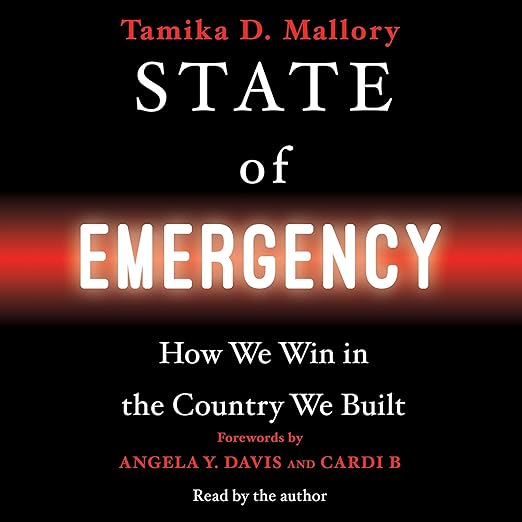
I listened to State of Emergency over the course of a weekend in which I was already thinking about what it means to be a witness to political events rather than a participant in them. Tamika D. Mallory's book arrived into that space with the force of a direct address. She is not interested in persuading skeptics; she is interested in equipping people who are already convinced that something is wrong with the practical knowledge of how to act on that conviction. That specificity of purpose is one of the things that makes the book unusual in a genre crowded with motivational rhetoric.
Mallory has been a frontline organizer since childhood, the daughter of activist parents who founded the National Action Network alongside Al Sharpton. Her experience is not theoretical. She was in Minneapolis after George Floyd's killing, in Louisville, in Portland, in Kenosha. State of Emergency was published in 2021, at the peak moment of what felt like a genuine national reckoning, and it speaks from inside that moment rather than analyzing it from a distance.
What We Made of It
The book is structured around practical questions that Mallory has spent a lifetime working through: how do you build coalitions across differences of class, geography, and political orientation? How do you translate the energy of a protest moment into the sustained legislative work that produces durable change? How do you speak truth to power in a way that does not simply make you feel better while leaving the power intact? These are not abstract questions in Mallory's hands; they are operational problems she has solved or failed to solve in specific contexts, and she is honest about both outcomes.
One reviewer, a Black woman from the suburbs, describes feeling simultaneously uncomfortable and unable to put the book down, which captures something real about what Mallory is asking her readers to do. The discomfort is not incidental; it is part of the book's method. Mallory asks readers to accept their privilege not as a source of guilt but as a resource, a platform from which to act rather than a position to retreat from. That reframe is more demanding than it sounds.
Why Listen to State of Emergency
Mallory is a public speaker of considerable power, and her gift for direct address translates into the audio format with unusual force. When she describes the communities most affected by the policies she is critiquing, there is no gap between the speaker and the subject matter. She has been there. She has made the calls, attended the funerals, built the coalitions, and she speaks from that accumulated experience rather than from research into it. One reviewer completed the book right after a period of civic upheaval and found in it both explanation and direction, which is exactly the function the book intends to serve.
What Might Not Land
This is not a dispassionate analysis of American racial politics from multiple perspectives. Mallory does not present counterarguments and evaluate them evenhandedly; she states a case. Readers seeking balance in the conventional journalistic sense will not find it here, nor is it offered. What they will find is a coherent framework for understanding how the gap between American ideals and American practice has been maintained across generations, and a specific set of tools for narrowing that gap. The two things are not incompatible, but knowing which you are getting matters before you start.
Who Should Pick Up State of Emergency
Listeners who are already politically engaged and want to understand how sustained movement-building functions will find this invaluable. Those new to social justice advocacy who want a framework rooted in practice rather than theory will find Mallory's experience-based approach more immediately useful than academic treatments of the same material. Listeners looking for a more detached historical account of the 2020 racial justice movement should seek other titles; this is advocacy, not journalism. The six-hour runtime is accessible even for listeners with limited time, and Mallory's narration makes it engaging throughout.
Key Details
- Voice: Mallory reading her own work gives the text a directness and urgency that no other narrator could supply; her voice carries the weight of someone who has been in the rooms where these decisions were made.
- Big ideas: Coalition building as political practice, the gap between legal equality and lived justice, privilege as a tool rather than a shield.
- Atmosphere: Urgent and direct, with the specific gravity of someone who has run out of patience for incrementalism.
- Worth it?: Essential listening for anyone trying to understand how sustained activism actually functions beyond the protest moment.
Before You Listen
Is this book primarily about the 2020 racial justice protests, or does it cover a longer period?
Both. Mallory uses the 2020 protests as a present-tense frame, but the book draws on her full lifetime of activism and the historical context of the civil rights movement to explain why the current moment looks the way it does.
Does State of Emergency offer practical guidance or is it primarily inspirational?
Mallory explicitly frames the book as practical. She covers coalition building, speaking truth to power, turning protest energy into legislative action, and using privilege strategically. The inspirational element is present but secondary to the how-to framework.
Is this related to Mallory's work with the Women's March?
Mallory was a co-chair of the 2017 Women's March, and the book draws on that experience among many others. The coalition-building lessons from that work, including its controversies, inform her broader framework for how movements can and cannot succeed.